
Every August, under a full moon that turns the alpine basin silver, something happens on the trail above Dhunche that has nothing to do with trekking itineraries or bucket lists. Thousands of people, some in their seventies, some barefoot, some carrying infants on their backs, climb for days through forest and scree to reach a lake at 4,380 meters and dunk themselves in water cold enough to stop your breath. Priests chant. Shamans fall into trance. Families who’ve made this same climb for three generations arrive at the shoreline and weep. I’ve guided commercial treks up this same path more times than I can count, but the year I first witnessed Janai Purnima at Gosaikunda, I understood I’d been visiting a landmark. The pilgrims were visiting a god.
This is the story of how that lake came to hold that kind of weight, and what it actually feels like to be there when the mountain fills with faith.
I remember standing near the shoreline that first year, half frozen despite three layers, watching an old man from a village near Sindhupalchowk unwrap a bundle of marigolds he’d carried for two days without letting them crush. He told me, through my guide translating, that his father had made this same climb, and his father before him. He wasn’t trekking Gosaikunda. He was still working on something. That distinction sits at the heart of everything that follows.
The Myth of the Blue-Throated God
Long before there were trails or teahouses in this valley, there was a churning. Hindu scripture tells of Samudra Manthan, the churning of the cosmic ocean, undertaken jointly by the gods and demons in search of amrita, the nectar of immortality. They used Mount Mandara as a churning rod and the serpent king Vasuki as their rope, and for centuries the ocean of milk turned beneath their combined effort.
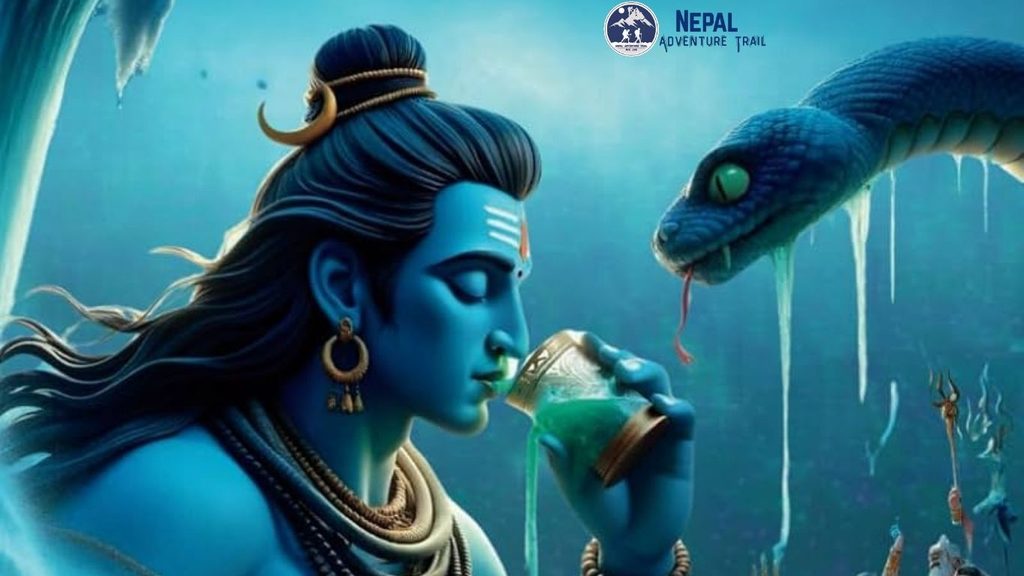
What rose from that churning first wasn’t nectar. It was Halahala, a poison so lethal that a single drop threatened to unmake creation itself. Gods and demons alike recoiled from it, terrified of a substance that could dissolve the universe they were fighting over. Only Shiva was willing to face it. He gathered the poison and swallowed it whole, and his consort Parvati, according to the older tellings, clutched his throat to keep the poison from descending past his neck and reaching his stomach, where it could have killed him outright. The poison stayed there, burning, and turned his throat a deep, permanent blue. This is why Shiva is called Neelkanth, the blue-throated one, in temples across the subcontinent.
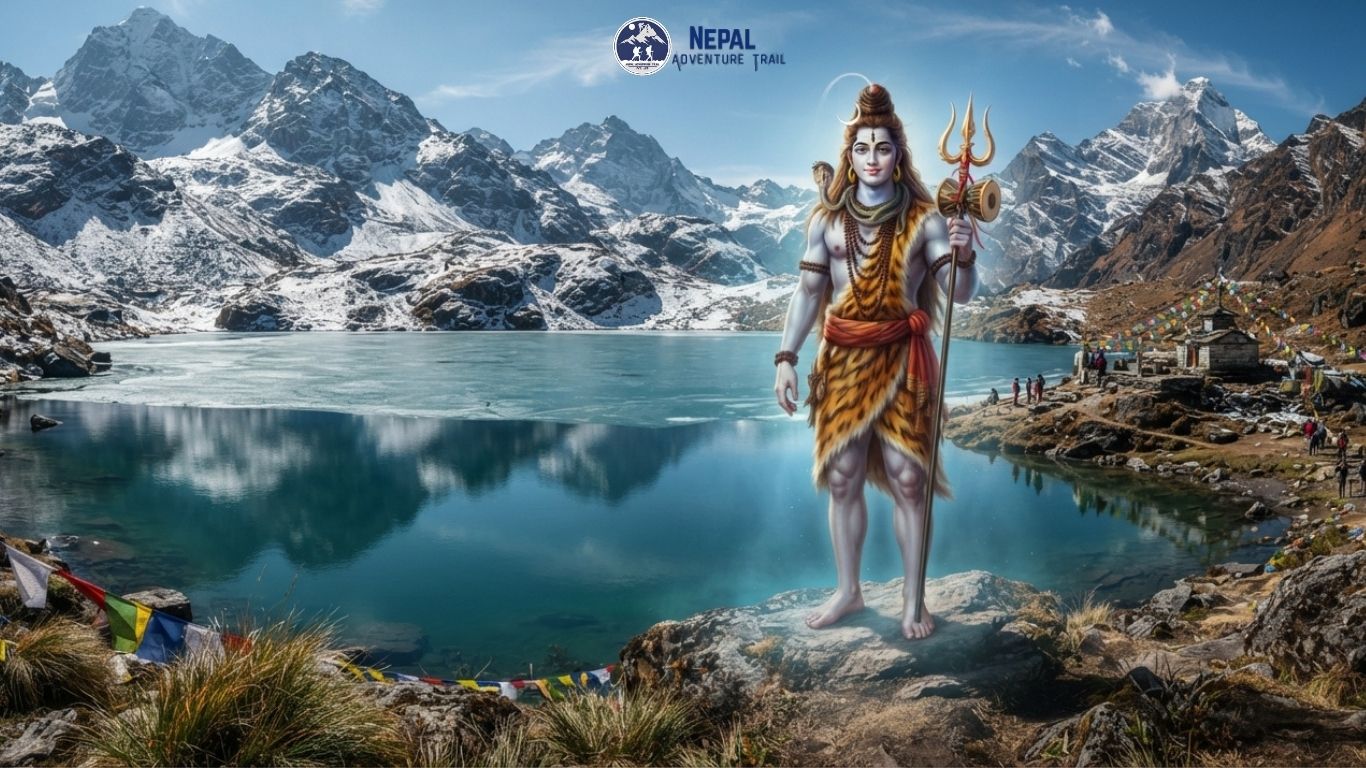
But even a god can only hold fire in his throat for so long. The stories say Shiva traveled into the high Himalayas seeking relief, and here in the Langtang region, he drove his trident, the Trishul, into the mountainside. Where the prongs struck, glacial water surged up to meet him, cool and clean, and he drank and bathed until the burning eased. That water pooled into the basin you see today. It’s why Gosaikunda carries the name it does, roughly translating to “lake of the deity,” and why the surrounding cluster of more than a hundred smaller lakes are treated as sacred overflow from that same divine act. Stand at the shore on a still morning, before the wind picks up and scatters the reflection, and you’ll understand why nobody who hears this story treats it as just folklore.
The Living Tradition: Janai Purnima at 4,380 Meters
Janai Purnima falls on the full moon of the Nepali month of Shrawan, usually landing in August, and its name comes from the janai, a sacred cotton thread worn across the chest by Hindu men of certain castes, renewed once a year on this day. Priests also tie protection threads, raksha bandhan, around the wrists of devotees as a blessing against harm in the year ahead. In cities and villages across Nepal, this is a quiet, domestic ritual, performed at local temples close to home.
At Gosaikunda, it becomes something else entirely. Thousands of pilgrims, many of them from the Kathmandu Valley and the surrounding hill districts, undertake the multi-day climb specifically timed to reach the lake for this one night. Brahmin priests set up temporary shrines along the shoreline to perform the thread ceremonies at altitude, which is no small thing when you consider they’re doing it in thin air and often freezing wind.
Alongside them come the jhankris, Nepal’s indigenous shamanic healers, dressed in feathered headdresses and beaded necklaces, carrying hand drums they beat into driving rhythms as they enter trance states believed to connect them directly to mountain deities and ancestral spirits. Watching a circle of jhankris drum through the night at that altitude, breath visible in the moonlight, is not something you forget.
The central ritual is the bath itself. Pilgrims strip down, often at dawn or under the full moon’s direct light, and submerge themselves in Gosaikunda’s glacial water, believing it washes away accumulated sins and grants spiritual merit for the year ahead. The water hovers barely above freezing even in August. I’ve watched elderly women wade in without hesitation, faces calm, while trekkers standing on the bank in down jackets audibly gasp on their behalf. It’s an act of devotion that has almost nothing to do with comfort and everything to do with faith outlasting discomfort, which might be the most honest description of pilgrimage I know.
A Sacred Meeting Ground: Hindu and Buddhist Harmony
What makes the Langtang region and Gosaikunda specifically so remarkable is that this reverence isn’t confined to one tradition. While Hindu pilgrims revere the lake as the abode of Shiva and his consort Gauri, Tibetan Buddhist communities living throughout this alpine corridor hold their own deep regard for these same waters and peaks. In Buddhist cosmology, high alpine lakes and dramatic mountain terrain are often understood as beyul, hidden sanctuaries, or as thresholds where the ordinary world grows thin and the boundary between earthly and divine realms becomes porous.
You’ll see this overlap physically on the trail. Prayer flags strung between rhododendron branches near villages that also host Hindu shrine sites. Mani stones carved with Buddhist mantras sitting a short walk from spots where Brahmin priests conduct Hindu rites. Rather than friction, what exists here is coexistence built over centuries, communities of Tamang, Sherpa, and Hyolmo heritage living alongside Hindu pilgrimage traditions, each honoring the mountain in their own language of devotion. Few places in Nepal illustrate religious harmony as plainly and as physically as the trail into Gosaikunda during festival season.
Historical Echoes in the Mountains
The reverence for this region isn’t a modern invention. References to sacred lakes in the high Himalaya appear scattered through older Hindu texts describing pilgrimage sites in mountainous terrain, and Gosaikunda has long been counted among the significant high-altitude tirtha, or pilgrimage destinations, in the Nepali Hindu tradition. The broader Langtang and Rasuwa region also carries its own military and political history: Amarsingh Thapa, the commander who held Nepal’s western front during conflicts with the British East India Company in the early nineteenth century, operated in territory connected to this same corridor. It’s a reminder that these mountains have always been more than scenery. They’ve been sacred ground, contested ground, and lived-in ground for people whose stories rarely make it into trekking brochures.
Planning the Pilgrimage Trek
If you want to experience Janai Purnima at Gosaikunda rather than simply read about it, timing and preparation matter more than usual. The festival falls on a fixed lunar date each August, so confirm the exact day well ahead of your gosaikunda trek from Kathmandu, since teahouse space along the route fills fast in the days before the full moon.
A few practical notes:
- Expect significantly heavier foot traffic than a standard gosaikunda trek best time window in autumn or spring; book lodging in advance where possible
- The gosaikunda lake height of 4,380 meters means altitude precautions apply just as strictly during festival season as any other time; don’t let festival excitement override acclimatization
- Nights are cold even in August at this elevation; pack accordingly regardless of the season
- Move at a respectful distance from active rituals unless invited closer, and always ask before photographing pilgrims or jhankris in ceremony
Why This Mountain Changes You
There’s trekking, and then there’s standing on a Himalayan shoreline at midnight surrounded by drumbeats, chanting, and people old enough to be your grandparents wading into water that could stop your heart, all because a story about a god swallowing poison to save the universe still means something to them, right now, in this century. You can visit Gosaikunda any month of the year and find something worth the climb.
But visit during Janai Purnima, and you stop being a tourist looking at a lake. You become a witness to a tradition that has outlasted empires, and that, more than any view from any pass, is what actually changes how you see these mountains afterward.