By the third morning in the Khumbu, the trail has changed character. The warm, pine-scented lanes below Lukla are behind you, the air above Namche is noticeably thinner, and the trekkers around you are walking more slowly than they did two days ago. That slowing down is not laziness. It is the first and most reliable defense against altitude illness on the Everest Base Camp trek.
Altitude sickness is the main medical risk of this route, and it does not care how strong you are. The trail climbs from Lukla at about 2,860 m to Gorak Shep at about 5,164 m, and the body needs time to adapt to every step of that gain. This guide explains what the illness is, why Everest Base Camp altitude sickness is a real planning issue, how a sensible itinerary lowers the odds, what the warning signs look like, and what to do when they appear. Good planning reduces risk. It does not remove it.
What Is Altitude Sickness on the Everest Base Camp Trek?
Altitude illness covers a range of conditions caused by moving too fast to heights where the air holds less oxygen. The mildest and most common form is Acute Mountain Sickness, or AMS. The serious forms are high-altitude cerebral edema (HACE), swelling of the brain, and high-altitude pulmonary edema (HAPE), fluid in the lungs. Both can be life-threatening.
On the EBC trek, most cases begin as AMS, which typically starts a few hours after arriving at a new sleeping altitude. CDC guidance describes onset as usually 2 to 12 hours after reaching a higher altitude. Medical guidance treats any symptoms that appear above about 2,500 m as altitude illness until proven otherwise.
Reports of how many trekkers feel some AMS on this route vary with ascent speed and how symptoms are measured. Studies are not consistent, but a significant share of trekkers report symptoms at some point. Mild cases are common. Severe cases are far less so.
Why Is Altitude Sickness a Risk at Everest Base Camp?
The risk comes from the profile of the trek, not from the name on the map. Trekkers start from a flight to Lukla, then spend about a week or more above 3,000 m, sleeping at 4,000 to 5,000 m in the upper valley. Days are physically demanding, nights are cold, and the nearest road is far away. If someone becomes seriously ill, the options for getting down are walking or a weather-dependent helicopter.
Two factors matter most. The first is the rate of ascent, meaning how much higher you sleep each night. The second is sleeping altitude itself. The CDC and the Wilderness Medical Society place more weight on where you sleep than on the highest point you reach during a day hike. That is why a day trip to a viewpoint is less concerning than a night at the same height.
Everest Base Camp Altitude: How High Does the Trek Go?
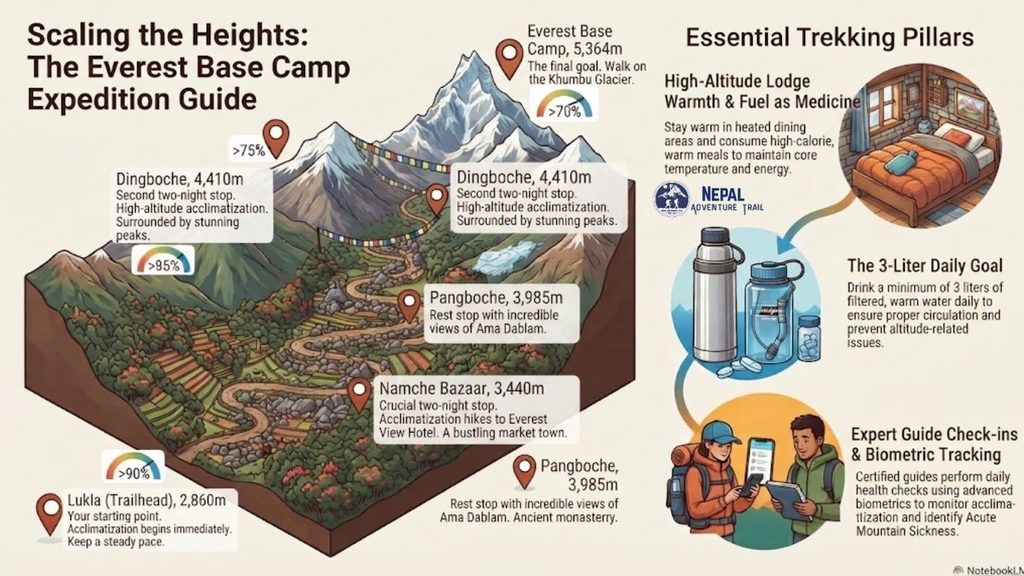
South Base Camp is at about 5,364 m. Trekkers do not normally sleep there. The standard overnight stop near the top is Gorak Shep at about 5,164 m, and many people climb Kala Patthar (about 5,545 m; sources give slightly different figures) for views of Everest. Reaching these heights involves a sleeping altitude well above where most people have ever slept.
Altitude Profile of the Everest Base Camp Trek
| Place | Approx. Elevation | Why It Matters |
|---|---|---|
| Lukla | 2,860 m | Starting altitude; flight arrival |
| Phakding | about 2,610 m | Common first night, slightly lower |
| Namche Bazaar | about 3,440 m | Major acclimatisation stop |
| Tengboche | about 3,860 m | Continued gain, monastery stop |
| Dingboche | about 4,410 m | Second acclimatisation stop |
| Lobuche | about 4,910 m | High sleeping altitude |
| Gorak Shep | about 5,164 m | Very high sleeping altitude, last lodge |
| Everest Base Camp | about 5,364 m | Day-visit destination |
| Kala Patthar | about 5,545 m | High viewpoint, day climb |
Sleeping altitudes and day-hike elevations are different things. You sleep at Gorak Shep, and you visit Base Camp and Kala Patthar from there. Elevations are approximate and vary slightly between sources.
What Causes Altitude Sickness?
As altitude rises, air pressure falls and each breath delivers less oxygen. The body responds by breathing faster, raising the heart rate and, over days, making changes that help it cope. That process is acclimatisation. If you climb faster than the body can adapt, fluid shifts and other changes can produce AMS, and in some people lead to HACE or HAPE.
Susceptibility varies between individuals. Previous success at altitude is useful information but not a guarantee, and a trek that went well once can go differently the next time.
Who Is at Risk of Altitude Sickness?
Anyone going high is at risk. CDC guidance is explicit that susceptibility differs between people and that physical fitness does not determine who gets sick. Young, strong, experienced trekkers get altitude illness, and so do older, less fit ones. The strongest known risk factors are a fast ascent, a high sleeping altitude and a personal history of altitude illness. A previous bout of severe altitude illness puts a traveller in a higher-risk category and is worth discussing with a clinician before departure.
Symptoms of Acute Mountain Sickness
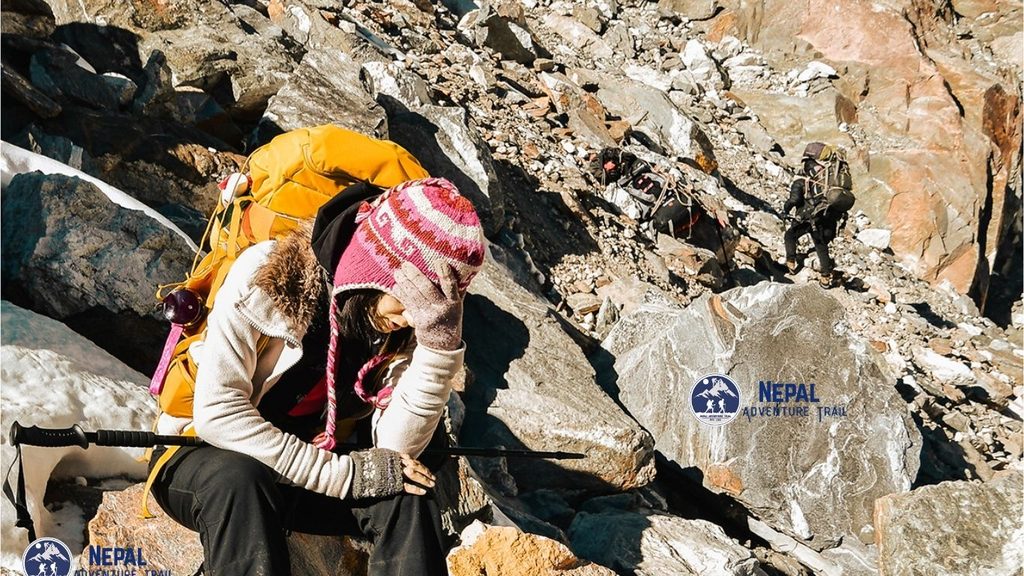
Headache is the hallmark. In AMS it is usually accompanied by at least one of the following: loss of appetite or nausea, dizziness, fatigue or weakness, and poor sleep. Nepal Tourism Board lists headache, appetite loss, nausea, fatigue and dizziness among early symptoms and advises stopping the ascent, and descending if symptoms worsen.
A bad night at altitude, a mild headache and a lack of appetite are common and are not automatically a crisis. They are a signal. The mistake is to treat them as background noise.
AMS vs HACE vs HAPE
| AMS | HACE | HAPE | |
|---|---|---|---|
| What it is | Common altitude illness | Swelling of the brain | Fluid in the lungs |
| Key signs | Headache plus nausea, dizziness, fatigue, poor sleep | Confusion, worsening headache, drowsiness, loss of coordination or unsteady walking | Breathlessness at rest, persistent cough, chest tightness, unusual weakness |
| Seriousness | Can become severe | Emergency | Emergency |
| Response | Stop ascending, rest, monitor | Descend and seek urgent medical help | Descend and seek urgent medical help |
CDC data suggest HAPE affects about 1 in 100 travellers or fewer at altitudes above roughly 4,300 m. That is uncommon, but this trek sleeps above that height. HACE and HAPE can develop quickly, and a person with confusion cannot judge their own condition, so the group must act for them.
How to Prevent Altitude Sickness on the EBC Trek
No single measure guarantees prevention. The aim is to lower risk with several measures working together.
Gradual Ascent
CDC guidance says that once above 3,000 m, travellers should move their sleeping altitude by no more than about 500 m per day, with an extra acclimatisation day for every additional 1,000 m gained. Wilderness Medical Society and UIAA guidance, summarised in a 2026 BMJ practice article, gives a safe ascent rate of 300 to 500 m per day. This is a rule of thumb for planning, not a formula to apply blindly to a trail itinerary.
Acclimatisation Days
Acclimatisation days at Namche and Dingboche are not rest days in the sense of lying in bed. Trekkers usually make a short walk to a higher point and then return to sleep lower, a pattern often summarised as climb high, sleep low. The body gets exposure to altitude, symptoms are monitored, and the next night’s sleeping altitude does not jump. Nepal Tourism Board advises allowing time to acclimatise at Namche rather than rushing upward.
Hydration and Nutrition
Dehydration can worsen how you feel at altitude, so drink regularly. But forcing large volumes of water is not a proven way to prevent AMS, and clear urine is not a requirement. The advice to drink four or five litres a day to avoid altitude sickness is not medically sound. Drink to thirst and urine colour, keep eating even when appetite is low, and replace electrolytes if you are sweating or sick.
Rest and Sleep
Sleep is often disturbed at altitude, partly because breathing patterns change. Disturbed sleep alone is common, but it is also a symptom on the AMS checklist, so notice how it fits with other signs.
Avoiding Alcohol
Avoid alcohol while ascending. It can worsen dehydration and impair sleep and judgment. Sedatives and sleeping pills can depress breathing and should be used only under medical advice.
Medication and Diamox
Acetazolamide (Diamox) speeds acclimatisation and is used to prevent and treat AMS. The CDC Yellow Book discusses prophylaxis for travellers at higher risk, and the 2026 BMJ article describes it as first-line for people at moderate or high risk, noting that it is used off-label for altitude illness. It does not replace a gradual ascent and it does not make worsening symptoms safe to ignore.
Side effects include tingling in the fingers and toes and more frequent urination, and it is not suitable for everyone, including people with a sulfonamide allergy. Whether to take it, at what dose and when to start are decisions for a clinician who knows your history. Speak to one before travel, not on the trail. Dexamethasone is a stronger drug used mainly for treating moderate to severe illness and HACE, and it is not a tool for climbing higher while sick.
Does Fitness Prevent Altitude Sickness?
No. Fitness helps with the physical demands of long walking days, but it does not determine how quickly you acclimatise. Athletes get AMS. A strong trekker may feel able to push on faster, which can work against them. Train for the trek, and do not assume training protects you from the altitude.
Pulse Oximeters: Useful or Not?
A pulse oximeter estimates oxygen saturation in the blood. Readings drop as you gain altitude and vary widely between individuals, with cold fingers and poor circulation affecting accuracy. A single number cannot diagnose AMS or rule it out. Symptoms and how a person looks and behaves matter more than chasing a figure. If a guide uses an oximeter, treat it as one data point alongside symptoms, and never as permission to continue upward.
Weather, Cold and Altitude
Cold, wind, sun and exhaustion make trekking harder and can mimic or worsen how altitude illness feels, but cold itself does not cause AMS. Hypothermia, dehydration, exhaustion and chest infections can be mistaken for altitude illness and vice versa, which is another reason to involve a guide or a clinic when in doubt.
How the EBC Itinerary Helps With Acclimatisation
A well-designed itinerary builds acclimatisation into the days. Based on the figures above, sleeping altitude rises roughly as follows: Phakding to Namche about 830 m, Namche to Tengboche about 420 m, Tengboche to Dingboche about 550 m, Dingboche to Lobuche about 500 m, and Lobuche to Gorak Shep about 250 m. Those gains do not follow a neat rule, which is why the extra nights at Namche and Dingboche matter and why a compressed schedule leaves less margin.
A typical itinerary runs from Lukla and lower Khumbu to Namche (with an acclimatisation day), Tengboche, Dingboche (with an acclimatisation day), Lobuche, Gorak Shep, Base Camp and back down. Real itineraries vary with operator, weather, flights, trail conditions and how people are feeling. A good plan has room to slow down or add a day, and the people running it should be willing to use that room.
What to Do If You Get Altitude Sickness on the Trek
Mild symptoms: stop ascending, tell your guide, rest and monitor. Do not climb higher until symptoms are gone. Avoid alcohol, keep drinking and eating, and reassess over the next hours.
Symptoms getting worse: do not go higher, get a medical assessment, and descend. Wilderness Medical Society and BMJ guidance advises stopping ascent for mild or moderate symptoms and descending for severe ones.
Severe symptoms (confusion, difficulty walking in a straight line, breathlessness at rest, a worsening cough or chest symptoms): treat as an emergency. Descent is the main treatment, and it should begin as soon as it is medically and logistically possible, with professional help sought and evacuation considered. Descent of several hundred metres often brings improvement, and HACE or HAPE may need more, under professional direction.
Medication does not change this. No pill makes it safe to keep climbing with worsening symptoms.
Quick Decision Box
- Mild symptoms: Stop ascending, inform guide, rest and monitor.
- Symptoms worsening: Do not ascend, medical assessment, descend.
- Severe neurological or breathing symptoms: Emergency. Immediate descent or evacuation, and medical care.
Don’t Push Through Altitude Sickness
Many people arrive thinking: “I paid for this, and I have to finish.” That belief is how mild symptoms become emergencies. Turning around is not failure. Guides should take symptoms seriously, and trekkers should report them early, even when it feels awkward. The safest decision can be to stay a night, descend, or end the trek. Base Camp will be there for another attempt. Your health will not always be.
When Should You Descend?
Descend, or stop and get urgent help, if you have worsening AMS, a severe or unrelenting headache, repeated vomiting, confusion, poor coordination, breathlessness at rest, a suspected HACE or HAPE picture, an inability to continue safely, dangerous weather, or severe exhaustion. Reaching Base Camp is never more important than getting down safely.
Emergency Evacuation From Everest Base Camp
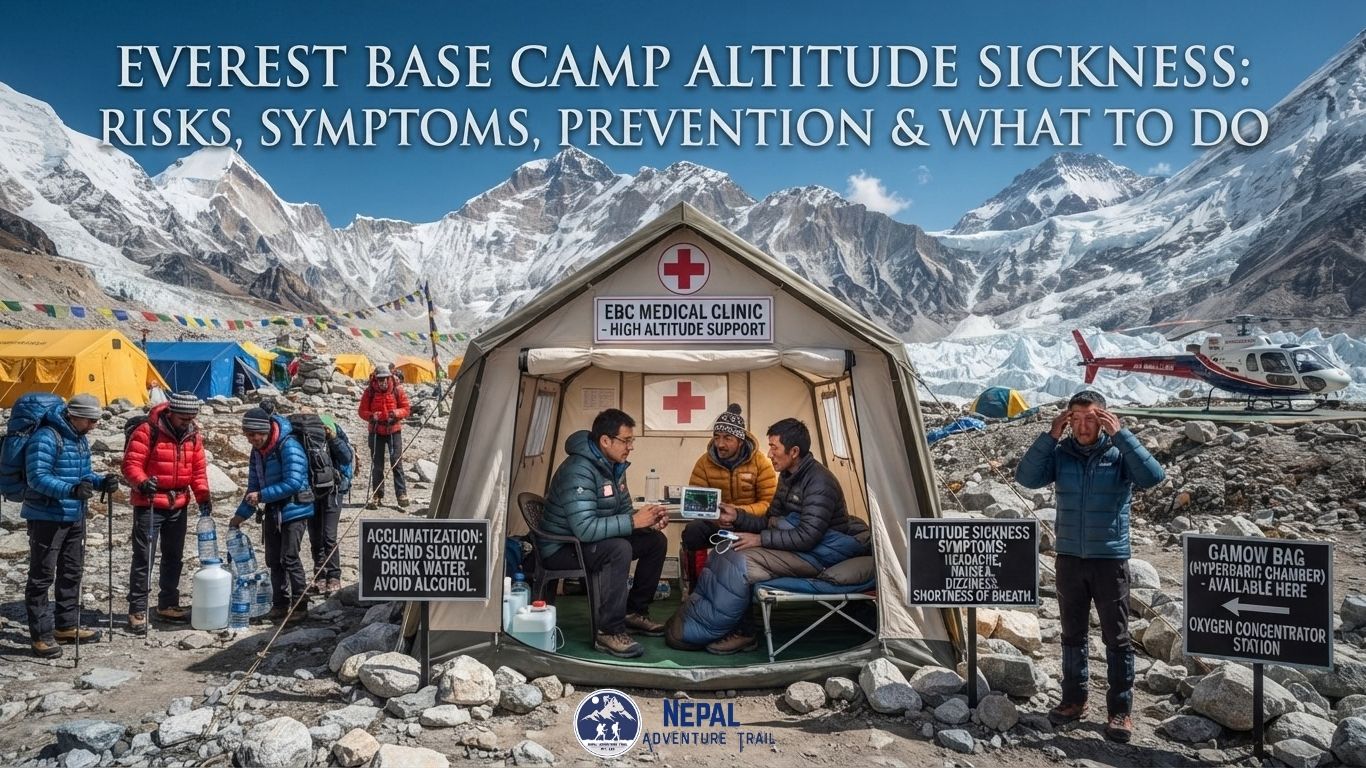
In an emergency, the usual sequence is that the guide recognises the problem, assesses the person and contacts the trekking agency, medical advice is sought, and a helicopter evacuation may be arranged if it is appropriate. Many evacuations take place from Gorak Shep, Lobuche or Pheriche. Nepal Tourism Board advises using your local agency to arrange helicopter evacuation and notes that rescue is expensive.
Helicopter rescue is never guaranteed. It depends on weather, visibility, aircraft availability, landing conditions, the location, the medical need and coordination with insurers or payment arrangements. In bad weather, descending on foot with help may be the only option. Reports from Nepal have also described investigations into fraudulent evacuations, so insurers may ask for documentation, and genuine medical need matters. A planned helicopter return at the end of a trek is a different thing from an emergency evacuation.
Himalayan Rescue Association and High-Altitude Medical Support
The Himalayan Rescue Association (HRA) is a non-profit formed in 1973 to reduce casualties in the Nepal Himalayas. In the Everest region it runs the Pheriche aid post at about 4,250 m, staffed by volunteer doctors during the trekking seasons, and a seasonal Everest-ER medical camp at Base Camp during the spring climbing season. HRA announced the posts open for spring 2026, with free daily altitude-illness lectures at 3 pm.
The Pheriche post is a valuable resource and the daily talk is worth attending. But the posts operate seasonally, and the HRA is not a substitute for your trekking company’s emergency plan or your own insurance. Confirm current opening dates and locations before you go.
Travel Insurance for Everest Base Camp Trek
Standard travel insurance often does not cover this trek. Nepal Tourism Board recommends comprehensive insurance that covers medical treatment and trekking and specifically advises cover for helicopter rescue. Policies differ in altitude limits, activity exclusions and pre-existing condition rules, so read the wording. Look for explicit cover of trekking to at least Base Camp and Kala Patthar altitudes with margin. Many trekking policies state a limit such as 6,000 m, but check yours.
Some insurers need to be contacted before an evacuation where possible, and claims need documentation. Keep the emergency number, your policy number and your guide’s contact details together. I have not recommended any insurer, because that requires its own research.
Insurance Checklist
Before flying to Nepal, confirm:
- Is Everest Base Camp trekking covered?
- What is the maximum covered altitude?
- Is helicopter evacuation covered?
- Is altitude sickness covered?
- Is hospitalisation covered?
- Is search and rescue covered?
- Are pre-existing conditions excluded?
- Does the insurer require prior authorisation?
- What emergency number should be used?
- What documents are needed for a claim?
How Nepal Adventure Trail Manages High-Altitude Risk
A trekking operator cannot remove altitude risk, but it can shape how the trek is run. Nepal Adventure Trail plans Everest Base Camp itineraries with acclimatisation, communication and emergency preparedness in mind. In practice that means itineraries that include acclimatisation days, experienced guides, altitude-aware planning, attention to how trekkers are feeling, encouragement to report symptoms early, flexibility to change plans when health requires it, local knowledge of the Everest region, practical pre-trek preparation, guidance on insurance and emergency planning, and help coordinating evacuation when needed.
The right questions to ask any operator, including this one, are how they decide when to slow down, what happens if a trekker becomes unwell, and who coordinates a descent or evacuation.
Preparing for the Everest Base Camp Trek
Medical preparation. Talk to a clinician, especially if you have heart or lung conditions, previous severe altitude illness, neurological conditions, pregnancy-related concerns, sleep-related breathing problems or regular medication. Ask whether acetazolamide is appropriate for you.
Physical preparation. Build endurance with long hikes, uphill walking and strength work. Training prepares your body for trekking. It does not guarantee protection from AMS.
Practical preparation. Insurance, clothing, a hydration system, a first-aid kit, clinician-recommended medication, sun protection, communication and emergency contacts.
Food, sleep and alcohol. Eat enough, even when appetite drops. Expect disturbed sleep. Avoid alcohol and unnecessary sedatives. Food and fluids support you, but they do not cure AMS.
Common Mistakes That Increase Altitude-Sickness Risk
- Ascending too quickly or skipping acclimatisation days
- Hiding symptoms from the guide or group
- Assuming fitness protects you
- Drinking excessive amounts of water
- Using medication without medical advice
- Treating severe symptoms as normal fatigue
- Continuing upward after symptoms worsen
- Ignoring weather
- Trekking without adequate insurance
- Not telling the guide about health problems
- Valuing Base Camp more than safety
Is Everest Base Camp Safe?
The honest answer is that it is a well-established route with real risks. Thousands of trekkers complete it, guides and medical resources exist, and most people who follow a sensible ascent reach Base Camp. At the same time, high altitude carries genuine health risks, the area is remote, weather can change plans, and descent logistics are not simple. Safety depends on acclimatisation, honest reporting of symptoms, the quality of local support and willingness to turn around.
On regulations, many sources describe a licensed guide arranged through a registered agency as required on major routes, and sources differ on details such as TIMS in the Everest region. Check the current rule with the Nepal Tourism Board or a registered operator before you book.
Frequently Asked Questions
What is altitude sickness at Everest Base Camp?
It is altitude illness, most often Acute Mountain Sickness, caused by gaining height faster than the body can adapt. It ranges from a headache with nausea to life-threatening HACE or HAPE.
How common is altitude sickness on the EBC trek?
Reports vary with ascent speed and how symptoms are counted, but a significant share of trekkers feel some symptoms. Mild AMS is common, and severe illness is far less so.
At what altitude does altitude sickness start?
Symptoms can appear above about 2,500 m, and risk rises with sleeping altitude and speed of ascent. Everest Base Camp trekkers sleep well above that.
What is the altitude of Everest Base Camp?
South Base Camp is about 5,364 m. The usual top-end overnight stop is Gorak Shep at about 5,164 m, and Kala Patthar is about 5,545 m.
What are the first symptoms of AMS?
Headache, plus nausea or loss of appetite, dizziness, fatigue and poor sleep. Stop ascending and tell your guide if these appear.
How can I prevent altitude sickness on the EBC trek?
Ascend gradually, use the acclimatisation days, climb high and sleep low, avoid alcohol, eat and drink sensibly, and report symptoms early. Discuss medication with a clinician. No measure guarantees prevention.
Can fit people get altitude sickness?
Yes. Fitness does not protect against altitude illness, and strong trekkers who push too quickly can be at higher risk.
Does drinking more water prevent AMS?
Not in the way people often claim. Staying reasonably hydrated helps you feel better, but forcing excessive fluids is not a proven prevention, and clear urine is not a requirement.
Does Diamox prevent altitude sickness?
Acetazolamide can reduce the risk and speed acclimatisation for some travellers, but people still get sick while taking it. It is a clinician’s decision, it does not replace gradual ascent, and it is not a reason to continue upward with worsening symptoms.
What should I do if I get altitude sickness on EBC?
Stop ascending, tell your guide, rest and monitor. If symptoms worsen, do not go higher, get medical assessment and descend. Severe symptoms are an emergency requiring descent and medical care.
When should I descend?
When symptoms worsen, or if you have severe headache, repeated vomiting, confusion, poor coordination or breathlessness at rest. Descent is the main treatment for serious altitude illness.
What is the difference between AMS, HACE and HAPE?
AMS is the common illness with headache and nausea. HACE is brain swelling, with confusion or loss of coordination. HAPE is fluid in the lungs, with breathlessness at rest and cough. HACE and HAPE are emergencies.
Does travel insurance cover helicopter evacuation from Everest?
Only if the policy says so. Check for cover of trekking to Base Camp altitudes, a maximum altitude above your highest point, helicopter evacuation, and any exclusions.
Is Everest Base Camp safe?
It is a well-trodden route with real risks. Careful acclimatisation, good guiding, insurance and a willingness to turn back make it safer, but nothing makes it risk-free.
Can Nepal Adventure Trail help if I become sick during the trek?
Your guide and the agency are your first line of response, and the agency can help coordinate descent or evacuation in line with weather and conditions. Rescue is never guaranteed.
Plan Your Everest Base Camp Trek With Nepal Adventure Trail
The safest approach is not to remove every risk, because that is impossible. It is to plan intelligently, ascend gradually, monitor symptoms and have experienced local support when conditions change. If you are weighing the trek, talk through your plans, choose an itinerary that allows time to acclimatise, review your insurance, and contact Nepal Adventure Trail for an Everest Base Camp trek plan.
Conclusion
Everest Base Camp altitude sickness is a manageable risk when it is taken seriously. Climb slowly, sleep lower when you can, report symptoms early and treat descent as the answer when things worsen. Reaching Base Camp is a great goal, and it is worth reaching in good health.