Let me be straight with you. I’ve walked into Base Camp more times than I can count on both hands, and I still get a knot in my stomach somewhere around Dingboche. That feeling never fully goes away, and if you’re smart, it shouldn’t.
Forget what the brochures tell you. This isn’t a “bucket list adventure” you check off in a week and forget. It’s 12 to 14 days of walking uphill on legs that get less oxygen every single day. You’ll sleep in teahouses where the water in your bottle freezes solid overnight. You’ll learn things about your own body you didn’t know before you started.
Here’s the thing people get wrong about the nepal everest base camp trek: it’s not a fitness test. You don’t need to be an athlete. What you need is patience, a stubborn streak, and enough respect for altitude to slow down when your body tells you to. Nail those three things and the mountain will treat you fair. Ignore them and it won’t matter how strong your legs are.
Geography & The Khumbu Experience
The trek sits entirely inside Sagarmatha National Park, a UNESCO World Heritage Site that starts just above Monjo and stretches all the way to the Tibetan border. You’ll pay a park entry fee at the checkpoint there, and a ranger will actually stamp your permit book by hand.
The Khumbu is Sherpa homeland, and that matters more than trekking blogs usually admit. The stone-walled fields, the mani walls you should always pass on the left, the prayer flags strung across every ridge. None of that is set dressing. It’s a living culture that happens to sit at 3,400 to 5,364 meters.
Namche Bazaar is the region’s beating heart, a horseshoe-shaped town carved into a hillside that somehow has bakeries, a Saturday market, and better espresso than my hometown. Above Namche, trees thin out fast. By Dingboche, you’re in high alpine desert. Rock, scrub, and wind.
The trail itself follows the Dudh Kosi river valley for the first few days, crossing it repeatedly on steel suspension bridges strung with tattered flags. The highest and most dramatic of these, the Hillary Bridge above Namche, sits about 125 meters above the river. Don’t look down if heights bother you. Just keep your eyes on the person ahead of you and walk.
The “Nepal Everest Base Camp Trek” Itinerary: A Guide’s Perspective
Here’s the itinerary I actually run, not the compressed version travel agencies advertise to look cheaper:
- Day 1-2: Fly Kathmandu to Lukla (2,860m), trek to Phakding (2,610m)
- Day 3: Phakding to Namche Bazaar (3,440m), the brutal climb
- Day 4: Acclimatization day in Namche, hike to Everest View Hotel
- Day 5: Namche to Tengboche (3,860m), home to a stunning monastery
- Day 6: Tengboche to Dingboche (4,410m)
- Day 7: Acclimatization day in Dingboche, hike to Nangkartshang
- Day 8: Dingboche to Lobuche (4,940m)
- Day 9: Lobuche to Gorak Shep (5,164m), then push to Everest Base Camp (5,364m) and back
- Day 10: Gorak Shep to Kala Patthar (5,545m) at sunrise, then descend to Pheriche
- Day 11-12: Descend back to Lukla via Namche
- Day 13-14: Fly to Kathmandu (buffer day always built in)
Notice the two dedicated acclimatization days. Cutting either of those to save a day is the single most common mistake I see, and it’s the reason so many trekkers end up being evacuated by helicopter from Pheriche.
Guide’s Pro-Tip: The climb from Phakding to Namche is where I’ve seen more people quietly question their fitness than anywhere else on the trail. It’s a relentless 700-meter gain over roughly 3-4 hours, much of it on a single exposed switchback above the river gorge. Go slow here even if you feel strong. This is not the hill to prove anything on.
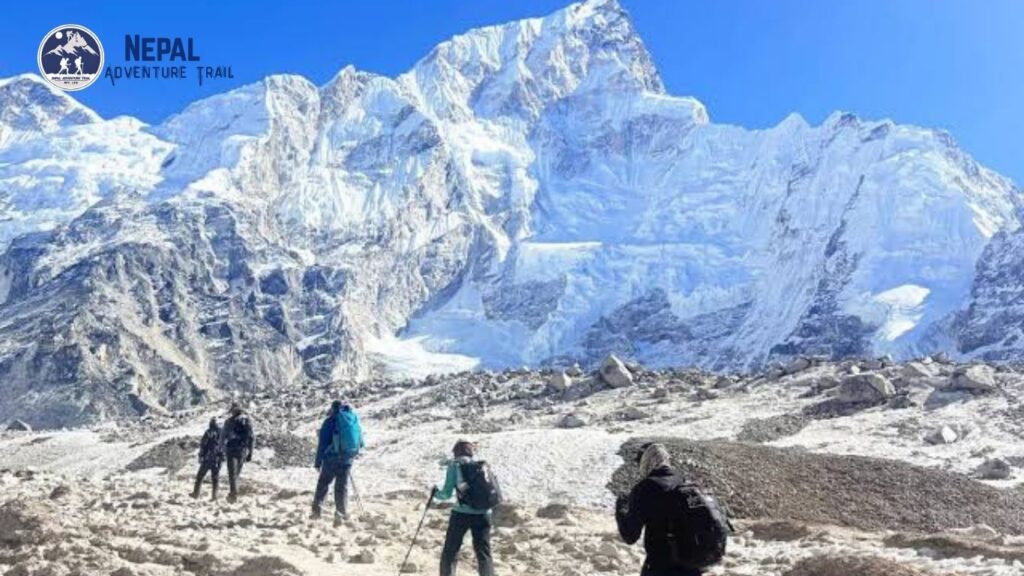
Base Camp itself, when you arrive, is honestly a bit anticlimactic in spring: a scattered field of rock and ice with a cairn of prayer flags marking the spot, and no view of Everest’s summit from where you stand. The mountain hides behind Nuptse. What you can see, if you look toward the Khumbu icefall, is the tumbling, shifting wall of seracs that climbers heading for the summit have to navigate before dawn, when the ice is coldest and least likely to shift underfoot.
Physical Preparation: What You Actually Need
People ask me how to prepare for Everest base camp trek season after season, and the answer disappoints them because it’s not glamorous: cardiovascular endurance beats gym strength every time.
You need legs that can carry you uphill for 5-7 hours a day, repeatedly, for nearly two weeks. Squats and lunges help. Stair climbing with a loaded pack helps more. If you have access to a StairMaster, spend three months putting in hour-long sessions with 15-20kg on your back.
Here’s what altitude actually feels like, since nobody tells you straight: at 5,000 meters, the air holds roughly half the oxygen it does at sea level. You’ll notice it first as a mild headache and shortness of breath on stairs you’d normally jog up. Push through the wrong way and it graduates to nausea, disorientation, and a pounding skull that no painkiller fixes. That’s your body telling you to descend, not push on.
This is why acclimatization in the Khumbu follows a strict rule locals have known for generations: climb high, sleep low. You gain altitude during the day, then drop back down to sleep at a lower elevation, letting your body build red blood cells gradually rather than shocking it.
Start a cardio program at least 8-10 weeks out. Include hikes on consecutive days to simulate cumulative fatigue, because that’s what actually breaks people on this trek. Not any single day, but day nine on legs that haven’t fully recovered from day eight.
The Logistics: Permits, Flights, and Altitude Safety
Let’s talk paperwork, because Nepal Everest base camp trek cost and permits confuse almost everyone on their first attempt.
Permits you’ll need:
- Sagarmatha National Park entry permit (approx. $30 USD)
- Khumbu Pasang Lhamu Rural Municipality entry permit (approx. $20 USD)
- TIMS card is no longer required for this specific route as of recent regulation changes, though this shifts periodically, so confirm before you fly
Budget realistically for Nepal Everest Base Camp Trek:
- Lukla round-trip flight: $340-400 USD
- Teahouse lodging: often free or $2-5/night if you eat dinner and breakfast there
- Meals: $25-40 USD per day as you climb higher (prices rise with altitude since everything is carried in by porter or yak)
- A licensed guide and/or porter: legally required for non-Nepali trekkers as of the 2023 solo trekking ban
Lukla flight logistics deserve their own warning. The airstrip sits at 2,860 meters, is only 527 meters long, and slopes at a 12% gradient into a mountainside. Flights operate only in clear morning weather, and delays or cancellations due to fog are routine, not exceptional. I always build in at least one buffer day on both ends of the itinerary. I’ve had clients wait four days in Kathmandu for a weather window.
Altitude safety comes down to Diamox as a preventive aid (discuss with a doctor before you go), a pulse oximeter to track your blood oxygen daily, and an honest conversation with your guide the moment you feel off. Every reputable operator should also carry a Gamow bag or arrange helicopter evacuation insurance as standard practice during the Nepal Everest Base Camp Trek.
EBC Packing Strategy: Beyond the Brochure
Forget generic packing lists. Here’s what matters based on two decades of watching what people actually use versus what sits dead weight in their duffel:
- Sleeping bag rated to -20°C: teahouse blankets are not enough above Dingboche
- Down jacket: temperatures at Gorak Shep regularly drop below -15°C at night
- Broken-in hiking boots: never trek in new boots; blisters at altitude become infected wounds fast
- Water purification tablets or a UV filter: boiled water is available but costs money at every teahouse
- A physical battery pack (10,000mAh minimum): charging costs $3-5 USD per device above Namche, and outlets are unreliable
- Diamox, ibuprofen, and rehydration salts: non-negotiable in your first aid kit
- Trekking poles: your knees will thank you on the descent through Namche, which is steeper than people expect going down
FAQS
Can I do solo trekking on this route anymore?
No, Nepal requires all foreign trekkers to hire a licensed guide for this route. This was introduced after search-and-rescue incidents involving unaccompanied trekkers.
Is the water safe to drink?
Not from taps or streams. Use purification tablets, a UV filter, or buy boiled water at teahouses. Expect to pay more the higher you climb.
How do I charge my devices?
Solar charging is unreliable in cloud cover, which is common. A quality power bank plus paid charging at teahouses is the realistic answer.
What insurance do I actually need?
Get a policy that explicitly covers high-altitude trekking up to 6,000 meters and helicopter evacuation. Read the fine print. Many standard travel policies cap coverage at 3,000-4,000 meters, which is useless here.
What’s the best time to trek Everest?
Pre-monsoon (late March to May) and post-monsoon (late September to November) are the two reliable windows. Winter is possible but brutally cold; monsoon season brings leech-heavy trails and grounded flights.
How hard is the Everest base camp trek difficulty, honestly?
It’s a long-distance endurance challenge at altitude, not a technical climb. The difficulty comes almost entirely from oxygen deprivation and cumulative fatigue, not terrain.
The Nepal Everest Base Camp trek is a serious undertaking that requires more than just fitness; it requires careful logistical planning. At Nepal Adventure Trail, we specialize in the specific nuances of the Khumbu region, from securing your Lukla flights to managing your acclimatization schedule. Contact us to ensure your expedition is as safe as it is rewarding.