
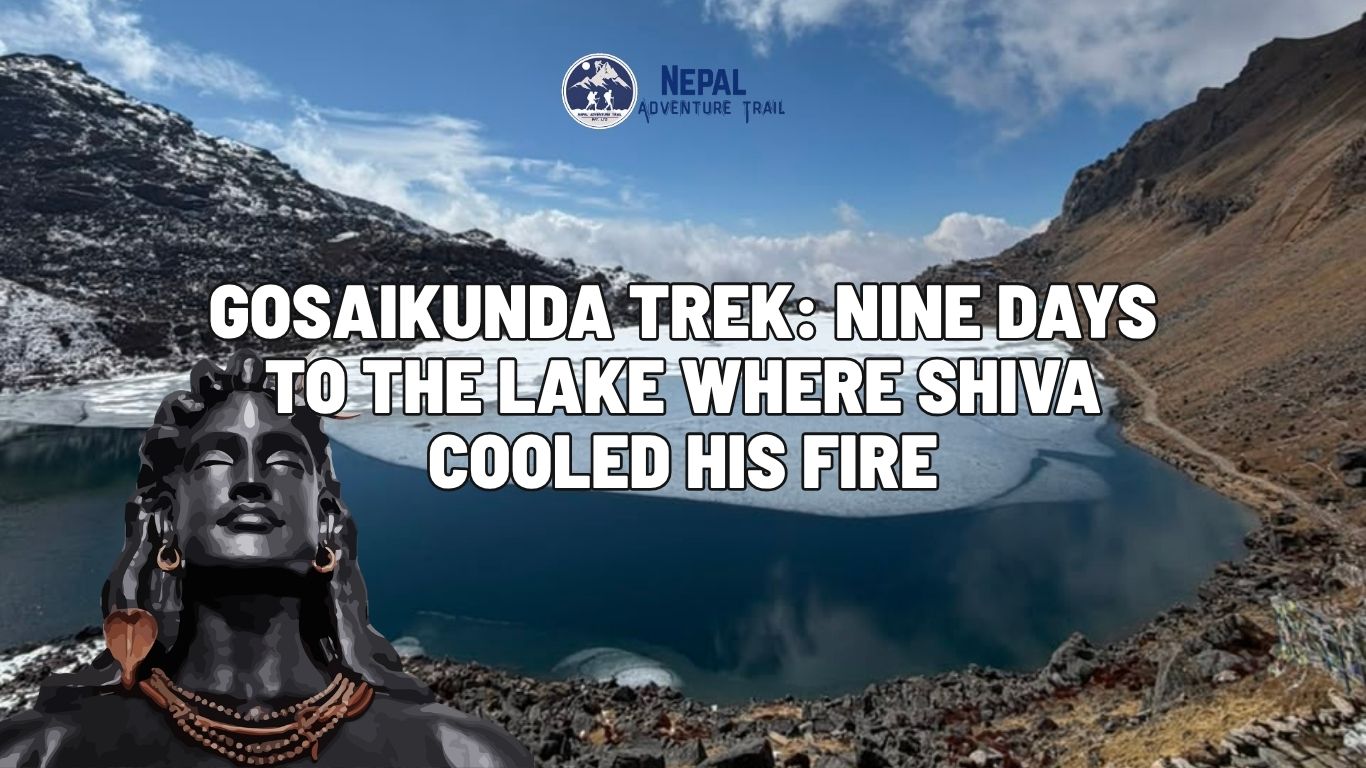
There’s a moment on the Gosaikunda trek, somewhere past Laurebina La, when the trail flattens out and the lake just appears. No warning, no drumroll. One second you’re staring at your boots counting switchbacks, the next you’re standing at the edge of water so still it looks poured rather than formed. I’ve led groups up to that ridge more than a dozen times, and every single group goes quiet at the same spot. Guides, porters, exhausted clients who were complaining about their knees ten minutes earlier. Everyone.
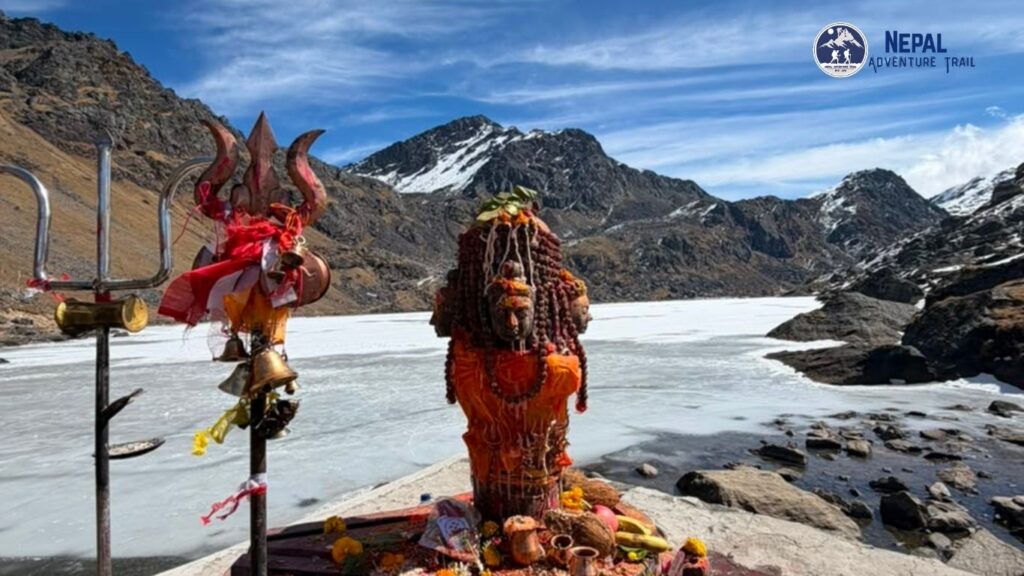
The story goes that when the gods and demons churned the cosmic ocean and pulled up a pot of poison strong enough to destroy the universe, Lord Shiva drank it to save everything else. The poison burned his throat blue, and legend says he plunged his trident into the mountainside here to draw out glacial water and cool the fire in his neck. That’s how Gosaikunda was born, according to the story Hindus and Buddhists alike have carried up this valley for centuries. Whether or not you believe a single word of it, standing at 4,380 meters next to a lake that turquoise, in air that thin, you start to understand why people built a myth around this place instead of just a trail marker.
Most trekkers reach the trailhead the same way we do: an early drive out of Kathmandu, two to three hours depending on the state of the Trishuli road, dropping you at Sundarijal or Dhunche depending on which route you’re running. From there, the real work begins. And that’s where I want to talk you out of the itinerary almost every other operator will hand you.
Gosaikunda Elevation and Why the Numbers Actually Matter
The gosaikunda lake height sits at roughly 4,380 meters (about 14,370 feet) above sea level, and it’s part of a cluster of over 100 lakes scattered through this alpine basin inside Langtang National Park. That number alone should tell you something: this isn’t a casual walk in the hills. You’re climbing from Kathmandu’s 1,400 meters to nearly triple that altitude, and your body doesn’t care how fit you are back home on a treadmill.
Altitude sickness doesn’t check your gym membership. I’ve watched twenty-five-year-old marathon runners get flattened by headaches at 3,500 meters while a sixty-year-old client with bad knees sailed through because she paced herself and drank enough water. The lesson I give every group before we leave Kathmandu is simple: your lungs and your ego are not the same organ, and only one of them should be making decisions on this mountain.
Above 3,000 meters, your body needs time to produce more red blood cells to carry oxygen efficiently. Rush that process and you’re looking at headaches, nausea, and in the worst cases, high altitude pulmonary or cerebral edema, both of which can turn fatal fast. This single fact is the entire reason behind how we structure our trek, and it’s worth its own section.
Practical Altitude Safety Tips (From Someone Who’s Made the Mistakes)
Early in my guiding career, I pushed a group too hard on a compressed itinerary because we were behind schedule and I didn’t want to disappoint anyone. One client ended up with a pounding headache and slurred speech by the time we reached Gosaikunda. We descended immediately, and she was fine within hours, but it scared both of us badly enough that I never made that call again. A few things I now tell every single group before we leave Kathmandu:
- Drink far more water than feels necessary, roughly 3 to 4 liters a day once you’re above 3,000 meters
- Avoid alcohol and sleeping pills at altitude; both suppress your breathing when you need it working hardest
- Walk at your own pace, not the pace of the fastest person in your group
- Learn the early warning signs: persistent headache, loss of appetite, disturbed sleep, and mild nausea are your body’s first messages, not something to push through
- If symptoms worsen, descend immediately rather than waiting to see if they pass on their own
None of this is meant to scare you off the trek. It’s meant to explain why nine days beats five, every single time.
The 9-Day Gosaikunda Trek Itinerary: Why We Don’t Rush It
Search around and you’ll find plenty of agencies advertising a 5-day Gosaikunda trek. Technically, yes, it’s possible to summit the pass and get back down in five days if the weather cooperates and nobody in your group gets sick. I’ve done rescue calls for groups running that exact itinerary, and I can tell you it’s not a story I want to be part of again.
Here’s our gosaikunda trek itinerary, spread across nine days precisely because it gives your body the acclimatization window it actually needs, while also letting you fold in the Helambu region, a stretch of terraced hillsides and Sherpa and Tamang villages that most rushed itineraries skip entirely.
Day 1: Kathmandu to Sundarijal, trek to Chisapani (2,300m) A gentle three to four hour climb through community forest gets your legs moving without shocking your system. Chisapani offers your first real mountain views if the sky cooperates.
Day 2: Chisapani to Kutumsang (2,470m) Ridge walking through rhododendron forest, past small Tamang settlements where prayer flags outnumber people. This is the day clients usually stop taking photos of the mountains and start taking photos of the villages instead.
Day 3: Kutumsang to Tharepati (3,690m) This is your first serious altitude jump, and it’s exactly why we don’t compress this trek. Your body needs this day to adjust before pushing higher.
Day 4: Tharepati to Gopte (3,440m) A short, deliberately easy day. We drop slightly in elevation here on purpose, one of the oldest tricks in high-altitude trekking: climb high, sleep low.
Day 5: Gopte to Phedi (3,730m) Steady, steep sections through forest that thins out as you climb. Phedi means “base” in Nepali, and it earns the name. Tomorrow is the big one.
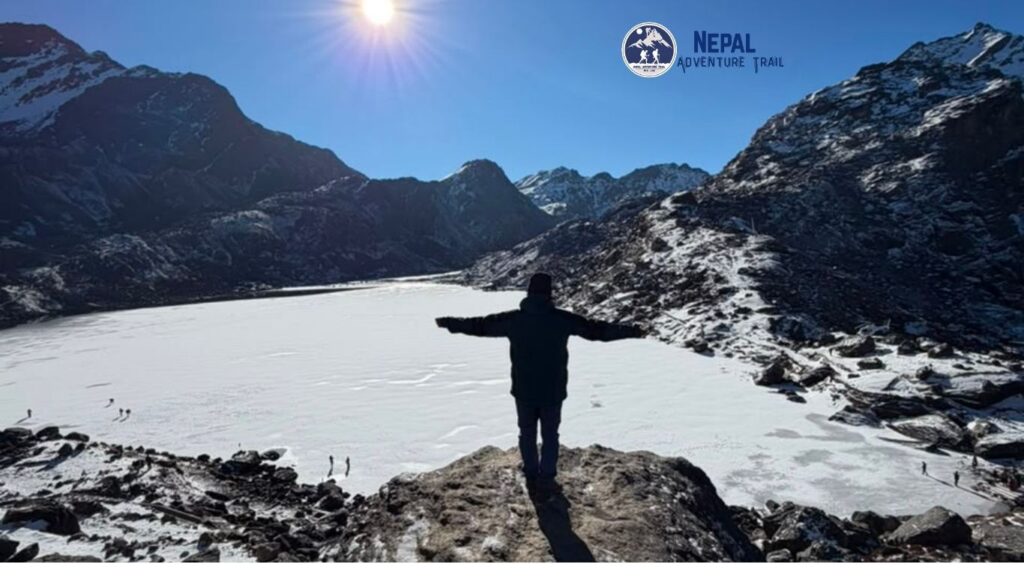
Day 6: Phedi to Gosaikunda (4,380m) You’ll cross Laurebina La pass early in the day, and this is where the landscape stops being forest and starts being raw alpine rock and ice-fed lakes. Reaching Gosaikunda itself, after five days of buildup, hits completely differently than reaching it after a rushed two-day sprint from Dhunche.
Day 7: Explore Gosaikunda, trek to Sing Gompa (3,330m) We build in a full morning at the lake before descending. Most 5-day operators skip this entirely, which means their clients spend twenty minutes at the destination they trekked five days to reach. That’s not a trek. That’s a checkbox.
Day 8: Sing Gompa to Dhunche (1,960m) A long descent through cheese-producing villages (yes, actual cheese, a legacy of a Swiss dairy project decades ago) back toward the road.
Day 9: Drive back to Kathmandu
This gosaikunda trek route, run over nine days through Helambu, isn’t slower for the sake of being slower. It’s slower because that’s what altitude physiology actually requires, and because rushing a trek like this to shave two days off a brochure price is how people end up in a rescue helicopter instead of a photo at the lake.
Gosaikunda Trek Difficulty: An Honest Take
I won’t sugarcoat this for you. This is a moderate to challenging trek, and anyone telling you it’s suitable for total beginners with zero preparation is trying to sell you something.
That said, “challenging” doesn’t mean “technical.” You don’t need climbing gear or rope skills. What you need is:
- A reasonable base level of cardiovascular fitness, built over at least six to eight weeks before departure through hiking, stair climbing, or running with a loaded pack
- Mental readiness for long walking days, sometimes six to seven hours, on uneven terrain
- Genuine respect for altitude, meaning you listen when your guide says slow down
Experienced hikers with prior high-altitude exposure will find the nine-day version comfortable and deeply rewarding. First-time trekkers can absolutely do this trek too, as long as they commit to proper preparation and don’t try to compress the schedule. I’ve guided plenty of first-timers to that lake. The ones who struggled weren’t the ones with weak legs. They were the ones who ignored their bodies on day five because they didn’t want to “hold the group back.”
Gosaikunda Trek Best Time to Go
Autumn (late September to November) is the gold standard. Clear skies, stable weather, and views of Langtang Lirung and the surrounding peaks that stretch on for what feels like forever. This is peak season, so trails and teahouses are busier.
Spring (March to May) runs a close second, with rhododendron forests exploding into red and pink along the lower sections of the trail. Slightly warmer, occasional afternoon haze.
Festival season, specifically the full moon of Janai Purnima, usually falling in August, transforms Gosaikunda into something else entirely. Thousands of Hindu pilgrims, along with Buddhist devotees, make the climb to bathe in the lake’s sacred waters and renew their sacred threads. We’ve written a dedicated deep-dive on the gosaikunda Janai Purnima trek if you want the full cultural context, but even a short version here is worth knowing: this is one of the few times you’ll trek alongside barefoot pilgrims, shamans in trance, and multi-generational families making a pilgrimage some of them repeat every single year. It’s crowded, it’s chaotic in the best way, and it’s unlike any other trekking experience in Nepal.
Winter (December to February) is possible for experienced cold-weather trekkers but expect snow on Laurebina La and significantly colder nights. Monsoon (June to August, outside Janai Purnima) means leeches, limited visibility, and slippery trails, so most operators, us included, discourage it outside festival dates.
Gosaikunda Trek Cost: A Transparent Breakdown
Pricing in this industry gets murky fast, so here’s what actually goes into a nine-day trip:
- Permits: Langtang National Park entry permit and TIMS (Trekkers’ Information Management System) card, combined typically running $30 to $50 USD
- Guide and porter fees: Budget roughly $25 to $35 per day for a licensed guide, $20 to $25 per day for a porter, though this varies by agency and season
- Teahouse lodging: Basic but comfortable, generally $5 to $15 per night depending on altitude (prices climb the higher you go, since everything is carried up by porters or mules)
- Meals: Around $20 to $30 per day for three meals, more at higher elevations
- Transport: Kathmandu to Sundarijal and Dhunche back to Kathmandu, usually $30 to $60 depending on private vehicle versus shared jeep
All told, a full-service nine-day Gosaikunda trek typically lands somewhere between $700 and $1,200 per person, depending on group size, season, and service level. Anyone quoting dramatically less is usually cutting corners on guide licensing, insurance, or porter welfare, none of which you want cut on a high-altitude route.
The Helambu Gosaikunda Trek Combination
I mentioned this earlier, but it deserves its own moment. Running the Helambu Gosaikunda trek as one combined route, rather than treating Gosaikunda as an isolated out-and-back from Dhunche, gives you two treks worth of culture and terrain for barely any extra time. Helambu’s lower valleys are home to Sherpa and Hyolmo communities with their own distinct customs, monasteries, and terraced farmland that looks almost sculpted into the hillside. You get that cultural richness on the front end, then the raw alpine drama of Gosaikunda on the back end. Very few trekkers who do this combination tell me they wish they’d skipped Helambu to save a day.
Ready for the Lake?
I’ve been coming back to Gosaikunda for over a decade now, and it still stops me at that same ridge every time. There’s something about a lake that took five days of climbing to reach that a five-minute cable car never could give you. The nine-day route isn’t the fast option, and it was never meant to be. It’s the one that gets you there in one piece, with enough in your legs and lungs to actually enjoy the view once you arrive.
If you’re weighing your options for a gosaikunda lake trek, whether you’re drawn by the mythology, the festival timing, or simply the idea of standing at 4,380 meters looking at water that color, reach out to us. We’ll walk you through the full itinerary, help you figure out the right season for your fitness level and schedule, and build a trip around what you actually want out of these mountains. Nine days. One lake. A story you’ll be telling for years.