Nar Phu sits in a fold of the Annapurna region that most trekkers never see, a pair of medieval villages where Tibetan prayer wheels still turn against a backdrop of raw scree and glacial rivers, close enough to the Tibet border that the culture here never diluted the way it did in more accessible valleys. Houses stack against cliff faces. Monasteries hold centuries-old murals that few outsiders have ever photographed. It’s the kind of place that earns every cliché about stepping back in time, except here the cliché happens to be accurate.
But you don’t just walk into Nar Phu. This valley sits inside a restricted zone, and getting there legally means working through a specific stack of permits, paperwork, and government rules that trip up a surprising number of trekkers who assume Nepal trekking permits work the same everywhere. They don’t. Nar Phu has its own logic, its own costs, and its own bureaucratic sequence, and if you get any part of it wrong, you’re not going to find a workaround at the checkpoint in Koto. You’re going to get turned back.
Here’s exactly how it works, and how a local agency actually handles it on your behalf.
Why Permits Are Mandatory in Nar Phu
Restricted area status in Nepal isn’t red tape for its own sake. Nar Phu earned that classification because of where it sits and what it protects. The valley runs close to the Tibetan border, close enough that the government maintains tighter control over foreign movement through the area than it does in open trekking zones like the Annapurna Circuit or Everest region. That border sensitivity is one half of the reason.
The other half is cultural and ecological. Nar and Phu villages have preserved a way of life, language, and religious practice tied closely to Tibetan Buddhist tradition, largely because uncontrolled tourism never flooded in the way it did elsewhere. The permit system, expensive as it feels on paper, functions as a filter. It keeps visitor numbers low enough that the valley’s monasteries, grazing lands, and fragile high-altitude ecology aren’t overwhelmed the way some more popular routes have been. When you pay for a Nar Phu Valley trek permit, you’re not just buying access. You’re funding the mechanism that’s kept this place intact.
The Essential Permits Breakdown
Two separate permits cover your legal entry into Nar Phu, and the costs shift with the season.
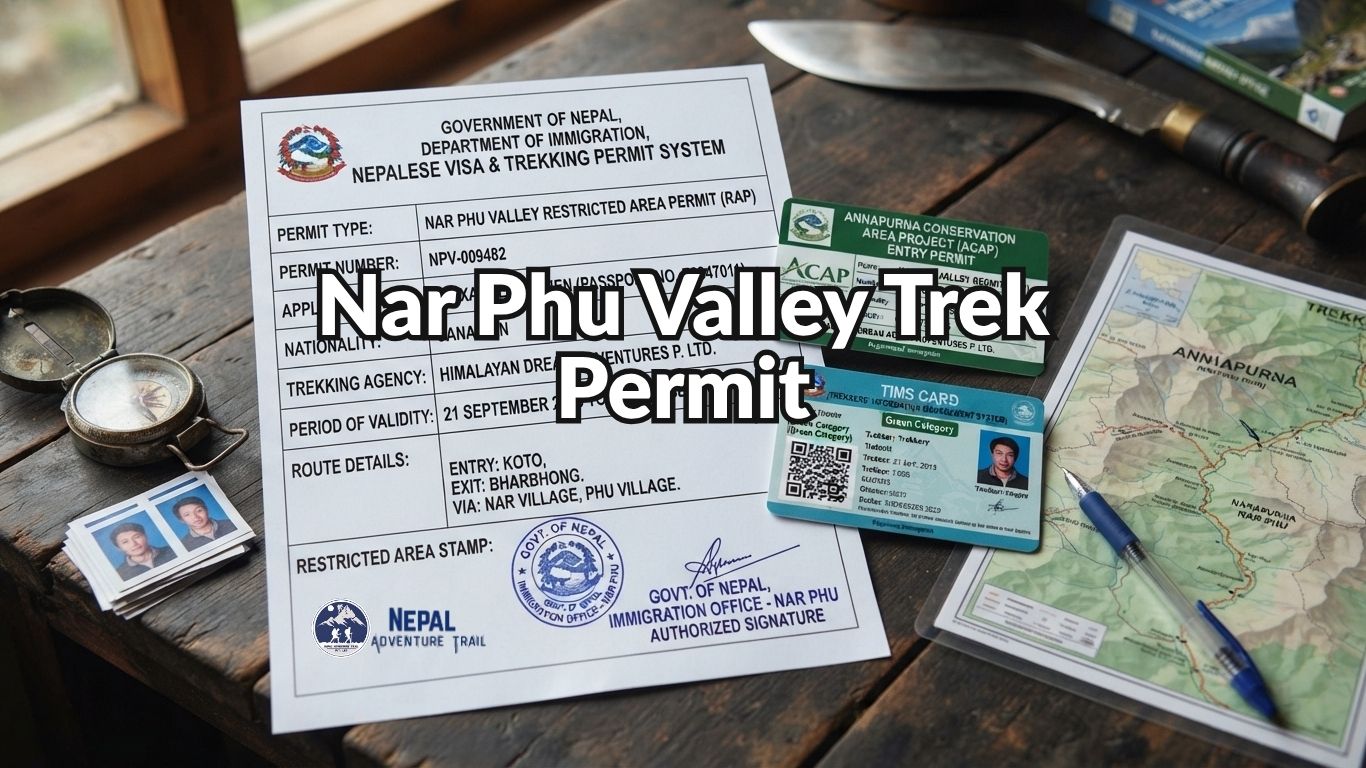
Nar Phu Restricted Area Permit (RAP)
This is the core document controlling your access to the valley itself, and pricing runs on a seasonal tier:
- Peak season (September to November): Roughly USD 90 to 100 per person for the first seven days
- Off-peak season (December to August): Roughly USD 75 to 80 per person for the first seven days
- Extension fees: Approximately USD 15 per additional day beyond the initial week
These figures shift periodically as the Department of Immigration adjusts fee structures, so always confirm current rates with your agency before finalizing a budget. What doesn’t shift is the underlying rule: this permit cannot be purchased by an individual walking into an immigration office. It has to be processed through a government-registered trekking agency, which submits your documentation on your behalf.
Annapurna Conservation Area Permit (ACAP)
Because Nar Phu sits inside the broader Annapurna Conservation Area, you also need an ACAP permit alongside the restricted area permit. This one is simpler:
- Flat fee: Roughly USD 20 to 30 per person
- Validity: Covers your entire time within the conservation area, with no daily extension structure like the RAP
ACAP funds conservation and community development work across the wider Annapurna region, and it’s a standard requirement whether you’re heading into Nar Phu specifically or trekking anywhere else within the zone.
TIMS Card: When You Actually Need It
The Trekkers’ Information Management System card matters most if your route links into standard Annapurna trails, such as combining Nar Phu with a continuation toward the Annapurna Circuit or a side trip to Tilicho Lake. If your itinerary stays purely within the Nar Phu restricted zone without crossing into those broader circuit trails, some agencies will confirm a TIMS card isn’t separately required, since the RAP and ACAP already cover your documented presence in the area. Because this detail depends on your specific route and can shift with policy updates, always confirm directly with your trekking agency which combination applies to your itinerary before departure.
The Guide Requirement, and What Actually Changed in 2026
For years, Nar Phu required not just a licensed guide but a minimum of two foreign trekkers on the permit application, which meant solo travelers had to either find a trekking partner or abandon the idea entirely. That specific rule changed. On March 22, 2026, Nepal’s Department of Immigration formally removed the two-trekker minimum across all of the country’s restricted area zones, Nar Phu included. A solo foreign trekker can now hold a restricted area permit in their own name.
What did not change, and what remains completely non-negotiable, is the guide requirement. A licensed guide from a registered Nepali trekking agency must accompany you throughout Nar Phu, full stop. Independent, unguided trekking through this valley remains prohibited regardless of group size. So if you’re planning solo, the good news is you no longer need to track down a second paying trekker just to satisfy the paperwork. The guide requirement, however, isn’t a formality you can skip by traveling alone. In terrain this remote, with border proximity this close and trail markings this sparse, your guide is doing more than satisfying a legal box. They’re the reason you find the right yak-herding trail at 4,000 meters instead of the wrong one.
Required Documents for Processing
Before your agency can submit anything to the Department of Immigration, they’ll need the following from you:
- Passport details: A clear scanned copy of your passport’s information page
- Valid Nepal visa copy: Your entry visa must already be issued before permit processing begins
- Passport-sized photographs: Typically two to four recent photos, standard passport format
- Travel insurance details: Coverage confirming high-altitude trekking and emergency evacuation, which most agencies will request proof of before departure even if it’s not formally part of the immigration paperwork
Get these documents to your agency early. Missing or mismatched information is the single most common reason permit processing gets delayed at the last minute. One detail that catches people off guard: your visa must already be stamped into your passport before your agency can submit the restricted area application. Arriving in Kathmandu on a tourist visa you plan to extend later, without having secured at least an initial entry visa, will stall the process until that’s sorted, so handle your visa arrangements before you expect permit paperwork to move.
Step-by-Step: How Your Agency Gets Your Nar Phu Permit
You never walk into a government building for this yourself. Here’s what actually happens behind the scenes once you’ve chosen a registered outfitter:
- You submit your documents. Passport copy, visa copy, photos, and insurance confirmation go to the agency, ideally well before you land in Kathmandu.
- The agency drafts your application. They compile your itinerary, dates, and personal details into the format the Department of Immigration requires for restricted area entry.
- Submission to the Department of Immigration. The agency physically or digitally files your RAP and ACAP applications, paying the relevant government fees on your behalf.
- Processing time. This typically takes one to three business days, though it can stretch longer during peak season when volume is high.
- Permit collection. Your agency collects the physical permits, which your guide will carry and present at checkpoints along the route, including Koto and other monitoring posts.
- Checkpoint verification. As you trek, your guide handles the checkpoint formalities, matching your permit to your passport at each stage.
You don’t see most of this process. You just need to make sure your piece of it, the documents, arrives on time.
Expert Tip: Timing Your Application
Here’s what I tell every client booking a Nar Phu trip: get your documents to your agency at least three to four weeks before your planned departure, especially if you’re traveling during September through November peak season. Processing delays happen most often when travelers submit passport scans or visa copies at the last minute, forcing agencies to rush submissions right as immigration offices are already handling peak-season volume from Manaslu, Upper Mustang, and other restricted zones simultaneously.
Nar Phu rewards patience in almost every sense, from the acclimatization schedule to the pace of the trail itself. Apply that same patience to your paperwork, hand the logistics to a registered agency you trust, and the bureaucracy stops being the hard part of this trek. The hard part becomes standing in Phu village at four thousand meters, looking at architecture that hasn’t changed in centuries, which is exactly the way it should be.