
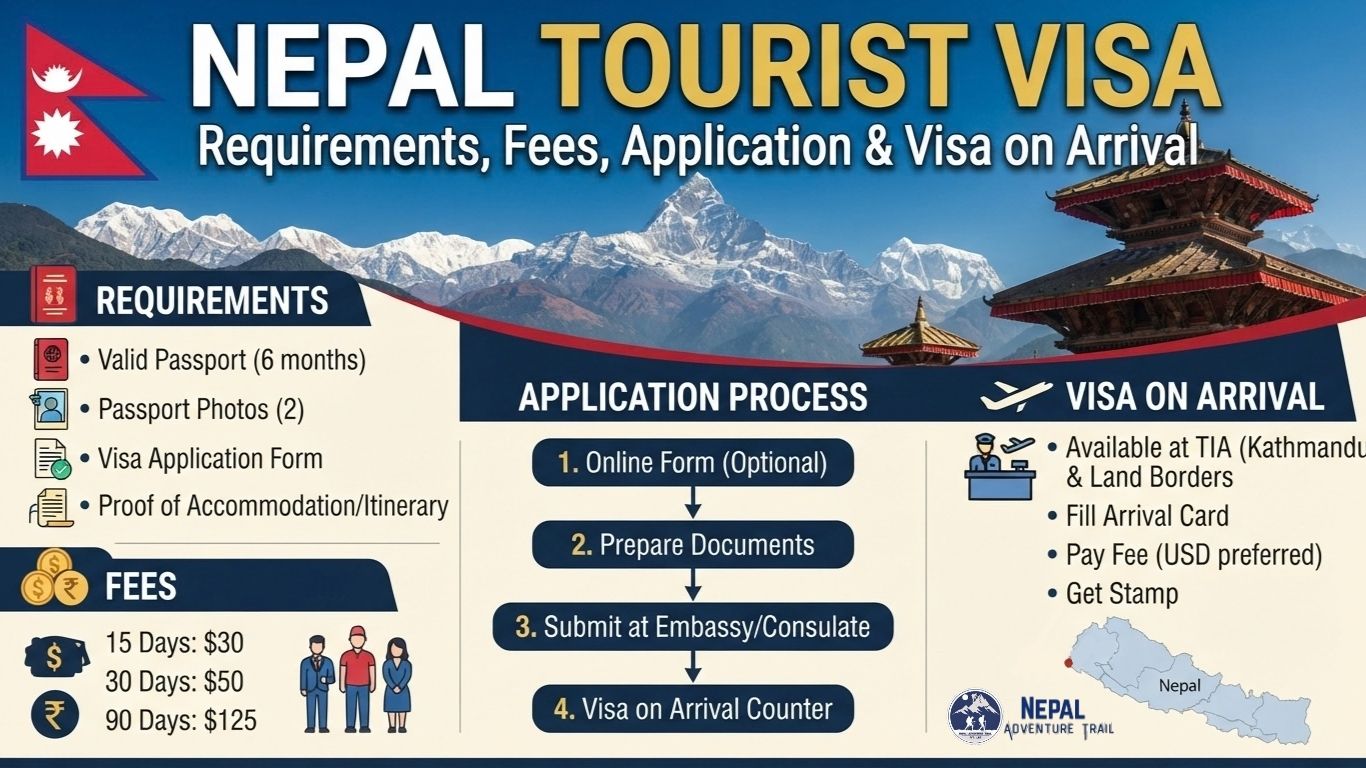
Nepal’s Himalayan landscapes, heritage cities, trekking routes and pilgrimage sites draw travelers from around the world, but the journey begins with a practical step: understanding how entry works. The Nepal tourist visa is the permission most visitors need, and for many nationalities it can be obtained on arrival, with the main steps being an application form, fee payment and immigration processing.
Some travelers need to arrange a visa before departure. Others, such as Indian citizens, do not need one at all. A few categories receive a free (gratis) visa, and fees, durations and extension rules each follow their own logic.
This guide explains who needs a Nepal tourist visa, what it costs, how to apply, what happens at Kathmandu airport and how to extend your stay. Figures are based on Department of Immigration information as reported in 2026. Visa rules change, so confirm them on the official portal shortly before you travel.
Nepal Tourist Visa at a Glance
| Visa detail | Current information |
|---|---|
| Visa type | Tourist visa |
| Durations and fees | 15 days: US$30. 30 days: US$50. 90 days: US$125 |
| Entry | Reported as multiple entry |
| Visa on arrival | Available to most nationalities |
| Application | Online pre-arrival form, kiosk at the airport, or Nepali diplomatic mission |
| Passport | Valid for at least six months |
| Maximum stay | 150 days per visa year (January to December), including extensions |
| Extension | At Department of Immigration offices in Kathmandu and Pokhara |
| Official authority | Department of Immigration, Nepal |
What Is a Nepal Tourist Visa?
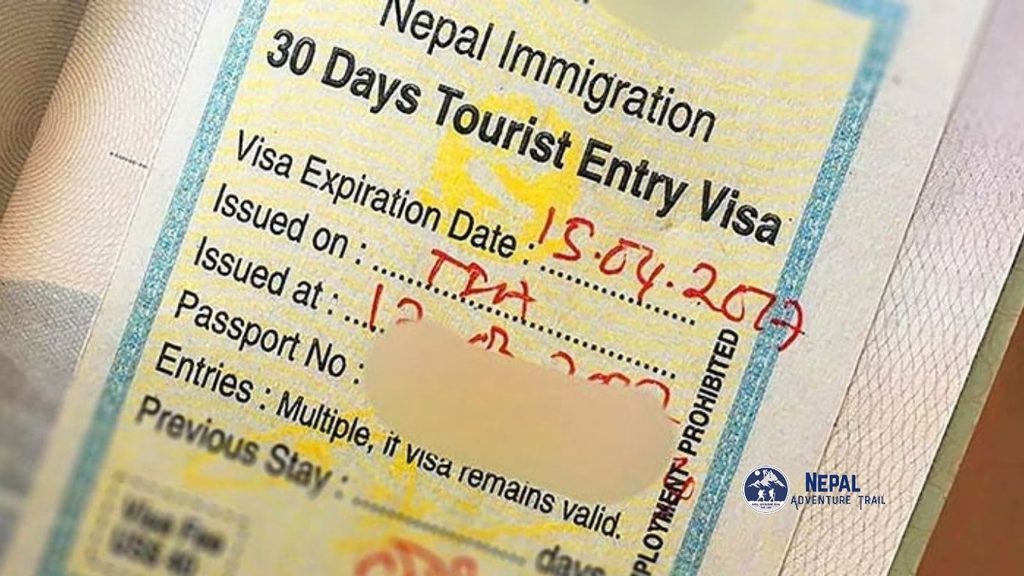
The Nepal tourist visa lets you enter for tourism, which includes sightseeing, trekking, pilgrimage visits and holidays. The visa is issued for 15, 30 or 90 days. Your permitted stay is counted from the day you enter Nepal, not from the day you applied or paid.
Visitors traveling for work, study or other purposes may need a different visa category. A tourist visa does not allow you to work in Nepal.
Who Needs a Nepal Tourist Visa?
Most foreign travelers need a tourist visa to enter Nepal. This includes citizens of the United States, United Kingdom, Canada, Australia and most European countries, who can generally get it on arrival.
Indian citizens do not need a visa to enter Nepal. They must carry accepted travel or identity documents, and the accepted documents can depend on how they enter, so check the Department of Immigration guidance before traveling.
Other categories may receive a gratis visa, explained below. Do not assume that no visa means no paperwork. Exempt travelers still go through immigration.
Nepal Visa on Arrival
Nepal offers visa on arrival to most nationalities. For eligible travelers, the process is relatively straightforward: complete the application form (online in advance or at a kiosk), pay the fee and present your passport at the immigration desk.
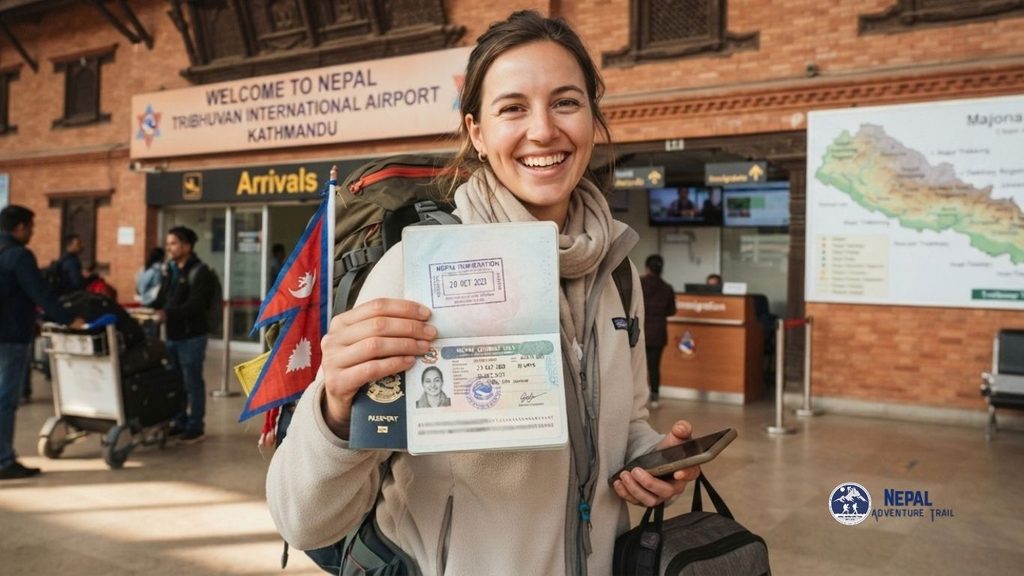
At Tribhuvan International Airport, the usual sequence is the arrival form or kiosk, the payment counter and then the immigration desk. Queues can be long in peak seasons, particularly in spring and autumn, so completing the online form in advance can save time.
Nepal Tourist Visa Requirements
Generally required:
- a passport valid for at least six months from arrival
- a completed visa application (online form with barcode or receipt, or kiosk form at the airport)
- the visa fee
- a passport-size photograph, which some sources list as required, so carry one
May apply to specific travelers:
- documents for gratis categories, such as a birth certificate for children under 10
- an advance visa from a Nepali embassy or consulate for nationalities not eligible for visa on arrival
Not every website’s checklist is official. Some guides list return tickets, proof of funds or hotel bookings as requirements. The sources reviewed did not show these as universal Department of Immigration requirements, so check the official source for your nationality before preparing extra paperwork.
Nepal Tourist Visa Fees
| Tourist visa duration | Fee |
|---|---|
| 15 days | US$30 |
| 30 days | US$50 |
| 90 days | US$125 |
These match the figures the Department of Immigration lists, according to current guides. Older pages, including some tourism material, show different historical numbers. Do not rely on them.
Keep these charges separate:
- Visa fee: the amounts above.
- Extension fee: charged per day once you apply to stay longer.
- Late fine: a daily charge if you stay beyond your permitted period.
Payment: US dollars in cash are the safest option at airports and land borders. Guides disagree about card payment. Some say airport counters accept cards but not reliably, and others describe card payment through an online process. Carry cash as a backup.
How to Apply for a Nepal Tourist Visa Online
- Open the official portal. The Department of Immigration’s visa portal is at nepaliport.immigration.gov.np, and the main site is at nepalimmigration.gov.np. Check that the address ends in .gov.np.
- Start the online application. Choose the tourist visa option and enter your details.
- Enter passport and personal information carefully. Match your passport exactly.
- Submit the application.
- Save or print the confirmation. The barcode or receipt helps at the airport.
- Pay and complete entry. Follow the payment and arrival instructions shown on the portal.
Timing matters. Guides report that the online form is valid if submitted within 15 days of arrival, and that forms submitted earlier are not accepted. Whether the online process issues the visa itself or pre-fills the arrival form, and whether you can pay by card online, is described differently across sources, so follow the portal’s current instructions.
Always verify that the website you use for a Nepal tourist visa is an official Government of Nepal immigration portal before entering passport details or making payment. The Department of Immigration has warned travelers about unauthorized websites and third-party platforms that collect visa fees. Official sites use .gov.np domains.
Visa on Arrival at Kathmandu Airport
The sequence at Tribhuvan International Airport:
Arrival, then form or kiosk, then payment, then immigration desk, then entry.
- If you completed the online form, go to the counter for online applicants and show your barcode or receipt.
- If not, use a kiosk or paper form. Fill in an arrival card too.
- Pay the visa fee at the payment counter and keep the receipt.
- Join the immigration line with your passport, receipt and form.
Keep your passport, photo and cash in your hand luggage, not in a checked bag. Processing time varies widely with the number of flights landing. Some guides suggest around an hour in normal conditions, but busy periods can take longer.
Countries That Cannot Get Visa on Arrival
According to current guides citing the Department of Immigration, nationals of these countries must obtain a visa in advance from a Nepali diplomatic mission:
Afghanistan, Cameroon, Eswatini (Swaziland), Ethiopia, Ghana, Iraq, Liberia, Nigeria, Palestine, Somalia, Syria and Zimbabwe.
Travelers holding refugee travel documents are also reported to need a visa in advance. One guide lists Israel in place of Palestine, which is a discrepancy you should check on the official site. Lists like this change, so confirm yours with the Department of Immigration or the nearest Nepali embassy before booking.
Nepal Visa for Indian Citizens
Indian citizens do not need a visa to enter Nepal. They generally enter with a valid passport, and other identity documents may be accepted under specific conditions that the Department of Immigration publishes. Because document rules differ by mode of entry and traveler category, check the current guidance rather than relying on older lists.
Gratis (Free) Nepal Tourist Visa
A gratis visa is issued without a visa fee. Current guides citing the Department of Immigration list these categories:
- children under 10 (except US citizens, who are reported to pay)
- SAARC citizens (except Afghanistan), for up to 30 days, once in a visa year
- Chinese nationals, exempt from the tourist visa fee
- Non-Resident Nepali (NRN) card holders
The terms differ. Visa-exempt means no visa is needed (Indian citizens). Gratis means a visa is issued but no fee is charged. Visa on arrival means you obtain the visa at an eligible entry point and pay the fee.
Nepal Tourist Visa for SAARC Citizens
Citizens of Bangladesh, Bhutan, Maldives, Pakistan and Sri Lanka are reported to receive a free visa of up to 30 days on their first visit in a visa year (January to December). Later visits in the same year follow standard fees. Afghan nationals are excluded and need a visa in advance. Indian citizens are visa-exempt. Extensions beyond the free period are subject to normal rules and fees.
Nepal Tourist Visa for Chinese Citizens
Chinese nationals are exempt from the tourist visa fee, according to Nepali embassy information. Guides disagree on how long the free stay lasts, with some saying up to 150 days per visa year and others quoting shorter periods. Confirm the current terms with the Nepali embassy or the Department of Immigration.
Passport Validity for Nepal
Your passport should be valid for at least six months from your date of arrival. Some guides add that it should have blank pages for the visa sticker. Check the condition, too: a damaged passport can cause problems. Make sure the personal details match your booking and application.
How Long Can You Stay in Nepal on a Tourist Visa?
The initial visa is 15, 30 or 90 days. Tourist stays, including extensions, are limited to 150 days per visa year, which runs from 1 January to 31 December. The limit applies per calendar year, not per entry, so a stay in November and December counts against one year and a stay in January starts a new one.
You can stack: a 90-day visa can be extended by up to 60 days, within the cap.
Nepal Tourist Visa Extension
Extensions are processed at the Department of Immigration in Kathmandu and the immigration office in Pokhara. Guides citing the Department of Immigration report:
- extension fee of US$3 per day
- minimum extension of 15 days (so US$45 as a minimum)
- late fine of US$5 per day if you apply after your visa expires
One guide gives the extension rate in rupees instead, which conflicts with the others, so confirm the current charge at the office or on the portal. Some guides say extensions are now handled online.
Practical tip: apply before your last day, especially if you are returning from a remote trek, because processing takes time and an extension is not automatic.
Nepal Tourist Visa Overstay
An overstay means staying past the date your visa or extension allows. Reported penalties include a daily fine on top of the extension fee, and in serious cases further consequences such as an entry restriction or a larger fine, which are described differently across sources. A recorded overstay can also complicate departure and future entry.
The simplest approach is to track your permitted stay and extend before it ends.
Nepal Tourist Visa for Trekkers
There is no separate trekking visa. Trekkers enter on the standard tourist visa. The visa is immigration permission to be in Nepal, and trekking usually adds other requirements:
- Trekking permits and protected-area fees: national park, conservation area or local municipality permits.
- Restricted-area permits: for regions such as Upper Mustang, Manaslu and Nar Phu, arranged through registered agencies.
- Guide and TIMS requirements: these vary by route and have been changing, so check current rules.
Make sure your visa covers your whole trip, including the trek and buffer days.
Nepal Tourist Visa Entry Points
By air: Tribhuvan International Airport in Kathmandu is the main entry point. Some guides also list Gautam Buddha International Airport (Bhairahawa) and Pokhara International Airport, but sources disagree on availability, so confirm before relying on them.
By land: guides commonly list Kakarbhitta, Birgunj, Belahiya (Bhairahawa), Jamunaha (Nepalgunj), Mohana (Dhangadhi), Gaddachauki (Mahendranagar) and, on the China border, Kodari and Rasuwagadhi. Cash is the usual payment at land borders. Do not assume every crossing issues tourist visas.
Visa-Free vs Gratis vs Visa on Arrival vs Visa in Advance
- Visa-free: no visa required (Indian citizens).
- Gratis visa: issued without a fee to certain categories.
- Visa on arrival: obtained at an eligible entry point after meeting requirements and paying the fee.
- Visa in advance: obtained through a Nepali diplomatic mission (or an applicable online process) before travel. Required for nationalities not eligible for visa on arrival.
Common Nepal Visa Mistakes
- Using an unofficial visa website.
- Entering incorrect passport details.
- Assuming every nationality qualifies for visa on arrival.
- Confusing visa duration with the date it was issued.
- Waiting too long to apply for an extension.
- Assuming a trekking permit is the same as a visa.
- Losing the application or payment receipt.
- Submitting the online form too early, when it is only valid within a set window before arrival.
- Relying on outdated fee tables found online.
Tips for a Smooth Nepal Visa Process
- Check passport validity before booking flights.
- Use official Government of Nepal websites.
- Complete online forms carefully.
- Keep digital and printed copies of confirmations.
- Carry US dollars in cash as a backup to cards.
- Allow extra time at the airport in peak seasons.
- Check nationality-specific rules before departure.
- Re-check fees shortly before travel.
- Track your permitted stay, and apply for an extension early.
Nepal Tourist Visa and Trip Planning
Once entry is sorted, planning becomes the enjoyable part: Kathmandu’s heritage sites, lakeside Pokhara, wildlife in Chitwan, Everest Base Camp and Annapurna treks, cultural tours and pilgrimage routes. Think about how your visa length fits the trip. A 15-day visa suits a short city and lakeside holiday. A 30-day visa suits most treks. A 90-day visa suits longer journeys that combine trekking with cultural travel.
Planning Your Nepal Trip with Nepal Adventure Trail
Nepal Adventure Trail, a local trekking and tour operator, can help with the parts that follow the visa: tour itineraries, airport transfers, accommodation, trekking arrangements, guides, permits and transport, planned around your dates and length of stay.
Frequently Asked Questions
Do I need a tourist visa to visit Nepal?
Most foreign nationals do. Citizens of countries such as the United States, United Kingdom, Canada, Australia and most of Europe can usually obtain it on arrival. Indian citizens do not need a visa, and some categories receive a free visa. A short list of nationalities must apply in advance through a Nepali embassy or consulate. Check your nationality on the Department of Immigration site before booking.
Can I get a Nepal tourist visa on arrival?
Yes, for most nationalities. At Tribhuvan International Airport in Kathmandu, you complete a form or kiosk entry, pay the fee and go through the immigration desk. Visa on arrival is also reported at some land borders. Nationals of a short list of countries, including Nigeria, Ghana and Afghanistan, cannot use it and must apply in advance. Completing the online form first can reduce waiting time.
How much does a Nepal tourist visa cost?
The Department of Immigration fees reported for 2026 are US$30 for 15 days, US$50 for 30 days and US$125 for 90 days. Children under 10, eligible SAARC citizens, Chinese nationals and NRN card holders may receive a gratis visa. Extensions are charged separately, reported at US$3 per day with a 15-day minimum. Fees can change, so verify them close to departure.
What documents are required for a Nepal tourist visa?
A passport valid for at least six months, a completed application form or online receipt, the visa fee and usually a passport-size photograph. Gratis categories may need extra proof, such as a birth certificate for children. Some websites list return tickets or proof of funds, but these were not shown as universal requirements in the sources reviewed. Confirm your nationality’s requirements officially.
How do I apply for a Nepal tourist visa online?
Use the Department of Immigration’s official portal, nepaliport.immigration.gov.np, and check that the address ends in .gov.np. Complete the form, review your passport details, submit it and save the confirmation or barcode. Guides say the form is valid within about 15 days of arrival. Follow the portal’s current instructions for payment, since sources differ on whether the online process issues the visa or pre-fills the arrival form.
How long is a Nepal tourist visa valid?
Tourist visas are issued for 15, 30 or 90 days, counted from your date of entry, and are reported as multiple entry. Your total stay in a visa year, from January to December, is capped at 150 days including extensions. You can extend within Nepal at immigration offices, but the extension is subject to approval and the annual limit. Plan your trip and any extension around those dates.
Can I extend my Nepal tourist visa?
Yes, at the Department of Immigration in Kathmandu or the immigration office in Pokhara, within the 150-day annual maximum. Guides report US$3 per day with a minimum of 15 days, and a US$5 per day late fine if you apply after expiry. One guide quotes a rupee rate, so confirm the current fee. Apply before your visa ends, especially after a remote trek.
Which countries cannot get a Nepal visa on arrival?
According to current guides citing the Department of Immigration, they are Afghanistan, Cameroon, Eswatini, Ethiopia, Ghana, Iraq, Liberia, Nigeria, Palestine, Somalia, Syria and Zimbabwe. Refugee travel document holders are also reported to need an advance visa. One source lists Israel instead of Palestine, so check the official list for your passport before booking flights and apply through a Nepali embassy or consulate.
Do Indian citizens need a visa for Nepal?
No. Indian citizens can enter Nepal without a visa, but they must carry accepted travel or identity documents. A valid passport is the standard document, and other IDs may be accepted in specific circumstances. Because these rules differ by mode of entry and can change, check the Department of Immigration’s current guidance before traveling. Entry is still processed at immigration.
Do I need a separate visa for trekking in Nepal?
No. Trekkers enter on the standard tourist visa, then obtain separate trekking permits and park or conservation-area entries depending on the route. Restricted areas such as Upper Mustang and Manaslu require special permits through a registered agency. Guide and TIMS rules also vary and have been changing. Make sure your visa length covers the whole trek plus a buffer for weather delays.
Can I pay for a Nepal tourist visa by card?
Sources disagree. Some say airport counters have card readers that work unreliably, others describe card payment through an online process, and land borders are generally described as cash only. US dollars in cash are the safest option. Whatever you choose, carry cash as a backup, keep your payment receipt and follow the official portal’s current payment instructions.
Where is the official Nepal tourist visa website?
The Department of Immigration’s visa portal is nepaliport.immigration.gov.np, and its main site is nepalimmigration.gov.np. Official Government of Nepal sites use .gov.np domains. The Department has warned about unauthorized websites and third-party platforms that collect visa fees, so check the address before entering passport details or paying. Information on other sites, including travel blogs, may be outdated.
Conclusion
Understanding the Nepal tourist visa is part of preparing for a smooth trip. Check your eligibility, use official immigration channels, keep your documents ready, confirm the current fee and track how many days you have left, especially if you plan a trek or a long stay.
With entry sorted, you can plan the rest: Kathmandu’s heritage squares, a quiet morning beside Phewa Lake, Chitwan’s wildlife or a route into the Himalayas. When you are ready to shape the itinerary, Nepal Adventure Trail can help arrange it.