
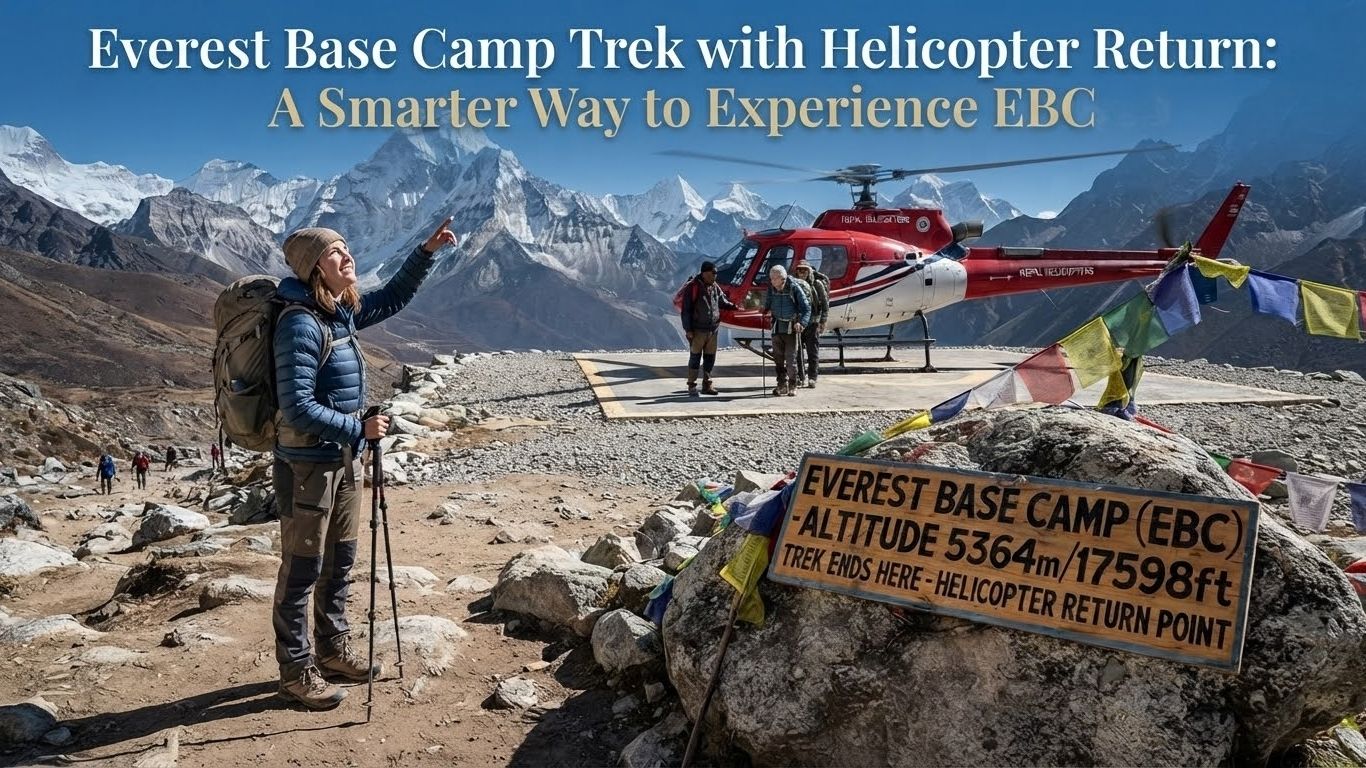
The route begins on foot. A trail climbs from Lukla through pine and rhododendron, crosses suspension bridges above the Dudh Koshi, and rises past Sherpa villages and prayer-flag ridges into the glacier-carved upper Khumbu. Days are spent walking slowly and sleeping higher. At the end, instead of retracing the trail for several more days, you board a helicopter and fly back down the valley.
That is the appeal of the Everest Base Camp trek with helicopter return. You keep the ascent, which is the part that makes the journey, and shorten the descent. It is not a shortcut to the mountain. The climb still demands acclimatization, fitness, and flexibility, and the helicopter is a weather-dependent flight, not a fixed appointment. This guide explains how the arrangement works, what it costs, and what to confirm before you book.
What Is an Everest Base Camp Trek with Helicopter Return?
You trek from Lukla to the Everest Base Camp area with the usual acclimatisation days, then fly back by helicopter instead of walking down. Depending on the itinerary and current operating conditions, pickup commonly takes place at Gorak Shep, and the flight goes to Lukla or on to Kathmandu. Operators describe this as saving roughly three to four days of descent. The helicopter changes the return. It does not change the ascent.
Do not confuse it with a helicopter tour. An Everest Base Camp helicopter tour flies from Kathmandu over the region in a few hours, usually with a breakfast stop and sometimes a landing near Kala Patthar, without the trek. The two are different products, with different costs, physical demands and experiences, compared in a table below.
Standard EBC Trek vs Trek with Helicopter Return
| Factor | Standard EBC Trek | EBC Trek with Helicopter Return |
|---|---|---|
| Trekking duration | Often 12 to 14 days round trip | Walking up only; itineraries are often listed at about 9 to 12 days in total |
| Return journey | Walk back to Lukla, then fly | Helicopter from the upper valley, itinerary-dependent |
| Physical demand | High altitude, long descent | Same ascent, less downhill walking |
| Total time | Longer | Shorter, though weather can add days |
| Cost | Lower | Higher, often by well over a thousand US dollars |
| Himalayan experience | Full valley revisited on foot | Aerial return over the same terrain |
| Flexibility | Moderate | Depends on flying weather and seat availability |
| Weather dependency | Affects Lukla flights | Affects both Lukla and the helicopter |
| Best for | Time-rich, budget-conscious trekkers | Time-limited travellers who want the ascent |
Sample Itinerary
No single itinerary is universal. Pace, flight arrangements, weather, operator and whether Kala Patthar is included all change the schedule. Treat this as a realistic outline, not a template.
| Day | Route | Notes |
|---|---|---|
| 1 | Kathmandu to Lukla (2,860 m), walk to Phakding | Flight departures may be from Manthali (Ramechhap) in peak months |
| 2 | Phakding to Namche Bazaar (about 3,440 m) | Steady climb, suspension bridges |
| 3 | Acclimatisation in Namche | Short hikes high, sleep low |
| 4 | Namche to Tengboche (about 3,860 m) | Monastery and mountain outlook |
| 5 | Tengboche to Dingboche (4,410 m) | Open, high valley |
| 6 | Acclimatisation in Dingboche | Rest or a short hike |
| 7 | Dingboche to Lobuche (4,910 m) | Reported at roughly six to seven hours |
| 8 | Lobuche to Gorak Shep (about 5,180 m), then Everest Base Camp (about 5,364 m) | Long day, reported at seven to eight hours |
| 9 | Helicopter return from Gorak Shep, or Kala Patthar at dawn first | Destination: Lukla or Kathmandu |
| 10 | Buffer day in Kathmandu | Useful if the flight slips |
Add days if you prefer a gentler profile. A shorter schedule has less margin for acclimatisation and weather. The itinerary should prioritise safe altitude gain over the shortest possible calendar.
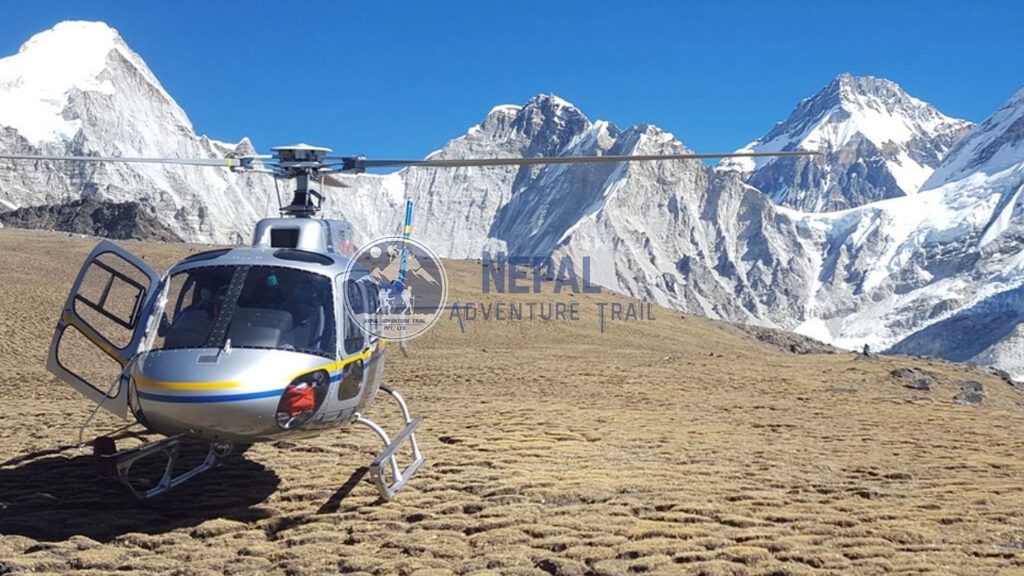
How the Helicopter Return Actually Works
- Where the trek finishes. Most itineraries end around Gorak Shep (roughly 5,164 to 5,180 m, depending on source) or Everest Base Camp.
- Where pickup occurs. Operators commonly describe pickups from Gorak Shep, and sometimes Lobuche or Pheriche, depending on conditions and arrangements.
- Where it flies. Typical routes run to Lukla or direct to Kathmandu, with a stop possible for fuel or to regroup. Confirm which one your booking includes.
- Shared or private. Shared seats fill a helicopter of up to about five passengers, with the load limited by weight and thin air. Private charters fly only your group.
- Why timing changes. Cloud, wind, visibility, payload and aviation clearance all shape pickup times. Aircraft also fly in rotations, so groups may leave in more than one shuttle.
- If it cannot fly. Delays happen. Ask in advance what the plan is: wait at altitude, descend by trail to a lower pickup, or fly fixed-wing from Lukla.
Can a Helicopter Land at Everest Base Camp?
Do not assume it. Base Camp sits on the Khumbu Glacier, and operators describe nearby landing points instead. Scenic tours fly over Base Camp and Kala Patthar. Landing at Kala Patthar (about 5,545 m) has depended on rules, aircraft and weather, and after the July 2023 Lamjura crash the Civil Aviation Authority of Nepal tightened oversight, with operators reporting changes to shared-group landings that later shifted again in 2026. Rules in the region change, so confirm what is possible for your dates. For trekkers, the practical pickup point is usually Gorak Shep, not Base Camp itself.
How Long Does the Helicopter Return Take?
Operator figures put the flight from Gorak Shep to Lukla at roughly 18 to 22 minutes, with Kathmandu longer. Those are flight times, not transfer times. Waiting for weather, rotations, refuelling and airport transfers add hours. Plan for a loose window, not a clock.
Everest Base Camp Trek with Helicopter Return: Cost
Prices vary widely by operator, season, group size and comfort. Treat the figures below as examples from published operator pages, not quotes, and verify before you book.
| Item | Reported Example |
|---|---|
| Group package with helicopter return | Roughly US$2,250 to 3,400 or more, depending on operator |
| Shared seat, Gorak Shep to Lukla | About US$850 (one operator) |
| Shared seat, Gorak Shep to Kathmandu | About US$1,420 (one operator) |
| Private charter, Gorak Shep to Lukla | From about US$1,800 (one operator) |
Cost drivers: trekking package, domestic flights, helicopter return, guide, porter, accommodation, meals, permits, insurance, tips, equipment and extra hotel nights. A helicopter return can add well over a thousand dollars compared with walking back, though the shorter schedule saves a few days of trail costs.
Is the helicopter included? It depends on the package. Ask whether the price covers a shared seat or private charter, which segment (Gorak Shep to Lukla or to Kathmandu), landing fees, weather-delay costs and any surcharge. Planned return costs and emergency evacuation costs are separate things.
Best Time for an EBC Trek with Helicopter Return
Spring (March to May). Rhododendrons on the lower trail, cooler air at height and haze that can soften distant views. Busy.
Autumn (late September to November). Often the clearest post-monsoon skies, and the most demand. Good visibility helps helicopter operations, though no season guarantees it.
Winter (December to February). Cold, with snow and short days. Fewer trekkers, and flying conditions can limit operations.
Monsoon (June to September). Cloud, rain, slippery trails and flight delays. Both Lukla flights and helicopter returns depend on visibility, so this is the hardest season for planning a fixed return.
Weather, Delays and Safety
A helicopter depends on visibility, cloud base, wind and precipitation. A helicopter return is not a guaranteed return at a fixed time. Build buffer days in Kathmandu before any international departure. Two or three is a common cushion.
On safety, choose licensed operators, expect pilots to make conservative weather decisions, and accept that passenger limits, altitude and aviation oversight shape every flight. No form of mountain travel is risk-free, and no blanket safety claim is honest. Travel insurance matters on both the trail and the aircraft.
Altitude, Acclimatisation and Difficulty
Taking a helicopter back does not remove the need to acclimatise. The altitude risk is on the way up. You climb from Lukla at 2,860 m to over 5,000 m, and your body needs time. Use the rest days at Namche and Dingboche, walk slowly, drink water and report symptoms to your guide. Common signs of altitude illness include headache, nausea, dizziness and poor sleep. Worsening symptoms mean stop ascending and descend. Seek medical advice before the trip, especially with heart, lung or other conditions.
The route is a genuine high-altitude trek. Expect rocky trail, steep sections, cold, thin air and daily walks of about four to eight hours at the upper end. The helicopter removes downhill trekking, not the ascent.
Who Should Choose This Itinerary?
It suits travellers with limited time, those who want the full ascent without the long descent, people who dislike steep downhill walking and trekkers who want an aerial view of the valley. The standard trek suits those with more time, tighter budgets or a taste for the long overland journey. Neither is superior.
Beginners. Previous trekking helps but is not always essential. Fitness, acclimatisation days and a guide matter more. Train with long hill walks, and do not assume the helicopter makes the trek easy.
Older travellers. Suitability depends on health, fitness, altitude tolerance, pace and medical advice, not on age. Talk to a doctor first.
Permits and Regulations
Rules change and sources conflict, so verify with the Nepal Tourism Board or a registered operator. Published 2026 figures typically list a Sagarmatha National Park permit at about NPR 3,000 and a Khumbu Pasang Lhamu Rural Municipality fee between NPR 2,000 and 3,000. TIMS is where reports disagree: some say it is no longer required in Khumbu, while the Nepal Tourism Board has listed Everest Base Camp among routes subject to guide and TIMS provisions. Many sources describe a licensed guide through a registered agency as required on major routes since 2023, with some describing the Everest region differently. Ask your operator for the current position in writing.
Teahouses on the Route
Teahouses along the route range from Lukla and Phakding to Gorak Shep. Rooms are basic, usually twin with shared bathrooms. Meals are dal bhat, noodles and eggs. Charging, hot showers and Wi-Fi are often paid extras. Heating is usually limited to the dining room. Comfort drops as altitude rises, and Gorak Shep is the most basic stop.
What to Pack
Base layers, fleece, down jacket, waterproof shell, trekking trousers, warm socks, gloves and hat. Broken-in boots and camp shoes. A backpack, poles, headlamp, water bottle or hydration system, and a sleeping bag if your operator does not provide one. Sunscreen, sunglasses, personal medication, a basic first-aid kit and altitude precautions. Passport, permits and insurance documents.
Helicopter considerations. Weight matters, because payload is limited at altitude. Many sources cite a 15 kg combined allowance (10 kg checked, 5 kg hand carry) on Lukla flights, but figures vary by source and there is no single universal helicopter allowance. Ask your operator for the written limit, use soft duffels and keep medication, valuables and warm layers in your hand luggage. Anything over the limit may be left behind or sent separately.
Insurance: Planned Return vs Emergency Evacuation
A planned helicopter return is a scheduled part of your itinerary. An emergency evacuation is a medical or safety response. They are not the same thing. Buying a helicopter-return package does not mean rescue costs are covered. Check that your insurance covers high-altitude trekking up to at least Base Camp elevations, medical treatment, helicopter evacuation, trip interruption and delays. Read the exclusions.
EBC Trek with Helicopter Return vs EBC Helicopter Tour
| Feature | EBC Trek + Helicopter Return | EBC Helicopter Tour |
|---|---|---|
| Trekking experience | Days on foot through Khumbu | None |
| Acclimatisation | Built in and essential | Limited; short ground time |
| Time required | About 9 to 12 days | Roughly half a day |
| Physical effort | High | Low |
| Cost | Package often in the thousands of US dollars | Reported from roughly US$1,300 to 1,800 shared |
| Mountain experience | Immersive, slow | Aerial, brief |
| Cultural interaction | Sherpa villages, monasteries, lodges | Minimal |
| Best for | Trekkers short on return time | Travellers who cannot or will not trek |
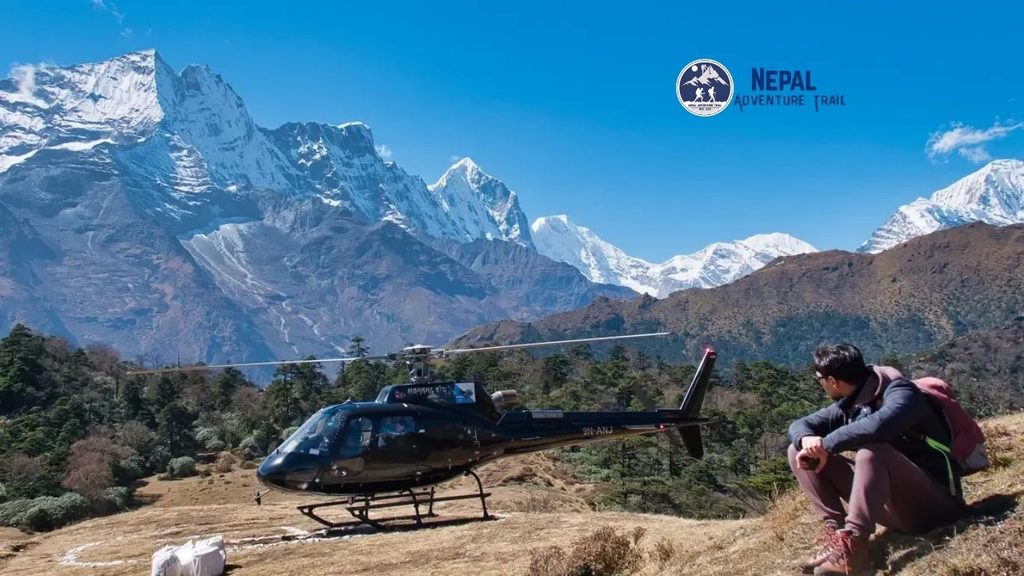
Common Misconceptions
- “I do not need to acclimatise.” You do. The risk is on the climb.
- “The helicopter always lands at Base Camp.” Pickups are usually at Gorak Shep, not Base Camp.
- “It flies regardless of weather.” It does not.
- “The trek is easy.” The ascent is the same.
- “Rescue is included.” A planned return and a rescue are different.
- “Luggage is unlimited.” Payload is limited.
- “It always goes straight to Kathmandu.” Some itineraries route through Lukla.
What to Check Before You Book
- Is the helicopter return included in the price?
- Shared seat or private charter?
- Pickup location, and the final destination (Lukla or Kathmandu)?
- What happens if the helicopter cannot fly?
- Is a trail or fixed-wing alternative available?
- What is the written baggage limit?
- Are permits, TIMS, a licensed guide, domestic flights, meals and lodging included?
- What are the payment and cancellation terms, including weather changes?
- Does your insurance cover altitude and evacuation?
Planning With Nepal Adventure Trail
A local operator can handle itinerary planning, permits, a licensed guide, lodging, domestic transport and helicopter arrangements. Nepal Adventure Trail plans Everest-region itineraries and can talk through schedule length, shared or private return options and contingency plans. The useful question to ask any operator, including this one, is what happens if the helicopter cannot fly.
Frequently Asked Questions
How much does an Everest Base Camp trek with helicopter return cost?
Published packages range from roughly US$2,250 to above US$3,400, depending on operator, comfort and whether the helicopter seat is shared or private. Compare inclusions carefully, including permits, flights and the helicopter segment.
How many days is the Everest Base Camp trek with helicopter return?
Operator itineraries commonly run about 9 to 12 days. Shorter plans leave less acclimatisation margin. Add a buffer day in Kathmandu for weather.
Where does the helicopter pick up trekkers?
Commonly at Gorak Shep, and sometimes Lobuche or Pheriche, depending on the itinerary and conditions. Confirm your pickup point and final destination with your operator.
Can a helicopter land at Everest Base Camp?
Operators describe pickups at nearby points, mainly Gorak Shep, and landings at Kala Patthar have depended on rules and weather. Do not assume a landing at Base Camp.
Is helicopter return guaranteed?
No. Visibility, wind, cloud and aviation clearance decide whether it flies. Ask for the contingency plan in writing.
What happens if the helicopter cannot fly?
You wait for conditions to improve, or arrange an alternative such as walking down to a lower pickup. This can add days, which is why buffer time in Kathmandu matters.
Is the helicopter return safe?
Operators fly under aviation rules and pilots make conservative weather calls, but mountain flying carries real risk. Use licensed operators and carry insurance.
Do I still need to acclimatise?
Yes. Ascent is the same as on the standard trek. Include rest days at Namche and Dingboche, and tell your guide about symptoms early.
Is the trek suitable for beginners?
Possibly, with good fitness, preparation, a guide and proper acclimatisation. It remains a high-altitude trek, and helicopter return does not make it easy.
What permits are required?
Usually a Sagarmatha National Park permit and a Khumbu local fee. TIMS and guide rules are reported differently across sources, so verify with the Nepal Tourism Board or your operator.
What is the best time for an EBC trek with helicopter return?
Spring and autumn are the main seasons, with better visibility for flights. Winter is cold, and monsoon is the most disruption-prone.
What is the difference between an EBC helicopter tour and a trek with helicopter return?
A tour is a short flight from Kathmandu with little or no trekking. A trek with helicopter return involves walking up through Khumbu, with acclimatisation, and flying back.