
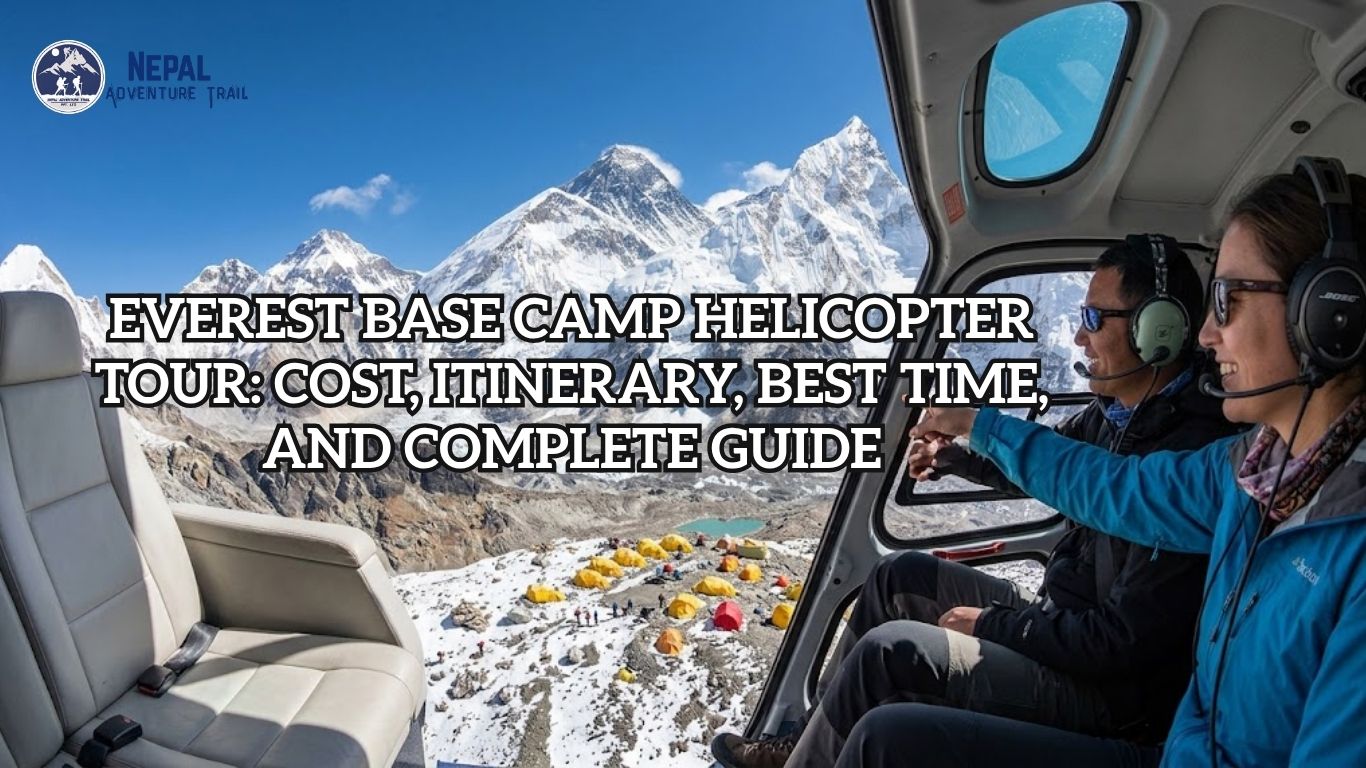
Most people who search for an Everest Base Camp helicopter tour are really asking one question: can I stand near the mountain without spending two weeks walking toward it? The short answer is yes, with a catch that deserves to be understood before you pay a deposit. The tour is named after Base Camp, but helicopters do not land on the Khumbu Glacier where the expedition tents stand. What you get is a flight up the Khumbu valley, a pass over Base Camp, and, depending on current rules and your booking, a landing at a high viewpoint or a lower stop with a long view of Everest.
The appeal is easy to see. A morning departure from Kathmandu, a refuelling stop at Lukla, and a return before lunch put the Himalayan scale within reach of travelers who have a few free days, not a few free weeks. This guide from Nepal Adventure Trail explains how the day unfolds, what affects the price, where the aircraft can and cannot land, how altitude and weather shape the plan, and what to ask before you book.
What Is an Everest Base Camp Helicopter Tour?
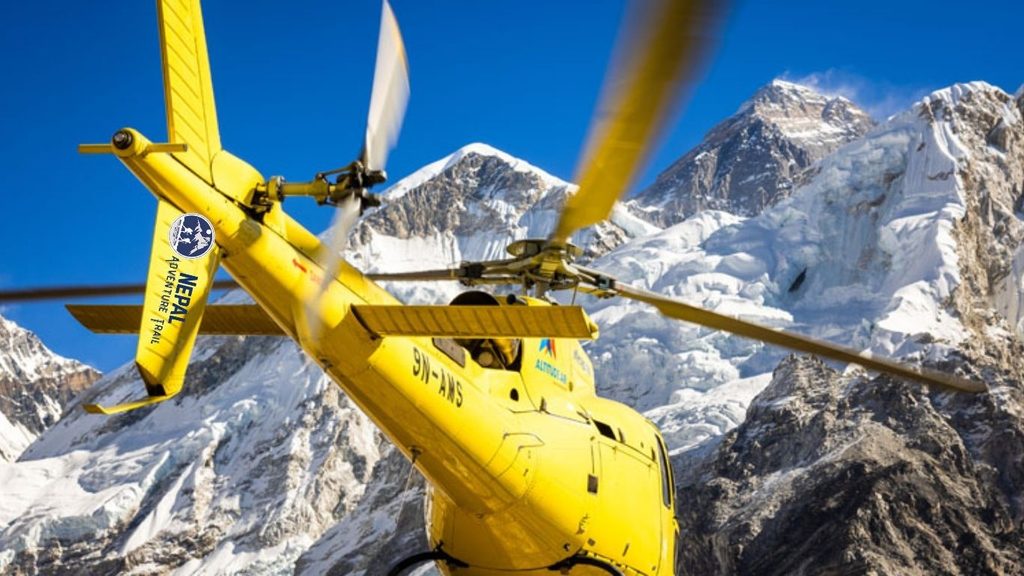
An Everest Base Camp helicopter tour is a one-day scenic flight from Kathmandu into the Khumbu region, the Sherpa homeland on the south side of Mount Everest. Aircraft normally fly east to Lukla, refuel, then continue up the valley past Namche Bazaar, Tengboche and Pheriche toward the Khumbu Glacier, Base Camp and the Kala Patthar ridge. Most itineraries finish with a stop at Hotel Everest View near Syangboche for breakfast, then return through Lukla to Kathmandu.
It helps to separate three things that get blurred in marketing. A sightseeing flight means you see Base Camp from the air. A landing tour adds a short touchdown at a high-altitude point such as Kala Patthar, if rules, weight and weather allow. An actual visit to Base Camp means walking there, which is the trek.
Travelers choose the helicopter for different reasons. Some are short on time. Some cannot manage a multi-day walk at altitude because of knees, health or age. Others simply want the aerial perspective, which shows how the Khumbu valley is laid out in a way trail-level views cannot. On a clear day you can expect Everest, Lhotse and Nuptse standing together, the broken white surface of the Khumbu Icefall, and the terraced villages far below. You cannot expect a guarantee of clear skies, and any operator who offers one is overselling.
Everest Base Camp Helicopter Tour Itinerary
The sequence below is a representative route, not a confirmed Nepal Adventure Trail itinerary. Operators vary the order, and a company’s written itinerary is the one that counts.
Early morning, Kathmandu. Hotel pickup usually happens before dawn, since mountain weather is usually calmer and clearer in the early hours. Expect a short safety briefing and a weight check, which is routine because payload matters at altitude.
Kathmandu to Lukla. The first leg crosses the hills east of the capital and takes roughly the time of a long breakfast. Lukla sits at about 2,860 m, and helicopters commonly refuel here.
Lukla to the upper Khumbu. From Lukla the aircraft follows the trekking corridor: Phakding, Namche Bazaar, the monastery ridge at Tengboche, then Dingboche and Pheriche as the valley opens and the trees give way to rock and ice.
Base Camp and Kala Patthar. Near Gorak Shep the route reaches the highest part of the flight. Everest Base Camp is at roughly 5,364 m and Kala Patthar at about 5,545 m. Depending on rules and passenger numbers, aircraft either fly over both, or land briefly at an approved point. Some operators also use a lower staging point at Pheriche, where heavier groups may be split into smaller shuttle loads.
Hotel Everest View. Many shared and private tours land near Syangboche, at about 3,880 m, for tea or breakfast with a view of Everest, Lhotse and Ama Dablam. This stop is not universal, so confirm that it is in your package.
Return. The helicopter flies back through Lukla to Kathmandu. Most people are back at their hotels by late morning.
Treat every stop as conditional. Weather, aircraft performance, aviation rules and safety decisions by the pilot can change the order, shorten a stop or remove it entirely.
Everest Base Camp Helicopter Tour Cost
Prices vary widely because the product itself varies. Public listings by Nepali operators show shared seats in the range of USD 1,295 to 1,395 per person for a standard day tour, and one operator advertised roughly USD 1,300 per person for a shared tour with a Kala Patthar landing from May 2026. A private charter is a different category. The Kathmandu Post reported in January 2025 that a helicopter tour of about USD 8,000 could carry up to four people as far as Lukla, with only two continuing to land at Kala Patthar. Treat those as industry context from operators and press, not as Nepal Adventure Trail pricing.
What moves the number:
- Shared versus private. A shared flight splits a seat-based price among travelers who may not know each other. A private charter is priced per aircraft, which suits couples, families and photographers who want control over timing.
- Landing versus flyover. A landing at a high-altitude point involves tighter weight limits, shuttle rotations and fees. Flyover-only tours are simpler and usually cheaper.
- Season. Spring and autumn are the busiest windows, and demand shapes availability more than the price list suggests.
- Fees and permits. Entry into Sagarmatha National Park and the local Khumbu Pasang Lhamu Rural Municipality can be priced into a package or charged separately. Ask which.
- Stops and meals. A Hotel Everest View breakfast may be included, or you may pay on arrival.
- Ground transfers. Hotel pickup in Kathmandu is common, but confirm it in writing.
Be careful with “from” prices. A low advertised figure may assume a full shared helicopter, no landing, and extra charges for permits or the breakfast stop. Ask for a quote that states the currency, whether the price is per person or per charter, the group size it assumes, and what is excluded. Nepal Adventure Trail can provide a written quote for your dates and group.
What Is Included in an Everest Base Camp Helicopter Tour Package?
Packages differ, so treat the lists below as questions to ask, not promises.
Often included in published packages:
- Helicopter flight from Kathmandu and return
- Hotel pickup and drop-off in Kathmandu
- Pilot, fuel and landing arrangements
- Breakfast or tea at Hotel Everest View, where the route includes it
- Some or all government and park fees
Often excluded:
- Travel insurance and emergency evacuation cover
- Nepal visa and international airfare
- Personal expenses and drinks beyond those specified
- National park or municipality permits, when not bundled
- Extra costs from itinerary changes, depending on the booking terms
Where an operator says “all fees included,” ask exactly which fees. Where a package says “landing at Kala Patthar,” ask what happens to the price if the landing is cancelled on the day.
What Will You See During an Everest Helicopter Tour?
The view changes as the aircraft gains altitude. Over the lower valleys, the landscape is green and creased, with stone-walled fields, prayer flags and the pale thread of the Dudh Koshi river. Near Namche Bazaar the village curves around its hillside like an amphitheater. Past Tengboche the vegetation thins, and by Pheriche you are above the tree line in a valley of boulders and yak pastures.
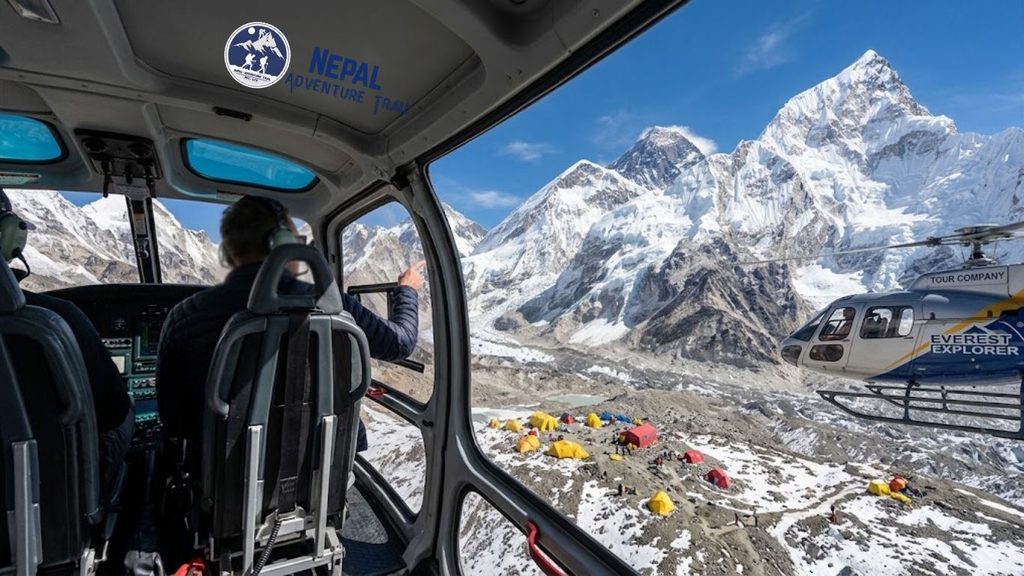
Higher up, the mountains close in. Ama Dablam, often called the most elegant peak in the region, appears as a fluted pyramid. Lhotse and Nuptse form a long wall, and Everest rises behind them, darker than most people expect, since steep rock sheds snow. The Khumbu Glacier runs below like a grey and white road, and in the climbing seasons you may see the colored tents of expedition camps at Base Camp.
Sagarmatha National Park, a UNESCO World Heritage Site, covers much of this terrain. From the air you see the park as a single piece of country, without the trail, the teahouses and the walking that structure the view on foot.
Visibility depends on cloud, haze, wind and the route chosen on the day. Not every peak will be visible on every flight. Pilots choose their lines for safety first, and the best photographs usually come from the right side of the aircraft on the way up, which is worth asking about.
Can a Helicopter Land at Everest Base Camp?
No. Helicopters do not land at Everest Base Camp. The camp sits on the moving ice of the Khumbu Glacier, which is unstable ground with no designated landing area, and the Kathmandu Post has reported that helicopters are allowed to fly over the camp but not to land there. Anyone advertising a Base Camp touchdown deserves a follow-up question.
Kala Patthar is a different place with a different rule. It is a rocky ridge above Gorak Shep, at about 5,545 m, and it offers one of the best views of Everest on the whole trek. It is also higher than Base Camp, so landing there puts you in thin air with little margin for aircraft performance.
The status of Kala Patthar landings is where reliable information gets harder to find. Operator websites disagree. Some say shared landings were restricted for nearly three years and resumed in May 2026 with a two-passenger shuttle from Pheriche. Others say only small private groups may land, and some say commercial landings are not permitted at all. We could not find a single current official notice that settles it. Until you see one, treat any Kala Patthar landing as conditional on aviation rules, local permission, aircraft weight and weather. A landing, if it happens, usually lasts about 5 to 15 minutes.
Before you book, ask the operator three things in writing: whether a Kala Patthar landing is currently permitted for your group size, what the alternative is if it is not, and how the price changes in that case. The Civil Aviation Authority of Nepal publishes aviation information, and a reputable operator should be able to explain the basis for what it promises.
If the landing is not available, the tour usually becomes a flyover with a landing at Pheriche or near Hotel Everest View. That is still a strong day, but it is a different product from one that stops on the ridge.
How Long Does an Everest Base Camp Helicopter Tour Take?
Operators describe the tour as taking about three to five hours door to door, and the variation is real. The time in the air is shorter than the total. Pickup, briefing, refuelling at Lukla, a landing or breakfast stop, and the return all add up. Weather holds, queueing for shuttle rotations and extra time at a viewpoint can stretch the day.
Treat the advertised duration as an estimate. A shared departure with a Pheriche shuttle takes longer than a private flyover. Ask your operator for the expected departure time and the latest realistic return, particularly if you have a flight out of Kathmandu the same day. Leave a generous buffer.
Best Time for an Everest Base Camp Helicopter Tour
Spring (March to May). Warmer, with long daylight and a climbing season in progress at Base Camp. Haze can build in the afternoon and soften distant views, so early flights matter. Rhododendrons flower on the lower slopes in April.
Autumn (September to November). Often the clearest stretch after the monsoon, with crisp air and sharp views. It is also the busiest period, so book early. October tends to be the most sought-after month.
Winter (December to February). Cold, dry and often clear in the morning, with fewer visitors. Snow cover is deeper and wind can be severe at altitude, which sometimes limits landings.
Monsoon (June to August). Cloud and rain frequently hide the mountains, and flights are more likely to be delayed or cancelled. Breaks occur, but they are less predictable.
No month offers certainty. Himalayan weather changes by the hour, and the pilot’s decision on the day outranks any seasonal pattern. If your dates are fixed, build one spare day into your Kathmandu schedule so a delayed departure can be rescheduled. If your dates are flexible, aim for the autumn or spring windows and fly in the morning.
Is the Everest Base Camp Helicopter Tour Safe?
Helicopter flight in the Himalayas carries real risk, and no operator can honestly call it risk-free. The terrain is steep, the air is thin, winds shift quickly, and clouds can fill a valley within minutes. Pilots work within weight and altitude limits, which is why passengers are weighed and why heavier groups may be split into shuttle flights.
Several things reduce risk in practice: flying early, accepting a change of route or a cancelled landing without argument, following the crew’s instructions around the aircraft, and choosing an operator that is open about its aviation partner, aircraft type and cancellation policy. Ask who the helicopter operator is, whether the pilot is experienced in high-altitude operations, and what the plan is if weather closes the route.
Nepal Adventure Trail can explain which aviation partners and procedures apply to a specific booking. Always confirm those details before you pay, and read the cancellation terms with the same attention you give the itinerary.
Altitude Sickness and Health Considerations
A helicopter tour shortens the walk, not the altitude. You can go from Kathmandu at about 1,400 m to over 5,500 m in a couple of hours, with none of the gradual acclimatization that trekkers get. That is why landing times are kept short.
Possible symptoms include headache, nausea, dizziness, shortness of breath and unusual tiredness. Most travelers feel little on a brief stop, but some feel unwell quickly. Tell the crew immediately if you do, and do not push on to finish a viewpoint stop. Descending is the treatment that works.
People with heart or lung conditions, high blood pressure, anemia, pregnancy, or any condition that affects oxygen use should speak to a doctor before booking. Ask the operator whether supplemental oxygen is carried on board. For general guidance on altitude illness, the CDC’s travel health pages are a reliable starting point.
What to Pack and Wear for an Everest Helicopter Tour
Kathmandu at 6 a.m. and a ridge at 5,500 m are different climates. Dress in layers you can add or remove:
- A warm base layer and a fleece or light down jacket
- A windproof outer shell
- Gloves and a warm hat, since wind chill at altitude is sharp
- Sunglasses with good UV protection, plus sunscreen and lip balm
- Comfortable closed shoes with grip for uneven ground
- A camera or phone with a fully charged battery and a spare, since cold drains batteries
- Personal medication, passport and insurance details
- A small soft bag, because baggage space and weight are limited
Avoid bringing anything loose that could blow around near the rotors, and check the operator’s baggage limit.
Everest Base Camp Helicopter Tour vs Everest Base Camp Trek
| Helicopter tour | Base Camp trek | |
|---|---|---|
| Time | One day | Roughly two weeks, depending on route |
| Effort | Minimal walking | Daily walking at rising altitude |
| Acclimatization | None, brief exposure | Gradual, built into the route |
| Cost structure | One higher fee for the flight | Spread across guides, permits, lodging and meals |
| Culture | Very limited contact | Nights in Sherpa villages, monasteries, teahouses |
| Views | Aerial, wide, short | Ground-level, changing, extended |
Neither option is better in itself. The helicopter gives a fast overview of the region and a view of the whole valley at once. The trek gives you the texture of the place: the suspension bridges, the smell of juniper smoke, the conversations in teahouses, the slow arrival at a mountain you have watched grow for days. Time, budget, fitness and what you hope to feel on the day should decide.
There is also a middle option. Some travelers walk to Base Camp and fly back by helicopter from Gorak Shep, which keeps the walking but saves the return days. The environmental trade-off is worth considering too. Helicopter flights have a higher carbon footprint per person than walking, and noise affects the quiet of the valley. A responsible operator will coordinate flights to limit unnecessary movements.
Who Should Choose an Everest Base Camp Helicopter Tour?
The tour suits travelers with a short stay in Nepal who want a Himalayan experience alongside Kathmandu sightseeing. It also suits people who cannot trek because of health, mobility or age, couples and honeymooners who want a private flight, photographers who value the aerial perspective, and families with older children, subject to the operator’s requirements.
It is less suitable for anyone with a serious heart, lung or blood condition, for young children, and for travelers who need certainty of outcome. Weight limits, health conditions and the operator’s own rules may exclude some passengers. If you are unsure, ask before booking, not at the airport.
Why Book Your Everest Helicopter Tour with Nepal Adventure Trail?
A helicopter tour depends on coordination: the aircraft, the permits, the pickup, the weather decision and a clear explanation of what changes when conditions change. Booking through a local company means you have someone in Nepal who can answer practical questions, confirm what your package includes and tell you quickly if a departure is moved.
Nepal Adventure Trail works with trekking and tour travelers across Nepal, and can help match the flight to your dates, group size and plans before and after, such as an Everest-region trek or a Kathmandu stay. Ask for the written itinerary, the inclusions and exclusions, the cancellation terms and the current landing arrangements, then compare them with any other quote you receive.
When you are ready, contact the team with your travel dates, group size and whether you want a shared or private flight, and request current availability and pricing.
Frequently Asked Questions About the Everest Base Camp Helicopter Tour
How much does an Everest Base Camp helicopter tour cost?
Published shared-seat prices from Nepali operators sit roughly between USD 1,295 and 1,395 per person, while private charters are priced per aircraft and cost considerably more. The final figure depends on the group size, the season, whether a landing is included, and which permits and meals are bundled. Ask for a written quote that names the currency, the basis of the price and every exclusion before you pay a deposit.
Can you land at Everest Base Camp by helicopter?
No. Helicopters can fly over Base Camp but do not land there, because the camp sits on shifting glacier ice. Some tours land at Kala Patthar or at lower points such as Pheriche or near Hotel Everest View, depending on current rules, group size and weather. Confirm in writing which landing applies to your booking and what happens if it is not possible.
How long is the Everest Base Camp helicopter tour from Kathmandu?
Most operators describe the full day as about three to five hours from hotel pickup to return, with the actual flying time being shorter. Refuelling at Lukla, a breakfast stop, shuttle rotations and weather holds all affect the total. Avoid scheduling an onward flight on the same day, and keep your schedule flexible.
What is the best month for an Everest helicopter tour?
Autumn, especially October and November, is often the clearest, and spring offers warmer air and a busy climbing season. Winter is cold and often clear in the mornings, while the monsoon brings more cloud and cancellations. No month guarantees good weather, so early flights and a spare day matter more than the calendar.
Is the Everest Base Camp helicopter tour safe?
It carries real risks from altitude, wind and mountain weather, and nobody can promise absolute safety. Reputable operators fly early, respect weight limits, follow the pilot’s decisions and cancel when conditions are poor. Ask about the aviation partner, the pilot’s high-altitude experience, the cancellation policy and the emergency plan before you book.
Can you see Mount Everest during the helicopter flight?
Usually, yes, on a clear morning, but it is not guaranteed. Everest often sits behind the Lhotse and Nuptse wall, so the best views come from the upper valley near Kala Patthar and Pheriche. Cloud and haze can hide it, and the pilot’s route choice is made for safety first. Flying early improves the odds.
Is altitude sickness possible during a helicopter tour?
Yes. You climb from about 1,400 m to well over 5,000 m in a short time without acclimatizing, so headache, nausea or dizziness can appear even on a brief stop. Tell the crew straight away if you feel unwell. If you have a heart, lung or blood condition, speak to a doctor before booking.
Does the tour include breakfast at Hotel Everest View?
Many packages include a stop near Syangboche for breakfast or tea at Hotel Everest View, but not all do, and some charge separately. The stop also depends on weather and operations. Check your itinerary and inclusions to see whether the meal is paid for and whether the stop can be replaced if conditions change.
What happens if the helicopter tour is cancelled due to bad weather?
Operators usually offer to reschedule to the next day, or to refund in whole or part, but terms differ. Ask in advance what the policy is, how much notice is given, and whether any costs, such as an extra hotel night, fall on you. Keep a spare day in your Kathmandu plans.
Is a private Everest helicopter tour better than a group tour?
It depends on your priorities. A private charter gives you control over timing and a quieter experience, and it may allow a landing where group rules do not, but it costs far more. A shared flight is cheaper but fixes the schedule and the passengers. Compare the written terms of each, particularly on landings and weight limits.
What should I wear for an Everest helicopter tour?
Wear layers: a warm base, a fleece or light down jacket, and a windproof shell. Bring gloves, a hat, sunglasses and sunscreen, and shoes with grip. Temperatures at a high stop can be far below those in Kathmandu, and wind chill is strong. Pack light, since baggage is limited, and keep your camera battery warm.
Do I need travel insurance for an Everest Base Camp helicopter tour?
Yes, buy it. Standard policies often exclude high-altitude activities, so check that yours covers flights and emergency evacuation to the altitudes involved. Operators commonly list insurance as an exclusion. Keep your policy details and emergency contact number with you, and ask your insurer in writing if you are unsure.
Conclusion
An Everest Base Camp helicopter tour compresses a trek that normally takes weeks into a single morning. It will not replace walking the valley, and it will not put you on Base Camp’s ice, but it can give you a clear, wide view of the highest country on earth within a day. The best experiences come from realistic expectations: a flexible schedule, an early flight, a plain answer about landings, and an operator who explains what changes when the weather does. To check current availability, pricing and landing arrangements, contact Nepal Adventure Trail with your dates and group size.