
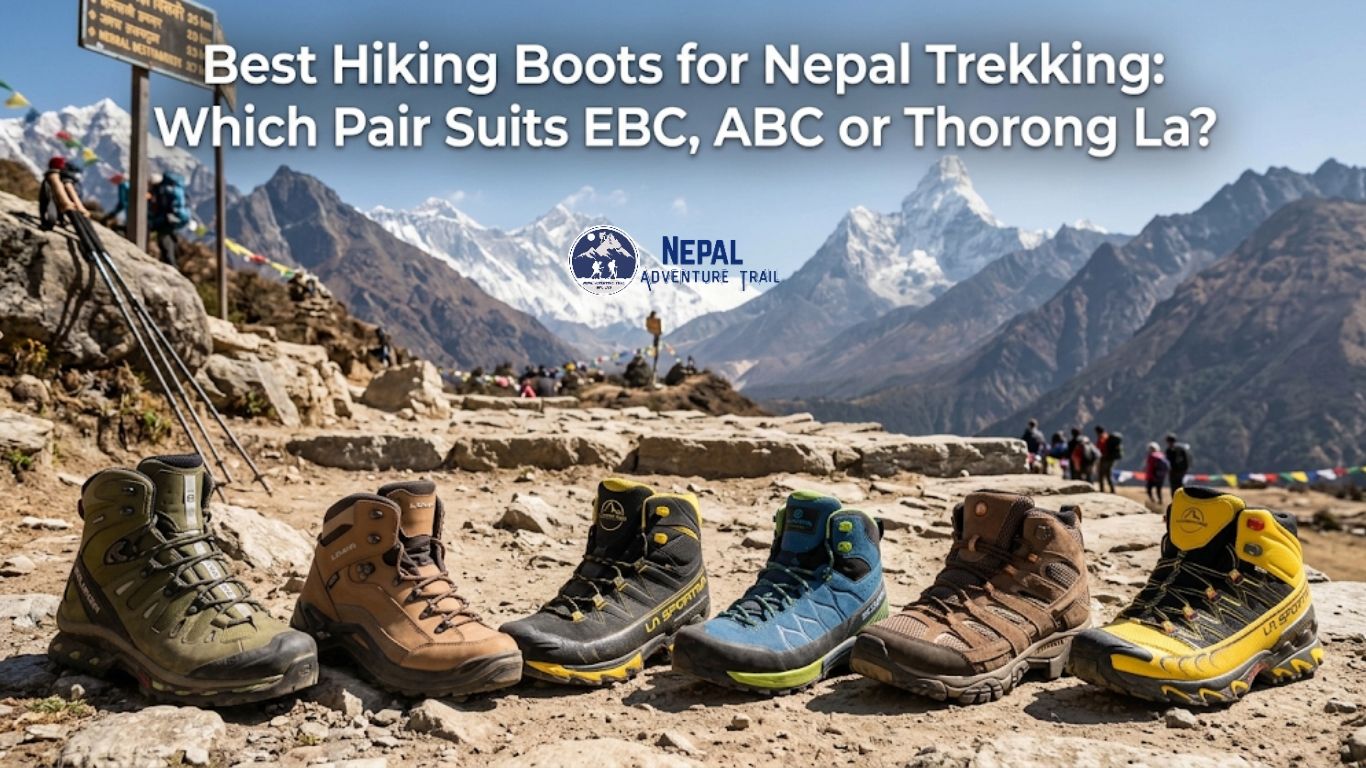
Day four on the Everest Base Camp trail is usually where a boot decision shows up. Stone staircases out of Namche. Loose moraine near Lobuche. A long descent with a sore toenail and a loaded daypack. Boots that felt fine in a shop can feel very different after six hours on that ground.
Nepal’s trails vary more than most trekkers expect. Stone steps, rocky paths, mud, rain on lower sections, and in some seasons snow or ice near the high passes. What works on an April walk to Poon Hill will not automatically work on the Thorong La crossing in a cold snap. The best hiking boots for Nepal trekking depend on your route, season, pack weight and, above all, your feet. They do not depend on price. A premium boot that does not fit is a worse choice than a mid-priced one that does.
This guide compares six verified models, matches boots to routes, and covers fit, waterproofing, break-in and foot care. Nepal Adventure Trail wrote it for travelers who want to buy once and walk well.
How These Boots Were Compared
Nepal Adventure Trail has not tested these boots on its treks, and nothing below claims firsthand testing. Specifications come from manufacturers and retailers. Opinions on comfort, grip and breathability come from independent reviewers, including OutdoorGearLab, Switchback Travel, CleverHiker and Section Hiker. Prices are US retail figures from reviews and retailer listings, checked in October 2026, in US dollars unless stated. They shift with sales, sizes and markets. Local availability in Nepal has not been confirmed for any model.
Quick Comparison of the Best Hiking Boots for Nepal Trekking
| Boot model | Best for | Main advantage | Main limitation | Approximate US price |
|---|---|---|---|---|
| Salomon Quest 4 GTX | Heavier packs, long days | Supportive chassis, reliable grip per reviewers | Runs warm in mild weather | About $230 |
| LOWA Renegade Evo GTX Mid | Structured leather comfort on rocky trails | Durable leather, Vibram sole | Clunky on easy ground per reviewers, higher price | About $280 |
| La Sportiva Nucleo High II GTX | Mountain terrain at moderate weight | Traction and support for its weight | Runs narrow per reviewers | $239 to $259 |
| Scarpa Zodiac Plus GTX | Long loaded days, premium budget | Supportive yet light per reviewers | Highest price here | $349 list |
| Merrell Moab 3 Mid Waterproof | First-time trekkers, tight budgets | Out-of-box comfort, low price | In-house membrane, not Gore-Tex | About $145 to $150 |
| La Sportiva Ultra Raptor II Mid GTX | Light packs, fast pace | Trail-runner feel with a mid collar | Less structure under heavy loads | About $220 |
Fit and suitability matter more than brand prestige. Two people can walk the same trail and need different boots.
The Best Hiking Boots for Nepal Trekking: Detailed Reviews
Salomon Quest 4 GTX
Verdict: a supportive midweight boot for loaded packs and long days.
Salomon built the Quest 4 around a chassis that wraps the heel and guides the foot, aimed at heavy packs and tired legs. It has a Gore-Tex lining, a leather and textile upper and a 12 mm drop, listed at 655 g per boot. Switchback Travel found the grip reliable in mud and loose rock, and found it runs hot in summer-like conditions.
It suits trekkers carrying their own pack on long Annapurna Circuit or Manaslu days in cooler months. It is more boot than a short, warm trek needs. Choose it over the Moab if you want more structure under a loaded pack. About US$230.
LOWA Renegade Evo GTX Mid
Verdict: a classic leather boot, revised with fewer seams.
The Renegade Evo has a Gore-Tex lining, a Vibram sole, a mid-height cut and a PU Monowrap frame. Retailers list roughly 1.1 to 1.2 kg per pair. REI positions it for day hikes and shorter backpacking trips. OutdoorGearLab liked the stable ride and noted a clunky feel and a high price.
It suits teahouse trekking on rocky paths where you want a structured boot, such as the Everest Base Camp trail in cooler months. Leather usually needs more break-in. Choose it over the Quest if you prefer a traditional leather feel. About US$280.
La Sportiva Nucleo High II GTX
Verdict: mountain-style traction without a heavy boot.
This nubuck boot has a Vibram sole and Gore-Tex Surround lining. OutdoorGearLab measured 2.41 lb per pair, praised traction and waterproofing, and noted it runs narrow. Section Hiker called it supportive for its weight.
It suits trekkers who want traction on steep, rocky ground without a bulky boot, and whose feet suit La Sportiva’s shape. Try it on before committing. Choose it over the Quest if lower weight matters more than padding. MSRP US$239, with REI listing US$259.
Scarpa Zodiac Plus GTX
Verdict: a premium boot that balances support and low weight.
The Zodiac Plus is a high-top suede boot with Gore-Tex and a rubber rand. Scarpa describes it as a softer, more flexible version of its mountaineering-oriented Zodiac Tech, and lists 545 g per boot in size 42. Switchback Travel notes it has no shank and fits true to size, and found it comfortable on high-mileage days with a heavy load.
It is the most expensive here, and it is a flexible hiking boot, not a mountaineering boot. Choose it over the Renegade if weight matters. US$349 list, with discounts varying by retailer.
Merrell Moab 3 Mid Waterproof
Verdict: the budget pick for first-time trekkers.
The Moab 3 Mid Waterproof has a suede and mesh upper, Merrell’s own waterproof membrane and a Vibram TC5+ outsole, listed around 2 lb per pair. Switchback Travel praised out-of-box comfort and quick break-in. GearJunkie noted it is not as waterproof as the Gore-Tex version and runs warmer. Merrell also sells a GTX and a non-waterproof version, so check the exact name.
It suits Poon Hill, Mardi Himal and Annapurna Base Camp style routes. About US$145 to US$150, and CAD 149.99 on Merrell’s Canadian site in July 2026.
La Sportiva Ultra Raptor II Mid GTX
Verdict: a light, agile boot for lighter loads.
This all-synthetic mid-cut boot comes from La Sportiva‘s mountain running line, with Gore-Tex Extended Comfort and a listed 470 g per boot for men. CleverHiker found it agile and narrow, and a wide version exists. OutdoorGearLab found it supportive for its weight.
It suits experienced hikers with light packs on well-formed trails. It has less structure than the leather boots above, so heavy loads and long descents will tax it more. Choose it over the Moab if you want less weight and can afford the price. About US$220.
Which Hiking Boots Are Best for Different Treks in Nepal?
These are starting points, not rules. Conditions change, and two trekkers on one trail can need different boots.
Everest Base Camp. Days of stone steps, moraine and cold mornings. A mid-cut boot with good grip and a sensible toe box suits most standard itineraries. They do not require technical mountaineering boots. Operators commonly advise carrying microspikes for icy sections near Lobuche and Gorak Shep in cold or early-season conditions.
Annapurna Base Camp. Thousands of stone steps, forest trail and mud. Comfort, grip and moderate weight matter more than stiffness. Check recent trail conditions for the season.
Annapurna Circuit and Thorong La. The pass reaches 5,416 m. Operators describe it as non-technical in normal conditions, with ice and frozen snow common on the pre-dawn approach, and microspikes often recommended. Heavy snow can close it. The 2014 storm on this pass is a reminder that weather turns quickly. Ordinary boots are not automatically enough for every pass day.
Manaslu Circuit. Long days and varied ground, with Larkya La above 5,000 m. Choose durable, supportive boots and plan for possible snow.
Langtang Valley and Mardi Himal. Many trekkers do well in comfortable mid-cut boots. Experienced hikers may prefer lighter footwear. Langtang trail access has been affected by the August 2026 Rasuwa flooding, so check current status before planning.
Ghorepani Poon Hill and shorter treks. Lightweight boots or trail runners can be sensible on lower, shorter, well-maintained routes.
Hiking Boots vs Hiking Shoes vs Trail Runners for Nepal
| Hiking boots (mid or high) | Hiking shoes (low) | Trail runners | |
|---|---|---|---|
| Weight and comfort | Heaviest, most structure | Lighter | Lightest |
| Ankle coverage | Most coverage, keeps debris out | None | None |
| Underfoot protection | Usually stiffer midsole | Moderate | Varies, often softer |
| Grip | Depends on outsole | Depends on outsole | Often good, varies on wet stone |
| Drying and breathability | Slower, especially waterproof | Faster | Fastest |
| Wet or cold | More protection if waterproof | Less | Least |
| Heavy packs, long descents | Most support | Less | Less, best with light loads |
| Snow and ice | Can take microspikes, check fit | Limited | Limited |
Ankle coverage alone does not prevent injury. Fit, strength, balance, terrain and technique matter too. Trail runners are not unsafe by default, and boots are not essential on every Nepal trek. Experienced hikers on suitable routes may prefer lighter footwear, while others benefit from more protection.
What to Look for When Buying Trekking Boots for Nepal
Fit and toe room. You need space for the toes on long descents, a secure heel and a comfortable midfoot. Feet often swell over a long day, and some trekkers notice swelling at altitude. Try boots on late in the day with your trekking socks. Do not automatically buy half a size up. Check that your toes do not hit the front on a downhill ramp and that your heel stays put.
Waterproofing and breathability. Gore-Tex and similar membranes help with rain, wet trails and snow. They also run warmer and dry slowly if water enters over the collar. Waterproof does not mean dry in every situation.
Grip and outsole. Tread pattern, rubber compound and wear all affect traction on wet stone, mud and loose gravel. No outsole brand guarantees grip everywhere.
Ankle support and stiffness. Flexible shoes, mid-cut boots and stiffer boots suit different terrain, loads and preferences. Taller boots do not remove ankle injury risk.
Weight. Small differences add up over many days of walking. Structure and durability cost some weight.
Warmth. Waterproofing is not insulation. Standard hiking boots may be inadequate for prolonged severe cold or technical alpine terrain.
Are Waterproof Hiking Boots Necessary for Nepal Trekking?
Not for every trek. Autumn is usually dry, though mornings can be wet and passes can hold snow. Spring brings showers on lower sections. The monsoon means mud and rain on lower trails. Cold shoulder seasons bring snow and frozen ground.
Waterproof boots help with wet trails, rain and snow. Breathable, fast-drying footwear can suit warm, dry routes. No boot compensates for poor socks, a bad fit or thin preparation. Wet feet from sweat are as common as wet feet from rain.
How Much Should You Spend on Hiking Boots for Nepal?
The models here run from about US$145 to US$349 (US retail, October 2026). Value depends on fit, intended use, durability, repairability and how many trips you will use them for. Check whether a maker offers resoling. A well-fitting mid-range boot can beat an expensive boot that does not fit. Do not read these as Nepal retail prices. Stock and prices for imported footwear in Nepal vary.
Should You Buy Hiking Boots Before Arriving in Nepal?
Usually, yes. Buying at home gives you a wider range of sizes and widths, and weeks to test the boots. Several trekking resources, including Nepal Traveller and KimKim, advise bringing boots from home.
Thamel and Pokhara have many gear shops. Switchback Travel and others warn that counterfeit branded gear is common in Thamel, with weaker stitching and fit differences. It lists official brand stores on Tridevi Sadak. If you buy locally, check authenticity, fit, quality and return terms first. Some operators say boots can be rented, but fit and hygiene are better served by buying. Rent poles and bulky down items instead.
How to Break In Hiking Boots Before Your Nepal Trek
Break-in needs vary. Some modern boots need little, and stiffer leather models need more.
- Start with short walks and build distance and elevation.
- Test on stairs, uneven ground and descents.
- Wear the socks you will trek in, and carry your trek pack where possible.
- Note pressure points, heel movement and toe contact.
- Fix problems before departure.
- Check the outsole, laces and overall condition.
A long trek is a poor place to learn that boots do not suit your feet.
Socks, Blister Prevention and Foot Care on the Trail
Moisture and friction cause most trouble.
- Choose comfortable, moisture-managing trekking socks.
- Carry a spare pair.
- Keep feet as dry as conditions allow.
- Tighten laces before steep descents.
- Treat hot spots early.
- Check for rubbing, pressure and damaged skin.
- Let boots and socks dry overnight where you can.
No sock or blister product prevents every blister.
Are Regular Hiking Boots Enough for Snowy High Passes and Peak Climbing?
It depends on which of three situations you are in.
Teahouse trekking. Good hiking boots are normally enough for the main routes.
High passes with possible snow or ice. Thorong La, Cho La and Larkya La can need more. Microspikes slip over boots for icy sections. Crampons need a stiffer boot, and compatibility varies by boot and device, so verify it for yours. Warmth and stiffness matter more here.
Technical mountaineering. Island Peak, Mera Peak and similar objectives typically call for specialist mountaineering boots, crampons and other equipment. Ordinary waterproof hiking boots are not automatically suitable. Requirements depend on route, season and conditions, so confirm with your operator.
Common Mistakes to Avoid When Choosing Hiking Boots for Nepal
- Buying by brand popularity instead of fit
- Wearing new boots on day one of a multi-day trek
- Choosing boots too tight in the toes
- Buying heavy boots for an easy trek
- Assuming waterproof boots suit every climate
- Ignoring worn tread or damaged soles
- Assuming a high collar prevents injury
- Using ordinary boots for technical climbing
- Skipping tests with trekking socks and a loaded pack
The costliest ones are untested boots and tight toes. Both show up on descents, usually as blisters and bruised toenails, and both are avoidable.
Final Verdict: Which Hiking Boots Should You Choose for Nepal?
There is no single winner, which is why the best hiking boots for Nepal trekking depend on who is wearing them.
- First-time trekkers: a comfortable, fitting mid-cut boot such as the Moab 3 Mid, or a step up if budget allows.
- Everest Base Camp: a supportive mid-cut boot with good grip and toe room, such as the Quest 4 or Renegade.
- Annapurna or Manaslu circuits: more structure, possible microspike compatibility, and warm socks.
- Budget buyers: the Moab, tried on and broken in.
- Experienced lightweight hikers: the Ultra Raptor II Mid, on suitable routes.
- Snow, ice or technical climbing: confirm requirements with your operator before buying.
Fit, route suitability and preparation should drive the decision more than price or brand. If you are planning a trek with Nepal Adventure Trail, tell the team your route, season and any footwear questions while you prepare.
Frequently Asked Questions
What are the best hiking boots for Nepal trekking?
It depends on your route, pack weight and feet. The Salomon Quest 4 GTX and LOWA Renegade Evo GTX Mid suit structured, supportive trekking. The Merrell Moab 3 Mid suits budgets and first treks. The Ultra Raptor II Mid suits light packs. Try several on with trekking socks.
Which boots are best for Everest Base Camp?
A comfortable mid-cut boot with good grip, a secure heel and room for the toes. Standard Everest Base Camp itineraries do not require mountaineering boots. Microspikes are commonly advised when icy sections appear near Lobuche and Gorak Shep, so check conditions for your dates.
Do I need waterproof hiking boots in Nepal?
Not always. Waterproof boots help in rain, mud and snow. Breathable, fast-drying footwear can suit dry, warm routes. They also run warmer and dry slowly if water enters over the collar. Match the choice to season and route.
Are trail runners suitable for trekking in Nepal?
They can be on shorter, lower, well-maintained routes, especially with light loads and experienced legs. They give less ankle coverage, structure and warmth than boots, and feet get wet faster. For long, loaded or cold treks, many trekkers prefer boots.
What boots should I wear for the Annapurna Circuit and Thorong La?
Durable, supportive boots with warm socks, and microspikes in your kit if ice is possible. Conditions change fast on the pass, and heavy snow can close it. Ordinary boots are not automatically enough for every pass day, so check recent conditions.
Are expensive hiking boots worth buying for Nepal?
Only if they fit and suit your route. A well-fitting mid-range boot often beats a premium boot that rubs. Price can buy durability, lower weight or repairability, which matter if you will use them again. Fit comes first.
Should I buy trekking boots before arriving in Kathmandu?
Usually, yes. At home you have more sizes and widths and time to break them in. If you buy in Kathmandu, check authenticity, fit and returns first, because counterfeit branded gear is common in Thamel.
Can I rent hiking boots in Nepal?
Some operators say rental is possible. Fit and hygiene make buying a better choice for boots. Renting suits poles, down jackets and sleeping bags more. Confirm any rental with your trekking company before you rely on it.
How long before my trek should I break in my boots?
There is no universal number. Start weeks ahead with short walks, then add stairs, descents and a loaded pack. Modern lighter boots may need little, and stiff leather needs more. If a boot still rubs after sensible testing, replace it.
How much toe room should hiking boots have?
Enough that your toes do not hit the front on steep downhill ramps, with a heel that stays secure. Try them on late in the day with trekking socks. Do not automatically size up half a size, since too much space also causes rubbing.
Are mid-cut boots enough for high-altitude trekking?
For standard teahouse routes, usually yes. Mid-cut boots with sensible grip work on many treks. Cold, snow, ice and high passes can need more warmth and stiffness, and technical climbing needs mountaineering boots. Check requirements for your specific route and season.
Can I use regular hiking boots for peak climbing?
Usually not. Peaks such as Island Peak and Mera Peak typically need specialist mountaineering boots, crampons and other equipment. Ordinary waterproof hiking boots are not automatically suitable. Confirm requirements with your operator before you buy anything.