
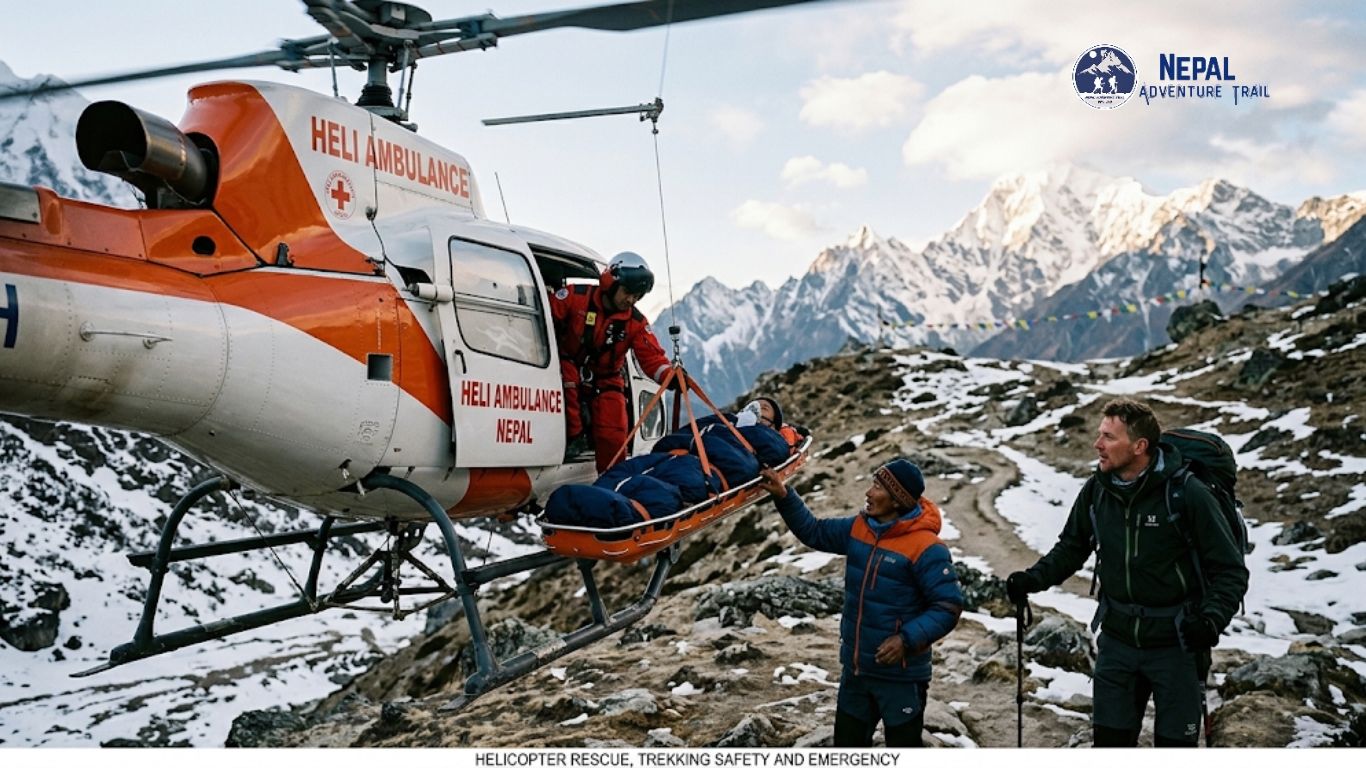
Most trekkers in Nepal never need a helicopter. A few do. The day it happens usually starts the same way: a headache that will not shift, a cough that has changed, an ankle that will not take weight, and a village hours from the nearest road.
Nepal’s trails cross some of the most remote country a traveler can walk. Lodges thin out above 4,000 metres. Weather turns within the hour. Hospitals sit days away on foot. In that setting a medical problem behaves differently than it does in a city, and the simple answer, get to a clinic, is not simple at all.
That is where the phrase Heli Ambulance Nepal comes from. Travelers use it for helicopter evacuation, a flight that moves a seriously ill or injured trekker toward medical care when conditions allow. Those last three words carry the weight. Helicopters do not reach every trail at every hour, and a rescue flight is not a hospital in the sky.
This guide explains how helicopter rescue works in Nepal, what it costs, where insurance fits, what the 2026 fraud investigation changed, and what to ask a trekking company before you book. It makes one point early. The best emergency plan starts before the trek, with a sensible itinerary, honest acclimatization and a guide you trust.
What Does Heli Ambulance Nepal Actually Mean?
In everyday use, “heli ambulance” is a loose label. Trekkers, lodge owners and agents apply it to any helicopter flight that carries a sick or injured person out of the mountains. It is not a regulated category with one fixed meaning, and the aircraft and crews behind it vary.
The differences matter, because each term carries different assumptions about crew, cost and insurance.
| Term | What it means | What it does not guarantee |
|---|---|---|
| Helicopter rescue | Reaching and lifting a person from a remote or difficult location, where terrain and weather allow | A doctor or medical equipment on board |
| Medical evacuation | Moving a patient to a suitable medical facility when evacuation is necessary and feasible | That the transport is a helicopter |
| Dedicated air ambulance | An aircraft configured or staffed for medical transport, where such a service exists | That one is available at trek altitude in your location |
| Helicopter charter | A paid transport flight | That it counts as a rescue or will be reimbursed |
| Scenic flight | A sightseeing service | Any emergency capability |
In practice, many trekking evacuations are flown by charter operators. First care before and during the flight often comes from the guide, a lodge, or a seasonal medical post. Some services do add a doctor or paramedic. Do not assume it. Ask any provider what crew, oxygen and equipment travel on the flight.
The right service depends on the patient’s condition, the location, the aircraft available, the landing site and the weather. A sightseeing flight to Everest Base Camp and a rescue flight from the same area are different products, even if they look alike on a booking page.
Why Helicopter Rescue Matters During Trekking in Nepal
Distance is the first problem. Many trekking regions have no road access to the high settlements. A walk that takes a fit person three days up can take a sick person much longer down, and descent on foot is not always safe.
Altitude is the second. Illness at height can worsen over hours. Weather and communication are the third and fourth: cloud closes valleys, mobile coverage drops out, and a message that would take seconds in a town can take half a day to arrive.
The range of problems is wider than altitude alone. A study of the Himalayan Rescue Association aid post at Manang across the autumn 2023 season found infectious disease made up 42 percent of cases and altitude illness 16 percent. The authors also noted that limits in medical evacuation options were among the challenges of providing care there.
A helicopter can shorten the time to treatment in the right circumstances. It is not always available, and it is not always the right medical choice. For severe altitude illness, going down is the treatment that works. A helicopter is one fast way to go down. Walking down, or moving to a lower lodge, can be another.
Helicopter rescue is a backstop. It does not replace pacing, acclimatization or a guide who listens when a trekker says something feels wrong.
How Does Helicopter Rescue Work in Nepal?
Nepal has historically had no single centralised dispatch center for rescue flights, and the government has proposed a digital rescue management system that would link trekker registration, rescue requests and insurance verification. Procedures differ by region, operator, insurer and situation. Treat the steps below as a general pattern, not a fixed protocol.
Step 1: Recognizing and Reporting the Emergency
It starts when a trekker or group member notices something wrong and tells the guide. Say it early. Severe headache combined with other altitude symptoms, unusual confusion, stumbling, breathlessness at rest, a serious fall, or an injury that stops safe movement all justify an immediate report. Trekkers should not try to diagnose themselves. Their job is to report symptoms honestly and not hide them to protect the itinerary.
Step 2: Initial Assessment and Immediate Assistance
The guide or other trained personnel assess the situation, give first aid within their training, and keep watching the patient. If a Himalayan Rescue Association aid post or another clinic is within reach, they may seek advice there. If symptoms point to severe altitude illness or another life-threatening condition, action starts now. Nobody waits for a helicopter booking to be completed before descending or giving basic care.
Step 3: Contacting the Relevant Emergency Support
Depending on the circumstances, the guide may contact the trekking company, the insurer’s emergency assistance line, a helicopter operator, a lodge, or a medical post. Many insurers require the assistance provider to be contacted before a flight is arranged, and arranging one independently can complicate a claim. There is no single universal hotline. Learn the order of calls for your own policy and company before you leave Kathmandu.
Step 4: Assessing Evacuation Feasibility
Medical urgency, the patient’s location, weather, visibility, altitude, aircraft availability and landing conditions all shape the decision. A flight may be delayed until the cloud lifts, or refused. Some locations have no safe landing site, which can mean moving the patient to one.
Step 5: Arranging Transport and Medical Care
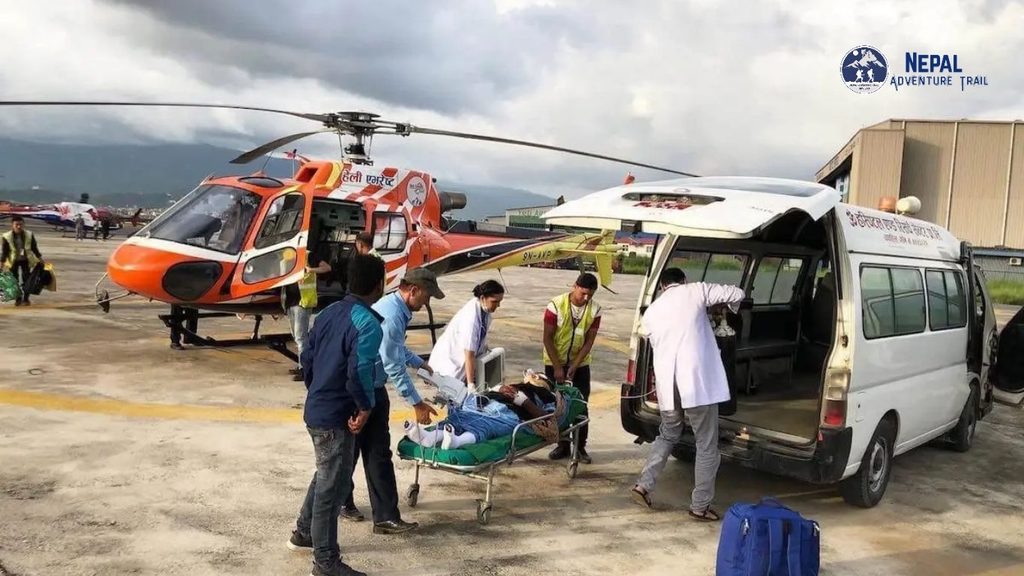
If evacuation is approved and feasible, the parties coordinate the flight and the receiving facility. Operators commonly want a payment guarantee before the aircraft lifts, which an insurer’s case number can supply. A flight to Kathmandu or Pokhara is a transfer. It does not mean a doctor was aboard, and it does not mean hospital treatment is paid for.
Step 6: Insurance and Documentation
Keep records. That means medical reports, the evacuation authorization, flight details, invoices and receipts. Requirements differ by insurer and assistance provider, so ask them what they need. In the current climate, insurers are examining claims more closely than they once did, which is why good records matter.
Common Trekking Emergencies That May Require Evacuation
Altitude Sickness
Altitude illness covers a spectrum. Acute mountain sickness, or AMS, usually shows up as headache with nausea, fatigue, dizziness or poor sleep. It is common above about 2,500 metres and often settles with rest and no further ascent.
The serious forms are rarer. High-altitude cerebral edema, or HACE, involves the brain and shows as loss of balance, confusion or changing alertness. High-altitude pulmonary edema, or HAPE, involves the lungs and shows as breathlessness that is worse than the effort explains, a cough, and falling stamina. Both can worsen fast.
Medical guidance is consistent. Above 2,500 metres, treat new symptoms as altitude illness until a qualified person says otherwise. Stop climbing for mild to moderate AMS. Descend for severe AMS, HACE or HAPE and get medical attention. Physical fitness does not protect against altitude illness.
A headache does not mean a helicopter. Mild symptoms should not be ignored either. The line between them is a judgment for your guide, a medical post, or a doctor, and it is why honest reporting matters.
Falls and Trekking Injuries
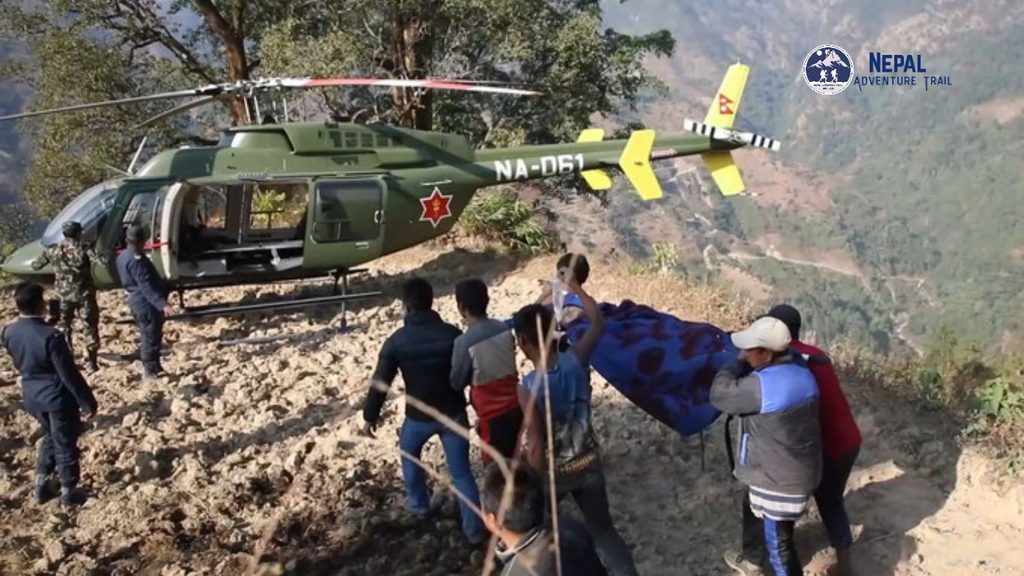
Stone steps, loose trail edges, wet slopes and long descents cause falls, suspected fractures and bad sprains. The question is whether the person can move safely under their own power. If not, the options include carrying, pony transport on suitable trails, or evacuation. Location, injury type, medical advice and available aircraft all feed that decision.
Severe Illness or Breathing Difficulties
Chest pain, significant breathing problems, fainting, altered consciousness or sudden severe symptoms call for urgent assessment. This is not the place for a home checklist. If something seems serious, tell the guide at once.
Dehydration, Exhaustion and Other Medical Problems
Most dehydration, stomach upsets and tiredness are handled with rest, fluids and care from the group. Severe or worsening cases need proper medical attention, and some need evacuation. Exhaustion alone is not a reason to call a helicopter.
When a Helicopter Cannot Fly
This is the part brochures leave out. A helicopter cannot reach every trekking location at any time. These factors can stop or delay a flight:
- Weather and visibility. Cloud, wind and precipitation close valleys, often by midday.
- Altitude and aircraft performance. Thin air reduces what a helicopter can do, and payload and fuel limits tighten with height.
- Landing conditions. Many places lack a safe, flat landing site.
- Daylight. Flying in mountain terrain generally depends on good light.
- Permissions and availability. Aircraft and crews may be committed elsewhere, and approvals may take time.
- Payment guarantees. Delay in confirming who pays can slow dispatch.
The practical consequence is simple. On standard trekking routes, the highest points sit around 5,400 to 5,550 metres, including Thorong La on the Annapurna Circuit and Kala Patthar in the Everest region. Even there, a rescue is not guaranteed on any given hour. If a guide says descend now, descending is usually the best medicine available, whether or not a flight is on its way.
The 2026 Rescue Fraud Case: What Trekkers Should Know
Any honest article on Heli Ambulance Nepal in 2026 has to cover the fraud investigation, because it changed how rescues are scrutinized.
According to news reports, Nepal’s Central Investigation Bureau arrested several people in January 2026, and police later charged 32 people, including trekking staff, helicopter operators and hospital administrators. Investigators alleged a scheme that drew around US$19.6 to 19.7 million from international insurers between 2022 and 2025. Police said the scam worked partly by filing several insurance claims for one flight, so that one unnecessary flight was paid several times over. A chargesheet also alleged that trekkers were pressured into airlifts for minor illnesses.
Reports differ on some details. The tourism ministry said claims such as trekkers being deliberately fed contaminated food were not substantiated by the bureau’s investigation. The Nepal Mountaineering Association said it knew of no verified cases of deliberate food poisoning or Diamox overdosing involving climbers. These are allegations connected to specific operators, not a finding about the whole industry.
The government announced a zero-tolerance policy, a joint monitoring task force drawing on the tourism ministry, the Civil Aviation Authority, police and the Nepal Tourism Board, and a proposed technology-based rescue management system. Insurers have responded with closer checks.
For a trekker, three things follow:
- A genuine emergency may involve more questions and paperwork than it once did.
- You can ask why a helicopter is being proposed and whether your insurer has been contacted.
- You should not accept a flight for mild symptoms without talking to a doctor or your assistance provider where communication allows.
Those are not signs of distrust. They are ordinary good practice.
How Much Does a Helicopter Evacuation Cost in Nepal?
There is no official rate card. What exists are quoted estimates from operators, agencies and insurance guides, and they vary.
Commercial sources in 2026 commonly quote about US$3,000 to US$10,000 for a high-altitude evacuation. One UK adventure company that coordinates rescues says there is no single definitive cost, because it depends on the pilot’s other commitments, the distance flown and the starting point, and puts the upper end at roughly US$10,000 from Everest Base Camp itself.
Keep three terms apart:
- Estimates are published guide figures, like those above.
- Quoted rates come from a specific operator for a specific flight.
- Actual charges are what appears on the invoice, which can include hospital care, ground transfers and other costs.
Operators typically ask for a payment guarantee or payment before dispatch. An insurer’s case number can serve as that guarantee. Without insurance, a trekker or a family member may need to provide a card or cash. Hospital treatment and repatriation flights are separate from the helicopter and can add substantially.
Does Travel Insurance Cover Helicopter Rescue in Nepal?
Sometimes. Not automatically.
Many standard policies exclude trekking above a certain altitude, limit helicopter cover, or treat adventure activity as high risk. Australia’s Smartraveller advice tells travelers not to assume insurance covers adventure or high-risk activities, and to confirm whether it covers evacuation costs if they become ill while trekking. UK government travel advice for Nepal, as summarized by trekking guides, says to make sure cover includes mountain rescue and helicopter costs.
Read the policy wording for these points:
- The altitude limit. It should cover the highest point of your route, not only the average altitude.
- The word “helicopter.” Look for helicopter, air ambulance or mountain rescue in the benefits. “Emergency assistance” or “medical evacuation” alone can be read as a road ambulance.
- Search and rescue limits. Check the per-claim limit against the cost figures above.
- Who pays first. Some insurers pay operators directly. Others reimburse after you pay.
- Contact rules. Many require you to call the assistance line before arranging a flight.
- Exclusions. Look at pre-existing conditions, activity wording, and what happens if you ignore medical advice.
- Purchase timing. Some insurers require you to buy before you leave your home country.
On legal requirements, sources conflict. Some commercial sites say proof of insurance is now mandatory for trekking permits. Others say there is no blanket national law and that agencies, not the permit office, ask for proof. Nepal’s Integrated Tourism Bill, which would require rescue insurance for expeditions, is reported with differing status and is framed around expedition teams. Check with the Nepal Tourism Board, the Department of Tourism and your trekking company for current rules. In practice, reputable agencies commonly want to see a policy before confirming a trek.
Insurance advice is specific to your policy and your health. Confirm details with your insurer or a qualified adviser.
Trekking Safety Measures Before an Emergency Happens
Most of what reduces the chance of an evacuation happens at home and in the first days on the trail.
- Choose a trek that fits. Match route, length and altitude to your fitness and experience.
- Pick an itinerary with real acclimatization. CDC Yellow Book guidance, as commonly summarized, suggests that above 3,000 metres you add no more than about 500 metres of sleeping elevation per day and take a rest day every three to four days. Check the current text yourself.
- Avoid rapid gain. Quick ascent, including flying or driving high, raises the risk of altitude illness.
- Learn the symptoms. Attend the Himalayan Rescue Association’s altitude talks where they are offered. Its seasonal aid posts at Manang (about 3,550 metres) and Pheriche (about 4,250 metres) have given daily talks on prevention and recognition. Check current schedules before you go.
- Follow the guide. Rest days and turnarounds are safety decisions, not setbacks.
- Carry the basics. Warm layers, water, personal medication and a simple first aid kit.
- Disclose health and mobility issues. Tell the company before booking, not on day four.
- Confirm communication. Ask how the guide reaches the company, and where coverage is unreliable.
- Buy suitable insurance. Then read it.
- Know the emergency process. Ask who calls whom, in what order.
Fitness does not remove altitude risk, and no itinerary can promise that an emergency will not occur. Careful planning lowers the odds. It cannot erase them.
What Does Nepal Adventure Trail Offer for Trekking Safety?
A responsible trekking company supports safety in practical ways, but the details vary from company to company, and travelers should ask for them in writing instead of assuming them. This section is about what to ask Nepal Adventure Trail before you book.
Ask the company to confirm:
- What briefings you receive before and at the start of the trek.
- How itineraries handle acclimatization and daily walking distances.
- What guides are told to do when a client reports symptoms, and what first aid or altitude training the assigned guide holds.
- How the guide communicates with the company’s operations team along your route.
- What help the company gives in contacting medical professionals, the insurer, or an assistance provider.
- Whether it coordinates helicopter evacuation, and who the external operator is. A trekking company and a helicopter operator are different businesses.
- What support exists after an evacuation, such as hotel changes, rebooking or logistics.
- What it expects from your insurance before departure.
A clear, specific answer to those questions tells you more than any general promise. Treat vague answers as information too.
Is Helicopter Rescue Included in a Nepal Trekking Package?
Usually not as a paid-for benefit, and the word “included” deserves care. It can mean several different things.
- Coordination help. The company or guide helps arrange the evacuation.
- The flight cost. Someone pays the helicopter bill.
- Medical treatment. Hospital care after arrival.
- Ground transfers. Ambulance or vehicle moves in Kathmandu or Pokhara.
- Changes to the trip. Hotels, flights and rebooking afterward.
- Insurance reimbursement. Whether and how much comes back to you.
- Extra expenses. Support staff, additional rescue costs or repatriation.
A company’s help with coordinating an evacuation is not the same as paying for it. Read the package inclusions and exclusions line by line. Then ask Nepal Adventure Trail, or any company you consider, to explain in plain terms what happens, step by step, if an evacuation becomes necessary on your route, and who pays at each stage. Do not assume free helicopter rescue unless the current written terms say so.
Final Thoughts
Helicopter rescue is a real and sometimes lifesaving part of trekking in Nepal. It is also limited by weather, altitude, landing sites, availability, payment and approval. The 2026 fraud case showed that the system has weak points, and that scrutiny is now higher.
Plan for the problem before it appears. Choose a route and pace that give your body time. Learn the symptoms. Report them early. Read your insurance policy, and ask your trekking company exactly how an emergency is handled. Those steps do more for your safety than any helicopter does.
Frequently Asked Questions
What is a heli ambulance in Nepal?
It is a common term for helicopter-based medical evacuation or rescue. It does not necessarily mean a hospital-equipped aircraft. Crew, equipment and medical support vary by operator and situation, so ask what any provider actually carries.
How does helicopter rescue work in Nepal?
The guide reports the problem, gives first aid and contacts the company, insurer or assistance provider. Feasibility is then checked against weather, altitude and landing conditions. If a flight is approved, the parties arrange transport and a receiving facility. Procedures vary.
How much does helicopter evacuation cost in Nepal?
Commercial sources quote roughly US$3,000 to US$10,000 for high-altitude evacuation, but there is no official rate. Cost depends on distance, location and aircraft. Hospital care and repatriation are extra.
Does trekking insurance cover helicopter rescue in Nepal?
Only if the policy says so and your route fits its altitude limit. Look for the words helicopter, air ambulance or mountain rescue, check the rescue limit, and read the exclusions. Confirm specifics with your insurer.
Is travel insurance mandatory for trekking in Nepal?
Sources conflict. Some commercial sites describe a mandatory rule, while others report no blanket national law. Many agencies require proof before confirming a trek. Check with the Nepal Tourism Board, the Department of Tourism and your company.
What happens if you get altitude sickness on a Nepal trek?
Mild symptoms usually mean stopping ascent and resting. Severe symptoms, confusion, loss of balance or breathlessness at rest call for descent and medical attention. Report symptoms to your guide early, and do not try to self-diagnose.
Can a helicopter rescue you anywhere in the Himalayas?
No. Weather, visibility, altitude, landing sites, availability and approvals can all delay or prevent a flight. Descent on foot may be the better option while conditions improve.
What should I do in a medical emergency on a Nepal trek?
Tell your guide immediately. Stop climbing, get the patient comfortable and protected, and let the guide contact the company and insurer in the order your policy requires. Do not delay descent for a helicopter booking.
What if bad weather stops a helicopter rescue?
The patient may need to descend or move to a lower lodge or medical post while the team waits for a window. That is one reason early reporting of symptoms matters.
Is helicopter evacuation included in a Nepal trekking package?
Not automatically. Coordination help, the flight cost, hospital care and insurance reimbursement are separate things. Read the inclusions and exclusions and ask the company to explain who pays at each stage.