
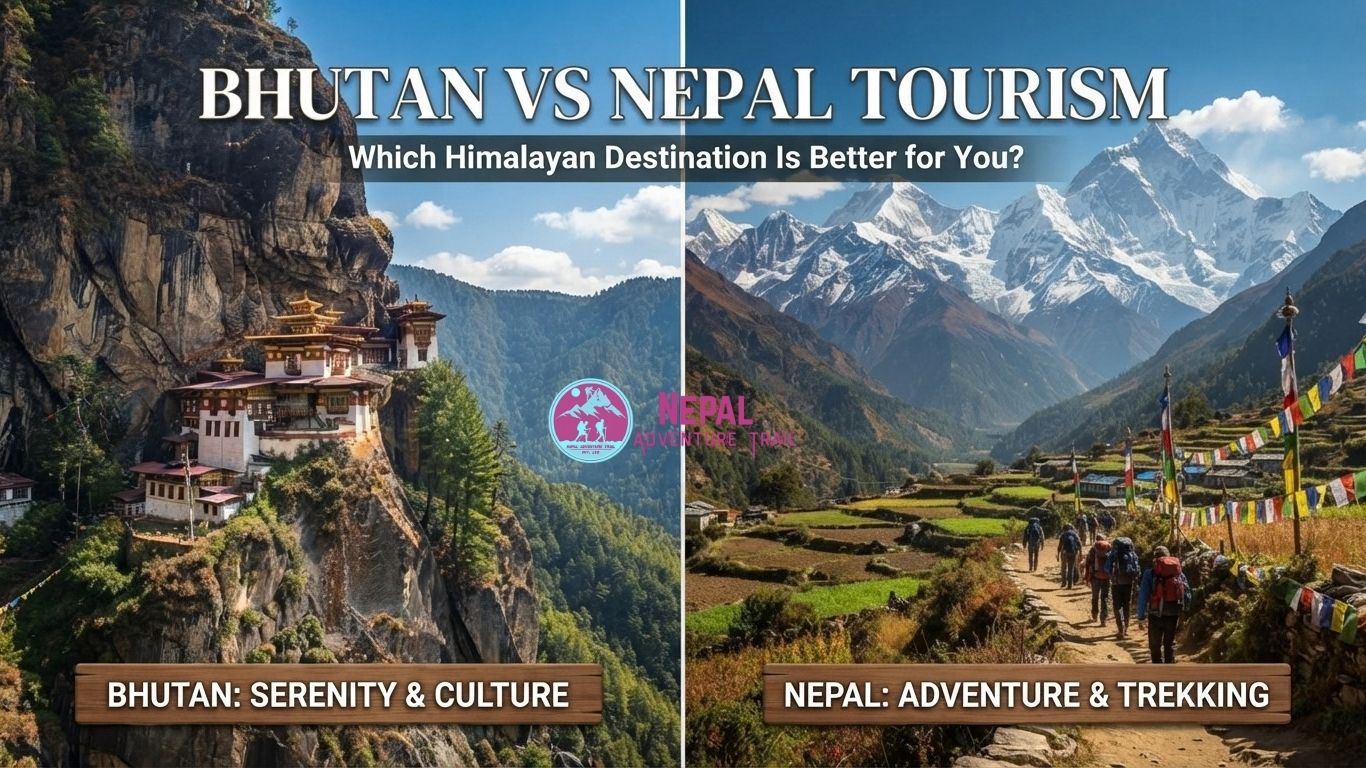
Bhutan and Nepal share a mountain range and a Buddhist heritage, but they run tourism in opposite ways. Bhutan manages visitor numbers through policy, charges a fixed nightly fee, and builds trips around a licensed operator or guide. Nepal is open, varied and priced across a huge range, from guesthouse budgets to private-helicopter luxury.
That difference shapes everything else in the Bhutan vs Nepal tourism decision: what a trip costs, how much freedom you have, what you can do and how crowded it feels. Nepal generally offers more variety in landscapes and activities, especially trekking and mountaineering. Bhutan offers a more structured, culture-led journey through valleys, dzongs and monasteries.
Neither is better in the abstract. The better choice depends on your budget, interests, available time and how much planning you want to do. This guide compares them on those terms, using current 2026 figures where they could be verified.
Bhutan vs Nepal Tourism at a Glance
| Category | Bhutan | Nepal |
|---|---|---|
| Overall travel style | Structured, culture-led, scenic | Varied, adventure and culture, flexible |
| Tourism model | Managed, fixed nightly fee | Open, wide range of options |
| Typical trip | Valley circuit by road | Mix of city, trek, safari or lake |
| Budget | Higher baseline from fee | Very wide spectrum |
| Trekking | Fewer, remote, guided routes | Largest choice, teahouse network |
| Culture | Vajrayana Buddhism, dzongs | Hindu and Buddhist, many ethnic cultures |
| Mountains | Valleys and passes, eastern Himalaya | Everest and many of the highest peaks |
| Wildlife | Forests, highland ecosystems | Lowland safari plus high-altitude species |
| Adventure | Trekking, biking, rafting | Trekking, climbing, rafting, paragliding and more |
| Independent travel | Limited, check current rules | More options, but guides required on treks |
| Infrastructure | Smaller scale | Larger tourism ecosystem |
| Ideal trip length | 6 to 10 days | 7 to 16+ days |
Details follow below.
Bhutan vs Nepal: What Is the Biggest Difference?
Bhutan describes its approach as high value, low volume. Visitors pay a Sustainable Development Fee (SDF) for each night they stay, and trips are generally organized through licensed operators with guides. The result is a smaller tourism footprint and a slower, more guided pace.
Nepal has a broader tourism industry. It offers trekking, mountaineering, wildlife safaris, pilgrimage and city sightseeing, with accommodation from basic teahouses to luxury resorts. There is no nightly charge on top of normal costs, though trekking permits and guide requirements apply.
Neither model is automatically superior. One manages scale. The other offers range.
Bhutan vs Nepal Cost
The cost question is best answered by separating mandatory charges from total spending.
Bhutan
- SDF: USD 100 per person per night for most international visitors, according to Bhutan’s official tourism site and operators, with the rate reported as confirmed through 31 August 2027. Children aged 6 to 12 get a 50% discount and children 5 and under are exempt. Indian visitors pay a separate rupee rate. Other regional rates exist, so check your nationality.
- Visa: a one-time fee of USD 40 per person.
- Everything else: accommodation, meals, guide, vehicle and entrance fees. Operators commonly quote all-in standard packages of roughly USD 350 to 400 per person per night including SDF, with deluxe packages higher. Treat these as indicative, not fixed.
- Flights: into Paro on Drukair or Bhutan Airlines.
Nepal
- Visa: commonly USD 30 for 15 days, USD 50 for 30 days, USD 125 for 90 days, multiple entry. Most nationalities can get it on arrival.
- Accommodation and food: from low-cost guesthouses to luxury hotels and lodges.
- Trekking permits: for example, Everest and Annapurna each require park or conservation permits costing a few thousand rupees. Guide requirements apply on most routes.
- Domestic flights, guides, porters and activities: vary by itinerary.
The key difference: Bhutan’s SDF is a fixed baseline charge before any hotel, guide or meal. Nepal has no equivalent nightly charge, so costs depend mostly on your choices.
Which Is Cheaper: Bhutan or Nepal?
For most travelers, Nepal is cheaper to visit, mainly because it has a much wider budget range. A traveler can keep Nepal costs low with guesthouses, local transport and teahouse trekking.
Bhutan’s SDF creates a significant floor. On a 7-night trip, SDF alone is USD 700 per adult plus the USD 40 visa, before anything else is paid.
Cheap is not the whole picture. Nepal can be expensive too: private guides, luxury lodges, helicopter flights and high-end treks add up quickly. Bhutan also has accommodation tiers, but the fee remains. If budget is the deciding factor, Nepal gives more room to adjust. If you are happy with a higher but more predictable cost, Bhutan’s structure may suit you.
Bhutan vs Nepal for Trekking
Nepal is the stronger choice for range. It has Everest, Annapurna, Langtang, Manaslu, Kanchenjunga, Mustang, Dolpo and other regions, with teahouse routes for beginners and remote expedition-style treks for experienced hikers. Difficulty ranges from a few easy days to multi-week high-altitude journeys.
Bhutan has fewer but distinctive routes, including the Druk Path, Jomolhari and the much longer Snowman Trek, among the toughest in the Himalaya. Trekking in Bhutan requires a licensed guide and support team, and routes are often camping-based. Traffic is low.
In short, Nepal suits travelers who want choice and established trekking infrastructure. Bhutan may suit those who prefer a controlled, culturally framed experience and fewer people on the trail.
Nepal’s rules matter too. Many sources report that a licensed guide booked through a registered agency has been required for foreign trekkers since 2023. Permit and TIMS requirements vary by region, so confirm before booking.
Bhutan vs Nepal for Mountain Views
The two offer different kinds of mountain experience.
Nepal contains Everest and several other of the world’s highest peaks, with close views from trekking routes such as Everest, Annapurna and Manaslu. Pokhara offers lakeside views of the Annapurna range without trekking.
Bhutan is more about valleys, forested ridges and high passes, with Himalayan peaks appearing along drives and treks. Mountaineering is restricted in Bhutan, and its highest peak, Gangkhar Puensum, has never been climbed.
That is not a ranking of scenery. If you want to stand close to the highest mountains on earth, Nepal offers that access. If you want pastoral valleys with mountains as backdrop, Bhutan fits.
Bhutan vs Nepal for Culture and Heritage
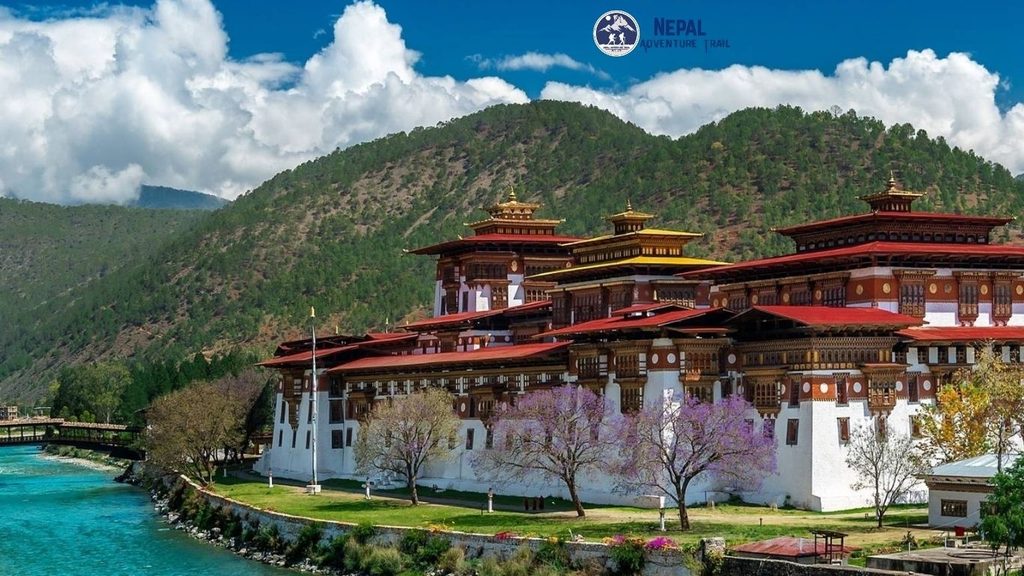
Bhutan is known for Vajrayana Buddhist traditions, dzongs (fortress-monasteries), temples and a strong emphasis on preserving traditional architecture and dress. Seasonal tshechu festivals feature masked dances and draw locals and visitors. Daily life remains closely tied to these traditions, though like anywhere it is changing.
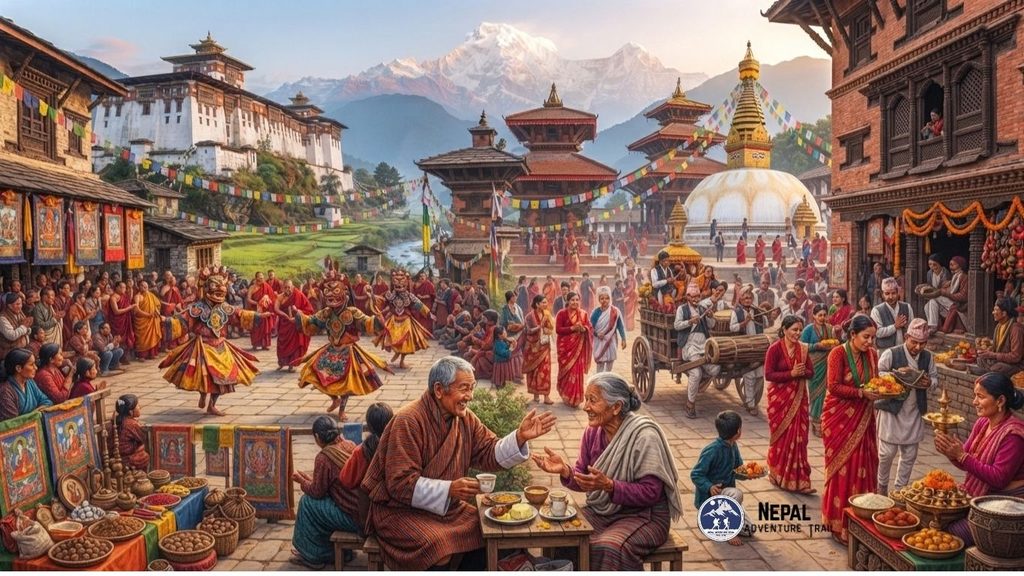
Nepal has a layered mix of Hindu and Buddhist heritage. The Kathmandu Valley contains multiple UNESCO sites, including Pashupatinath, Boudhanath, Swayambhunath, Patan and Bhaktapur. Lumbini is the birthplace of the Buddha. Communities such as Newar, Sherpa, Gurung, Tamang and Tharu each have distinct traditions.
Bhutan’s culture feels more concentrated and consistently presented. Nepal’s feels more varied and often more spontaneous. Visitors interested in depth in one tradition may prefer Bhutan. Those interested in range and layers may prefer Nepal.
Bhutan vs Nepal for Adventure
Nepal offers trekking, peak climbing, mountaineering, white-water rafting, canyoning, bungee jumping, paragliding, mountain biking and jungle safaris. Pokhara and the Annapurna region are common bases for paragliding and lake activities. Not every activity is available everywhere or in every season.
Bhutan offers trekking, hiking, mountain biking, rafting and cultural exploration, plus wellness-oriented experiences. The scale is smaller and activities are usually arranged through operators.
Travelers wanting variety and higher adrenaline will find more in Nepal. Those who want gentle hiking tied to culture may be comfortable in either.
Bhutan vs Nepal for Wildlife
Wildlife differs because the ecosystems differ.
Nepal has lowland safari parks such as Chitwan and Bardia, where rhinos, tigers, crocodiles and many bird species live, and high-altitude parks such as Sagarmatha, Annapurna and Langtang with Himalayan species. Sightings are never guaranteed.
Bhutan is heavily forested, with extensive protected areas, birdlife and highland ecosystems. Wildlife viewing is typically a bonus on cultural or trekking trips rather than the main focus. In winter, the Phobjikha valley is known for visiting black-necked cranes.
For classic safari experiences, Nepal is the more developed option. For forest and highland ecosystems, Bhutan provides quieter encounters.
Bhutan vs Nepal for Honeymoon
Bhutan suits couples who want a quiet, slower trip with boutique or luxury stays, monasteries, scenic drives and wellness. The SDF is part of the cost, and itineraries are usually pre-arranged.
Nepal suits couples who want mountain views, lake resorts in Pokhara, wildlife, culture and optional adventure, often combined in one itinerary. It is easier to scale the budget up or down.
Neither is universally better. Choose Bhutan for calm and structure, Nepal for variety and flexibility.
Bhutan vs Nepal for Family Travel
Suitability depends on the children’s ages and the itinerary.
Bhutan involves long drives on mountain roads and temple visits, with a guide and a set route. Children aged 6 to 12 get a reduced SDF and under-6s are exempt. Nepal offers more family-friendly variety: Chitwan safaris, Pokhara lakeside days, Kathmandu sightseeing and easy hikes. Treks at altitude need careful planning with children.
Both involve road time and altitude in places, so itinerary design matters more than the country.
Bhutan vs Nepal for Luxury Travel
Luxury means different things.
In Bhutan, luxury usually means high-end lodges and resorts in Paro, Thimphu, Punakha and Phobjikha, private guides, wellness and cultural stays within a managed environment.
In Nepal, luxury includes five-star hotels, Pokhara lakeside resorts, safari lodges, luxury trekking with upgraded lodges, helicopter experiences and private cultural tours.
Nepal offers more variety in kinds of luxury. Bhutan offers a more uniform, quiet style.
Bhutan vs Nepal for Solo Travel
This depends on the current rules, and sources disagree.
In Bhutan, many operators and sources say all visitors must travel with a licensed guide arranged through an operator. Some sources report that rules were relaxed in 2025 to allow independent travel within the Paro, Thimphu and Punakha corridor, while guides remain required for dzongs, areas beyond the corridor and treks. Confirm the current position with Bhutan’s Department of Tourism or an operator before planning. Solo travelers can still visit, with a private guide.
In Nepal, you can move around cities and tourist areas independently. For national parks and conservation areas, including most treks, a licensed guide booked through a registered agency is widely reported as required for foreign trekkers.
Legal requirements and practical advice differ. Even where independent movement is allowed, a guide helps with logistics and safety in both countries.
Bhutan vs Nepal for First-Time Himalayan Travelers
Choose Bhutan if you want structured cultural travel, scenic drives, monasteries, a slower pace and a managed environment.
Choose Nepal if you want variety, trekking, adventure, multiple landscapes, flexible budgets and the option of a longer trip.
First-timers who are unsure should consider how much planning they want to do and how they feel about a fixed daily fee. Nepal is easier to adjust as you go. Bhutan is easier if you want it organised.
Visa and Entry Requirements
Bhutan: most visitors need an e-visa, fee USD 40 per person, applied for through the official process, along with payment of the SDF. Indian citizens do not need a visa but pay their own rate. Bangladeshi and other regional visitors have separate arrangements.
Nepal: most nationalities can get a multiple-entry tourist visa on arrival at Kathmandu airport or land borders, or apply online. Commonly published fees are USD 30 for 15 days, USD 50 for 30 days and USD 125 for 90 days. Citizens of India enter visa-free, SAARC nationals are generally eligible for a free 30-day visa once per visa year, and a short list of nationalities must apply in advance at an embassy.
Passports should be valid for at least six months. Requirements change, so check the official Nepal Department of Immigration and Bhutan tourism sites close to travel.
Transportation and Accessibility
Bhutan is reached mainly through Paro, served by Drukair and Bhutan Airlines from cities such as Kathmandu, Delhi, Kolkata and Bangkok. Within Bhutan, travel is by road, often winding and slow, and distances that look short can take hours.
Nepal is reached through Kathmandu, with domestic flights, tourist buses and private vehicles to Pokhara, Chitwan and beyond. Trekking regions such as Everest are reached by flight or long road journeys, and weather delays are common.
Neither is easy everywhere. Both reward flexible schedules.
Tourism Infrastructure
Nepal has a much larger tourism ecosystem: more hotels, guesthouses, restaurants, trekking lodges and transport options. Quality varies. Bhutan’s is smaller and more concentrated around its main valleys, which is part of its model. Smaller does not mean worse, but options and flexibility are narrower.
Mobile networks, ATMs and medical facilities are strongest in cities and weaker in remote regions in both countries. Carry cash and insurance for trekking in either.
Best Time to Visit
Both countries have spring and autumn peaks, but the details differ.
Bhutan
- Spring (March to May): rhododendrons, mild weather and major festivals such as the Paro Tshechu.
- Summer/monsoon (June to August): rain and cloud, greener scenery, fewer visitors.
- Autumn (September to November): generally clear and popular, with festivals including Thimphu Tshechu.
- Winter (December to February): cold, often dry and clear in lower valleys, black-necked cranes in Phobjikha.
Nepal
- Spring (March to May): warm, rhododendron blooms, busy trekking, some haze.
- Monsoon (June to September): heavy rain, poor mountain views, lush landscapes, fewer trekkers.
- Autumn (October to November): clear skies, peak season for trekking.
- Winter (December to February): cold at altitude, good sightseeing in lowlands and clear days, fewer crowds.
Pick the season based on what you want: trekking, festivals, wildlife, photography or quiet.
How Many Days Do You Need?
Bhutan: a short cultural trip can run 5 to 7 days around Paro, Thimphu and Punakha. A fuller trip with Phobjikha or Bumthang takes 8 to 12 days. Trekking adds several days to weeks.
Nepal: 5 to 7 days covers a cultural trip in Kathmandu and Pokhara or Chitwan. 7 to 10 days gives a highlights tour. 10 to 14 days suits an adventure or short trek. Trekking itineraries like Everest or Annapurna run 12 to 16+ days.
These are guides, not rules. A 7-day Nepal trip cannot cover the whole country.
Sample Itinerary Comparison
Bhutan, 7 days: Paro, Thimphu, Punakha, Paro. Includes the Tiger’s Nest (Taktsang) hike, dzongs, a mountain pass drive and a free day. Adjust for current logistics.
Nepal, 7 days: Kathmandu (heritage sites), then Pokhara (lake, mountain views), or Kathmandu, Chitwan (safari) and Pokhara. Nepal’s geography means many different routes are possible.
Can You Visit Bhutan and Nepal Together?
Yes, and it works well for travelers with enough time. Drukair and Bhutan Airlines connect Kathmandu with Paro, and the flight is short. Check current schedules and book both legs carefully.
Plan for different systems: Bhutan needs an e-visa and the SDF for every night spent there, while Nepal typically offers visa on arrival. A combined trip of 10 to 14 days gives a contrast between Nepal’s variety and Bhutan’s structured culture. Shorter trips can feel rushed.
Responsible Tourism
Bhutan uses the SDF to fund services, infrastructure and conservation, and limits visitor numbers through policy. Nepal relies on conservation areas, national parks, community tourism, local guides and the teahouse economy, with waste management a continuing challenge on busy trails.
Different models, different strengths. Travelers can support both by using local guides and lodges, carrying reusable bottles and respecting local customs.
Which Country Should You Choose?
Choose Bhutan if you prioritise:
- cultural immersion
- structured travel
- quieter experiences
- dzongs and monasteries
- wellness and boutique luxury
- scenic road journeys
Choose Nepal if you prioritise:
- trekking and mountaineering
- adventure
- greater destination variety
- wildlife
- pilgrimage
- flexible budgets
- longer trips
Choose both if:
- you have 10 to 14 days or more
- you want contrasting Himalayan cultures
- you want structured culture and trekking or adventure in one trip
Explore Nepal with Nepal Adventure Trail
If Nepal fits your plan, Nepal Adventure Trail can help arrange the practical side: trekking packages, cultural tours, transportation, guide support, accommodation and permit assistance, built around your dates and budget. For combined or multi-country trips, ask about available options.
Frequently Aasked Questions
Is Bhutan or Nepal better for tourism?
Neither is better in every case. Nepal offers more variety, with trekking, mountaineering, wildlife, pilgrimage and city sightseeing across a wide budget range. Bhutan offers a managed, culture-led experience with dzongs, monasteries and scenic valleys, and a fixed nightly fee. The right choice depends on your budget, interests, trip length and how much structure you want. Many travelers who have time visit both.
Is Nepal cheaper than Bhutan?
For most travelers, yes. Nepal has a much wider price range, from budget guesthouses to luxury lodges, while Bhutan charges a USD 100 per person per night SDF plus a USD 40 visa before any hotel or guide costs. Nepal can still be expensive if you choose private guides, luxury hotels or helicopter trips, so the gap depends on your style of travel.
Why is Bhutan more expensive for tourists?
Mainly because of the Sustainable Development Fee, a government charge of USD 100 per person per night for most international visitors, with discounts for children and a separate rate for Indian visitors. It supports national development and reflects a high-value, low-volume tourism policy. Licensed guides and organised logistics add to costs. The fee is separate from hotels, meals and activities.
Which is better for trekking, Bhutan or Nepal?
Nepal is stronger for range and infrastructure, with Everest, Annapurna, Langtang, Manaslu and many other regions, plus teahouse routes for different abilities. Bhutan has fewer routes, such as the Druk Path and Jomolhari, mostly guided and camping-based, with lower traffic. If you want choice and flexibility, choose Nepal. If you want a quieter, culturally framed trek, consider Bhutan.
Which has better mountain views?
They offer different views. Nepal gives access to Everest and many of the world’s highest peaks, especially from trekking routes. Bhutan’s scenery is more about forested valleys, high passes and mountains seen from roads and treks. If proximity to the highest mountains matters, Nepal fits. If you prefer mountains as a backdrop to culture, Bhutan works well.
Is Bhutan or Nepal better for families?
It depends on the children’s ages and the itinerary. Nepal offers more varied family options, including Chitwan safaris, Pokhara lakeside time and short hikes. Bhutan involves long road journeys and temple visits with a guide, and gives reduced SDF for children aged 6 to 12 and free entry under 6. Altitude and road time deserve thought in both.
Which is better for a honeymoon?
Bhutan suits couples wanting quiet, boutique stays, monasteries, scenic drives and wellness. Nepal suits couples wanting mountain views, Pokhara resorts, wildlife, culture and optional adventure, with more budget flexibility. Neither is universally better. Choose Bhutan for calm and structure, or Nepal for variety and the freedom to mix relaxation with activity.
Can I visit Bhutan and Nepal on the same trip?
Yes. Drukair and Bhutan Airlines connect Kathmandu and Paro, so combining the two is common for travelers with enough time. Plan for different entry systems: Bhutan requires an e-visa and the SDF, while Nepal usually offers a visa on arrival. A trip of 10 to 14 days or more works best, and flight schedules should be checked before booking.
How many days do you need in Bhutan?
A short cultural trip can fit in 5 to 7 days around Paro, Thimphu and Punakha, including the Tiger’s Nest hike. Adding Phobjikha or central Bhutan suits 8 to 12 days. Treks add more. Because travel is by winding mountain roads and the SDF is charged nightly, many visitors plan carefully so the days are well used.
How many days do you need in Nepal?
It depends on your goals. A cultural trip to Kathmandu and Pokhara or Chitwan fits in 5 to 7 days. A highlights tour takes 7 to 10 days. Adventure itineraries run 10 to 14 days, and treks such as Everest Base Camp or Annapurna Base Camp need 12 to 16 days or more. A short trip cannot cover the whole country.
Is Bhutan harder to travel to than Nepal?
Bhutan involves more steps. You need an e-visa, SDF payment and usually a licensed operator, and rules on independent travel have been described differently by different sources, so confirm them with Bhutan’s tourism authorities. Nepal is simpler for most visitors, with visa on arrival, though guides are required for treks. Both depend on weather and mountain flights.
Which country is better for first-time Himalayan travelers?
Choose Bhutan if you want a structured, cultural trip with scenic drives and minimal planning. Choose Nepal if you want variety, trekking, adventure and flexible budgets. First-timers unsure of their interests may find Nepal easier to adjust as plans change, while those who prefer everything organised may find Bhutan’s model more comfortable.
Conclusion
The Bhutan vs Nepal tourism choice comes down to what you want from the Himalaya. Bhutan suits travelers who value structured cultural travel, scenic valleys and quieter, guided experiences. Nepal suits those who want trekking, adventure, wildlife, cultural diversity and flexible budgets. Travelers with enough time can combine both for contrast. If Nepal is part of your plan, Nepal Adventure Trail can help arrange the details.