
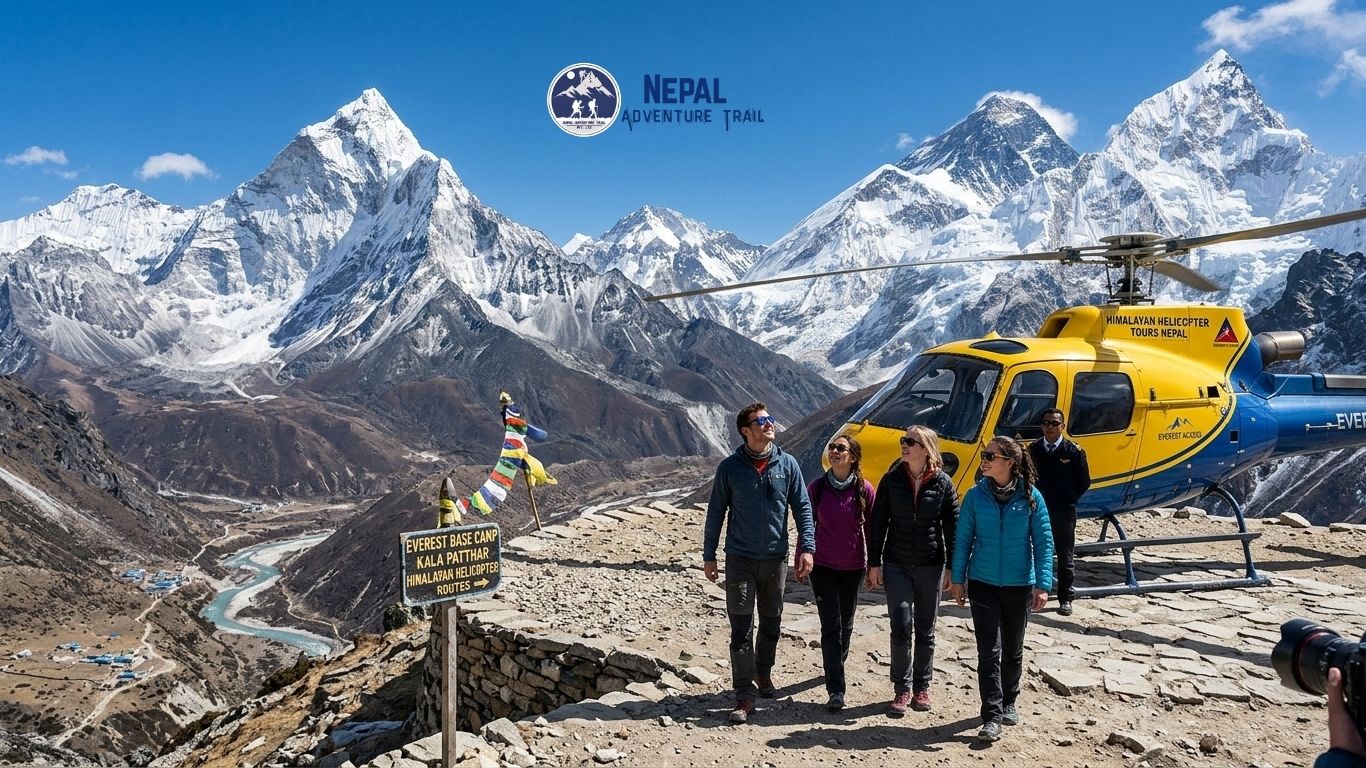
The Himalayan helicopter tour Nepal lifts off, and the mountains starts to unfold in layers. First the terraced hillsides, cut like steps into the slopes, then the brown braids of a river in a deep gorge, then villages shrinking to a scatter of tin roofs. Somewhere past the last forested ridge the air changes. Snow appears, then glaciers, then a wall of peaks that seems to have been waiting behind the hills all along.
That is the appeal of a Himalayan helicopter tour in Nepal. It brings mountain scenery that normally takes days of walking into a single morning, which matters to travellers with limited time, to people who cannot manage a long trek, and to pilgrims heading for high-altitude shrines. It also raises practical questions that brochures tend to skip. Does the helicopter actually land, or only fly past? Is the price per person or for the whole aircraft? What happens when cloud closes the valley?
This guide covers the main routes, what each experience really involves, how pricing works, when to fly, how to weigh safety and altitude, and what to confirm before you pay. It is written for Nepal Adventure Trail readers who want the full picture before they inquire.
What Is a Himalayan Helicopter Tour in Nepal?
A Himalayan helicopter tour is a chartered or seat-based flight that takes passengers into Nepal’s mountain regions, usually from Kathmandu or Pokhara, for aerial views and sometimes a landing. The label covers several quite different products, and the differences are worth understanding.
A scenic flight is mainly about the view. The aircraft flies a route, passengers look and photograph, and it returns. A landing tour adds a stop on the ground at a designated site, often with breakfast or tea, for a limited time. A pilgrimage charter carries devotees to a religious site such as Muktinath. A helicopter shuttle is point-to-point transport, for example flying trekkers out from a high camp, and is not sightseeing at all. Helicopter-supported trekking combines walking with a flight in or out.
The most common misunderstanding is that every tour lands at its headline destination. It does not. A tour sold under the name of a base camp may fly over it, land at a nearby approved point, or land at the camp itself, depending on the place, the current rules, the aircraft’s load and the weather. Ground time is usually short, often measured in minutes at the highest sites.
A helicopter also does not replace trekking. It saves days and removes the physical demand, but it does not give you the slow arrival, the villages, the teahouse conversations or the gradual adjustment to altitude that walking provides.
Why Choose a Himalayan Helicopter Tour in Nepal?
People choose this kind of trip for a handful of practical reasons.
Time. A fortnight-long walk becomes a morning. For travellers with a week in Nepal, that can be the difference between seeing the high Himalaya and only reading about it.
Perspective. From the air, you see how a valley connects to a glacier and how a ridge leads to a summit. On foot, much of that is hidden behind the next bend.
Access. Some sites, including certain lakes and sanctuaries, are days from the nearest road. A helicopter reaches them in a few hours.
Photography. Aerial angles, morning light and the chance to see a mountain wall from above the valley floor appeal to photographers, though cloud and haze can limit what you get.
Flexibility for families, couples and older travellers. A flight asks for far less fitness than a trek. That said, high-altitude landings still carry physical risk, and a comfortable seat does not make a thin atmosphere any easier on the body.
Combination itineraries. A helicopter day fits easily into a longer trip that also includes cultural sightseeing, a lowland safari or a shorter walk.
The honest limitation is that you trade depth for speed. If your main interest is village life, trail culture or the slow build of a mountain landscape, walking offers more.
Best Himalayan Helicopter Tours in Nepal
The routes below are the ones travellers ask about most. Each is described by what the experience involves and what to confirm. Where this article quotes operator information, it is drawn from published operator pages and is not independent verification, so check anything that affects your booking directly with the operator.
Everest Base Camp Helicopter Tour
The Everest region draws travellers who want to see the world’s highest mountain, at 8,848.86 metres, and the peaks around it. On a clear day, a typical route follows the Khumbu valley past Namche Bazaar, Tengboche and Pheriche toward the Khumbu Glacier, with Everest, Lhotse, Nuptse and Ama Dablam in view.
The detail that matters most is the landing. Helicopters do not land at Everest Base Camp itself, which sits on moving glacier ice. The Kathmandu Post has reported that helicopters may fly over the camp but not land there. Kala Patthar, a ridge at about 5,545 metres, is a separate place, and the rules for landing there have changed over recent years. Operator websites disagree about the current position. Some report that shared landings resumed in 2026, some say only small private groups are allowed, and some say commercial landings are not permitted. We could not find a single current official notice that settles the matter, so treat any Kala Patthar landing as conditional and ask for written confirmation.
Many Everest tours instead include a stop near Hotel Everest View at Syangboche, at roughly 3,880 metres, which offers a long view of Everest and a more manageable altitude. One operator lists this tour at 4 to 5 hours.
The altitude at the highest points is demanding. A landing at the upper end of the route is a very different experience from a flight that stays lower, and travellers should factor that in before choosing.
Everest Scenic Helicopter Flight from Kathmandu
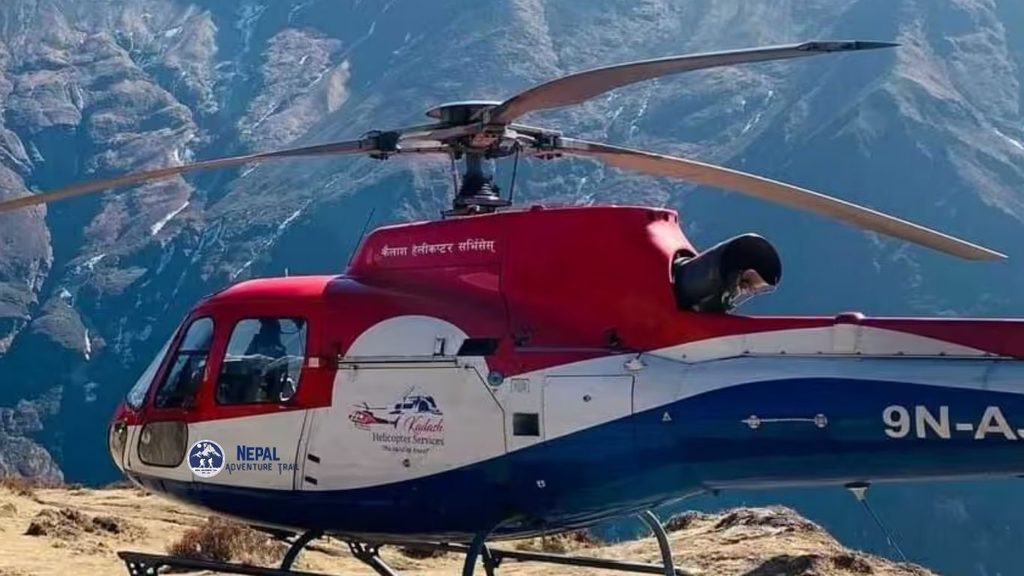
A scenic flight suits travellers who mainly want the aerial view and do not need to set foot on high ground. Operators describe these flights as shorter than full landing tours. One Kathmandu operator lists its Everest scenic flight at roughly 1 to 1.5 hours and offers both private and shared options, with an optional landing near the base camp area for breakfast.
The phrase “optional landing” deserves a question. Ask exactly where it takes place, what the current permission is, how long you stay and what changes if the landing cannot go ahead. A scenic flight and a landing tour are priced and operated differently, and the two names are sometimes used loosely.
Annapurna Base Camp Helicopter Tour
The Annapurna Sanctuary is a glacial amphitheatre ringed by peaks, with Annapurna I at 8,091 metres, Annapurna South, Hiunchuli and the fishtail summit of Machhapuchhre in view. The classic trek in takes seven to twelve days. By helicopter, an operator describes a morning excursion with a landing at Annapurna Base Camp at about 4,130 metres, time on the ground for photographs and a breakfast stop.
Departures can start from Pokhara, which is closer to the range, or from Kathmandu, which means a longer flight and a higher price. The operator lists group departures from Pokhara and describes national park permits and an onboard oxygen cylinder as part of the package. Treat those as that operator’s inclusions and confirm them for your own booking, including the landing arrangement and the permitted ground time.
Langtang Helicopter Tour
Langtang, north of Kathmandu, is known for its valley, glaciers and closeness to the capital. A flight there offers a different view of a region many travellers know only from trekking.
A serious caution applies right now. On 26 August 2026 a flash flood struck the Rasuwa corridor, damaging roads and bridges on the approach to Langtang and Gosaikunda. Reports differ on how much of the upper valley is affected and on when normal access will return, and some advisories recommend avoiding the area until authorities confirm it is safe. An operator may still list a Langtang flight, but you should ask what the route, any landing and the ground arrangements look like today, and check current official advice before booking. Do not rely on a pre-flood itinerary.
Gosaikunda Helicopter Tour
Gosaikunda is a high-altitude lake in Langtang National Park, sacred to Hindus and Buddhists, and especially busy around the Janai Purnima festival in August. An aerial visit appeals to pilgrims and to travellers who want to see the lake’s alpine setting without the multi-day approach.
It is a different experience from trekking to the lake, and it is subject to landing permission, ground time and weather. The same Rasuwa flood caution applies. Confirm current conditions and any permitted landing before committing, and do not assume a festival-day charter will operate as it did in earlier years.
Muktinath Helicopter Tour
Muktinath, in the Mustang region, is a major pilgrimage site for Hindus and Buddhists, set at about 3,800 metres beneath the Thorong La. A helicopter shortens a pilgrimage that would otherwise involve a long road journey or a flight to Jomsom followed by a transfer, which suits elderly devotees and those with limited time.
One operator lists a private charter for this route at roughly 4 to 5 hours. Because Muktinath is a temple visit and not a viewpoint, the key questions are practical. Where does the helicopter land, how far is the temple from there, and how much time is allowed for darshan? Do not assume the package includes time inside the temple complex unless it says so.
Other Himalayan Helicopter Destinations
Remote-region charters also exist for areas such as Manaslu, Makalu, Kanchenjunga, Tilicho Lake and Rara Lake. These are usually private, priced for the whole aircraft and arranged around a specific request, not run as routine daily sightseeing. One operator lists indicative charter prices from roughly USD 4,000 for Manaslu to USD 9,000 for Rara Lake, which gives a sense of how much distance and complexity affect cost. If one of these places is your goal, plan well ahead, expect a bespoke quote and confirm whether the trip is a flyover, a landing or a transfer.
For every destination, keep the same four terms apart: a flyover, a landing, a transfer and a tour with real time on the ground. Operators do not always use them consistently.
Himalayan Helicopter Tour Itinerary: What to Expect
Itineraries differ by route, so use this as an illustration, not a standard.
- Booking confirmation and instructions. You receive a pickup time, a baggage limit and usually a weight declaration.
- Hotel transfer. If included, a vehicle collects you early, often around six in the morning, since mountain mornings tend to be calmer and clearer.
- Check-in and briefing. Passenger and baggage checks, a safety briefing and a chance to ask about the route.
- Departure. The helicopter lifts out of the valley and climbs through foothills toward the high range.
- Views and any stop. The aircraft flies the planned route, with a permitted landing if there is one.
- Ground time. If included, this is typically short. At high sites it may be a matter of minutes, and a breakfast or tea stop at a lower site may run longer.
- Return and transfer. The aircraft flies back, and a transfer takes you to your hotel.
Durations vary widely. Operator pages in this article describe tours from about an hour of flying to four or five hours door to door. Always ask for flight time and total excursion time separately, and leave buffer around any onward flight.
Himalayan Helicopter Tour Cost in Nepal
Pricing causes the most confusion, mainly because quotes are not directly comparable.
What changes the price:
- Destination and total flying time
- Departure airport (Pokhara or Kathmandu)
- Shared seat versus private charter
- Number of passengers and aircraft capacity
- Technical stops, such as refuelling
- Landing arrangements and time on the ground
- Airport charges, taxes, permits and fees
- Season, demand and weather disruption
- Transfers, meals and other inclusions
Indicative published prices. The figures below come from one operator’s published listings, viewed on 14 October 2026, and its Annapurna page states that prices are indicative and vary with season, group size and fuel. They are not Nepal Adventure Trail prices and not an industry average.
| Experience | Shared seat (per person) | Private charter (per aircraft) | Listed duration |
|---|---|---|---|
| Everest Base Camp helicopter tour | About USD 1,400 | About USD 5,900 | 4 to 5 hours |
| Annapurna Base Camp helicopter tour | About USD 500 | From about USD 2,500 | 2 to 3 hours flying, 3 to 5 hours overall |
| Langtang helicopter tour | About USD 500 | About USD 2,200 | 1 day |
| Muktinath pilgrimage tour | Not listed | About USD 4,800 | 4 to 5 hours |
The Annapurna page also gives broader ranges: roughly USD 450 to 650 per person shared, about USD 2,200 to 2,800 for a private charter from Pokhara, and about USD 3,800 to 4,800 from Kathmandu. For context, the Kathmandu Post reported in January 2025 that a tour of around USD 8,000 could carry up to four people to Lukla, with only two continuing to land at Kala Patthar. That figure is dated, and it shows how sharply landing limits can raise a quote.
Do not compare a shared per-person price directly with a whole-aircraft charter. A charter looks expensive until you divide it among the people the aircraft can carry, and a shared price looks cheap until you check what it leaves out.
What Is Usually Included in the Price?
Inclusions vary. Common items are the helicopter flight, airport or hotel transfers, applicable park entry permits, and a meal or refreshment at a scheduled stop. One Annapurna operator also lists an onboard oxygen cylinder. Do not assume any of these are included. Ask which fees are covered, since permits, landing charges and local fees are sometimes bundled and sometimes billed separately.
What May Cost Extra?
Possible extras include accommodation before or after the flight, meals outside the package, ground transport, special charter requests, travel insurance and costs caused by schedule changes where the booking terms make you responsible. Ask for an itemised quotation in writing, stating the currency, whether the price is per person or per charter, the group size it assumes, and every exclusion.
Best Time for a Himalayan Helicopter Tour in Nepal
The best season depends on your destination and what you value, and the day’s weather outranks any calendar.
Spring: March to May
Mornings are often clear, days are warmer and the lower hills can be colourful with rhododendron. Cloud tends to build later in the day, and haze can soften distant peaks, so early departures are worth asking for.
Autumn: September to November
After the monsoon the air is often at its clearest, which is why autumn is popular for mountain sightseeing. It is also the busiest period, so book early. Clear skies are likely but never guaranteed.
Winter: December to February
Expect cold, often dry air and snow-covered peaks, with fewer visitors. The landing sites can be far colder than Kathmandu or Pokhara, and wind and snow can still limit what an operator can do.
Monsoon: June to August
Cloud and rain frequently hide the mountains and raise the chance of delay or cancellation. Flights do operate when conditions allow, so keep your schedule flexible.
No season guarantees the best views. Early departures take advantage of calmer conditions, but visibility on the day depends on the specific flight and the weather.
Is a Himalayan Helicopter Tour Safe?
Flying in Nepal’s mountains carries real risk. The terrain is steep, the air is thin and the weather can change within the hour. No operator can honestly promise a tour is risk-free, and any claim of “100% safe” or a “guaranteed landing” is a reason for more questions, not fewer.
Sensible habits reduce risk:
- Choose a licensed operator and ask who actually flies the aircraft, since some companies sell tours that another operator flies.
- Ask about the aircraft and pilots, including experience in mountain flying.
- Respect weight and baggage limits. Payload matters more at altitude, which is why passengers are weighed and groups are sometimes split into shuttle flights.
- Accept weather decisions. A responsible operator may delay, reroute or cancel when conditions are unsuitable.
- Follow crew instructions around the aircraft, especially near the rotors.
- Understand landing restrictions. Rules for high-altitude landings can change, and a normal scenic flight is a different operation from a demanding high-altitude landing.
Do not treat a safety statement on a website as verification. Ask for the booking terms, the cancellation policy and the plan if the route closes.
High-Altitude Landing and Altitude Sickness
A flight over high mountains and a landing at high altitude are different experiences. A short visit does not make a landing risk-free.
A rapid ascent can cause acute mountain sickness. Symptoms include headache, nausea, dizziness, fatigue and reduced appetite. More serious altitude illness needs urgent attention and descent. Because you climb in a matter of minutes or hours, with no gradual acclimatisation, symptoms can appear even on a short stop.
Practical points:
- Consult a doctor before booking if you have a heart, lung or blood condition, high blood pressure, or are pregnant.
- Follow the operator’s pre-flight and altitude guidance.
- Tell the pilot and crew immediately if you feel unwell, and do not push on to finish a viewpoint stop.
- Ask whether supplemental oxygen is carried and how it is used.
A brief visit does not mean everyone can safely land at a very high site. For general guidance, the CDC’s travel health pages on high-altitude illness are a reliable starting point.
What Should You Wear and Pack?
Mountain temperature and wind feel far colder than Kathmandu or Pokhara. Dress in layers you can add or remove, and keep your bag small.
- Warm layered clothing, including a fleece or light down jacket
- A wind-resistant outer shell
- Comfortable closed footwear with grip suited to the landing surface
- Sunglasses and sun protection
- A camera or phone, secured and fully charged, with a spare battery since cold drains them
- Personal medication
- Identification and any booking documents the operator requests
- A small soft bag within the operator’s baggage limit
You do not need a full trekking kit for a short helicopter excursion. Confirm expected conditions and baggage limits before departure.
Who Should Consider a Himalayan Helicopter Tour?
This kind of trip suits several kinds of traveller, with caveats.
- Travellers short of time who still want a Himalayan experience
- Photographers who value aerial angles and early light
- Couples and honeymooners, often through a private charter
- Families, subject to age, health and operator requirements
- Older travellers who want mountain scenery without a long trek
- Pilgrims visiting selected religious sites
- Trekkers who want to use a helicopter for part of a larger itinerary
Not every route suits every traveller. Health, mobility, tolerance of altitude, passenger weight limits and the nature of the landing all matter. Do not assume a tour is suitable for all ages or all medical conditions, and ask the operator before booking, not at the airport.
Private vs Shared Himalayan Helicopter Tours
| Shared seat | Private charter | |
|---|---|---|
| Price structure | Per person | Per aircraft |
| Group size | Joined with other passengers | Your own group, up to aircraft capacity |
| Departure flexibility | Fixed dates and times, often subject to enough people joining | More flexibility on timing |
| Itinerary options | Set route | Some customisation, within permissions and limits |
| Ground time | As set by the operator | Possibly more flexible, but still capped by rules |
| Booking conditions | Check the minimum numbers and any date changes | Check cancellation and rescheduling terms |
Neither is automatically better. A solo traveller or couple often finds a shared seat the better value, while a family or a group of friends can find a charter’s cost per head reasonable and its schedule easier. A shared departure may move if too few people join or if weather changes the plan. Whichever you choose, compare the written terms on landings, weight limits, cancellation and refunds.
How to Book a Himalayan Helicopter Tour in Nepal
Before you pay, confirm these ten things in writing:
- The exact destination and flight route
- The departure airport and expected total duration
- Whether the tour includes a landing
- The actual landing location and permitted ground time
- The current price, and whether it is per person or per charter
- Passenger and baggage limits
- Included transfers, meals, permits, taxes and other services
- Weather cancellation, rescheduling and refund policies
- Insurance coverage and any exclusions, particularly for high-altitude flights and evacuation
- Any health or altitude-related preparation required
Do not rely on a tour’s name or headline price. Request the detailed itinerary and inclusions first, and keep a spare day in your Kathmandu or Pokhara plans in case of weather delay.
Himalayan Helicopter Tour vs Trekking in Nepal
| Helicopter tour | Trekking | |
|---|---|---|
| Time | Hours to a day | Several days to weeks |
| Physical demand | Minimal walking | Sustained daily walking |
| Cost structure | One higher fee for the flight | Spread across guides, permits, lodging and meals |
| Landscape | Aerial, wide, brief | Ground level, changing, extended |
| Culture | Limited contact | Nights in villages, monasteries and teahouses |
| Time at altitude | Brief but abrupt | Longer, with gradual acclimatisation |
| Weather dependence | High, and a delay can cancel the day | Also weather dependent, with more room to adjust |
A helicopter gives rapid access to selected viewpoints and destinations. Trekking offers a slower passage through villages, forests and changing terrain, with time to adjust to altitude. Neither is better for everyone. Budget, available time, fitness and what you hope to feel on the day should decide. Some travellers combine the two, walking in and flying out, or flying in to a high point and walking down.
Book Your Himalayan Helicopter Experience with Nepal Adventure Trail
Planning a helicopter tour involves more moving parts than it looks. Routes differ, inclusions differ, landing rules shift, and prices are quoted in ways that do not compare directly. A local travel company can help you sort through that before you commit.
Nepal Adventure Trail can help you think through route options, compare what different packages include, coordinate the travel around your flight and prepare for the journey you choose. When you are ready, send your preferred destination, travel dates, group size and whether you want a shared or private tour, and ask for current availability and an itemised quote.
Frequently Asked Questions About Himalayan Helicopter Tour Nepal
What is a Himalayan helicopter tour in Nepal?
It is a flight into one of Nepal’s mountain regions, usually from Kathmandu or Pokhara, offering aerial views and sometimes a landing at an approved site. Routes include Everest, Annapurna and pilgrimage destinations such as Muktinath. A tour may be a scenic flyover, a landing with limited ground time, or a charter to a remote site, so confirm which one you are buying.
How much does a Himalayan helicopter tour in Nepal cost?
It depends on destination, flying time, season and whether you share. One operator lists about USD 1,400 per person for an Everest tour and about USD 500 for Annapurna, with charters from roughly USD 2,500 to USD 5,900 for those two routes. Treat these as indicative, dated figures, and ask for an itemised quote stating whether the price is per person or per aircraft.
What is the best time for a Himalayan helicopter tour?
Spring and autumn are generally the most popular because mornings are often clear, with autumn frequently offering the sharpest visibility. Winter is cold but can be clear, and the monsoon brings more cloud and cancellations. No month guarantees good weather, so fly early, keep a spare day and expect the pilot’s decision on the day to outweigh the calendar.
Can you see Mount Everest on a helicopter tour from Kathmandu?
Often, on a clear morning, but not always. Everest can sit behind the Lhotse and Nuptse wall and may be hidden by cloud or haze. Views are usually best in the upper Khumbu valley. Pilots choose routes for safety first, so no operator can promise a particular view. Early departures improve your chances.
Can a helicopter land at Everest Base Camp?
No. Helicopters can fly over Everest Base Camp but do not land there, because the camp sits on moving glacier ice. Some tours land elsewhere, such as Kala Patthar where permitted, Pheriche or near Hotel Everest View. Rules for Kala Patthar have changed and operator information conflicts, so ask for written confirmation of the landing in your booking.
What is the difference between an Everest scenic flight and an Everest Base Camp helicopter tour?
A scenic flight is mainly an aerial sightseeing flight and is generally shorter, while an Everest Base Camp helicopter tour usually flies the full Khumbu route and may include a landing and a breakfast stop. The names are sometimes used loosely, so ask for the route, the flight time, the landing location and the ground time before comparing prices.
How long does a Himalayan helicopter tour take?
Anywhere from about an hour of flying on a scenic flight to four or five hours door to door on a landing tour or pilgrimage charter. Total time includes pickup, briefing, any refuelling stop, ground time and the return. Ask for flight time and total excursion time separately, and avoid scheduling an onward flight the same day.
Is a Himalayan helicopter tour in Nepal safe?
It carries real risks from terrain, altitude and fast-changing weather, and nobody can promise absolute safety. A responsible operator is licensed, respects weight limits, follows the pilot’s weather decisions and cancels when conditions are poor. Ask who flies the aircraft, about pilot experience and what the cancellation policy is, and be wary of guarantees.
Can you experience altitude sickness on a helicopter tour?
Yes. You can reach a high site within hours without acclimatising, so headache, nausea or dizziness can appear even after a short stay. Tell the crew immediately if you feel unwell, and do not continue a viewpoint stop out of politeness. If you have a heart, lung or blood condition, or are pregnant, speak to a doctor before you book.
What should I wear on a Himalayan helicopter tour?
Wear layers: a warm base, a fleece or light down jacket and a windproof shell, plus gloves, a hat, sunglasses and sun protection. Choose closed shoes with grip. Wind and altitude make landing sites much colder than Kathmandu or Pokhara. Pack light, since baggage limits are tight, and keep your camera battery warm.
Is a private helicopter tour better than a shared tour?
Not automatically. A private charter gives more control over timing and a quieter experience, but it is priced per aircraft and costs more overall. A shared seat is cheaper per head but follows a fixed schedule and depends on enough people joining. Compare the written terms on landings, weight limits and cancellation before choosing.
Can you take a helicopter tour to Annapurna Base Camp?
Yes, operators advertise Annapurna Base Camp helicopter tours from Pokhara and Kathmandu, with a landing at about 4,130 metres and a breakfast stop. Pokhara departures are shorter and usually cheaper. Confirm the landing arrangement, ground time, what the price includes and what happens if weather prevents a landing.
Are helicopter tours available from Pokhara?
Yes. Annapurna tours commonly depart from Pokhara, which sits close to the range, and one operator lists group departures from the city on published dates. Availability varies by operator, season and weather, so confirm departure dates and minimum group numbers directly before planning around them.
What happens if bad weather cancels my helicopter tour?
Operators usually offer to reschedule or to refund in whole or part, but terms differ. Ask beforehand how much notice you will get, whether a partial flight such as a flyover can replace a cancelled landing, and whether any extra costs fall on you. Keep a spare day in your schedule, particularly in the monsoon.
What is included in a Himalayan helicopter tour package?
It varies by operator. Common inclusions are the helicopter flight, airport transfers, park permits and a meal at a scheduled stop. Common exclusions are insurance, accommodation, extra meals and costs from itinerary changes. Do not assume anything is included, and ask for a written list of inclusions and exclusions before you pay.
Conclusion
A Himalayan helicopter tour in Nepal can give you a clear, wide view of mountain country that would take days to reach on foot. It will not replace the slow pleasures of a trek, and it will not guarantee a landing or a cloud-free morning. The best experiences come from realistic expectations, a plain answer about what the aircraft will actually do, and an operator who explains what changes when the weather does. To compare routes, check current availability and request an itemised quote, contact Nepal Adventure Trail with your dates, group size and preferred destination.