
Most Annapurna treks start with a crowd. This one starts with a dirt road and a village.
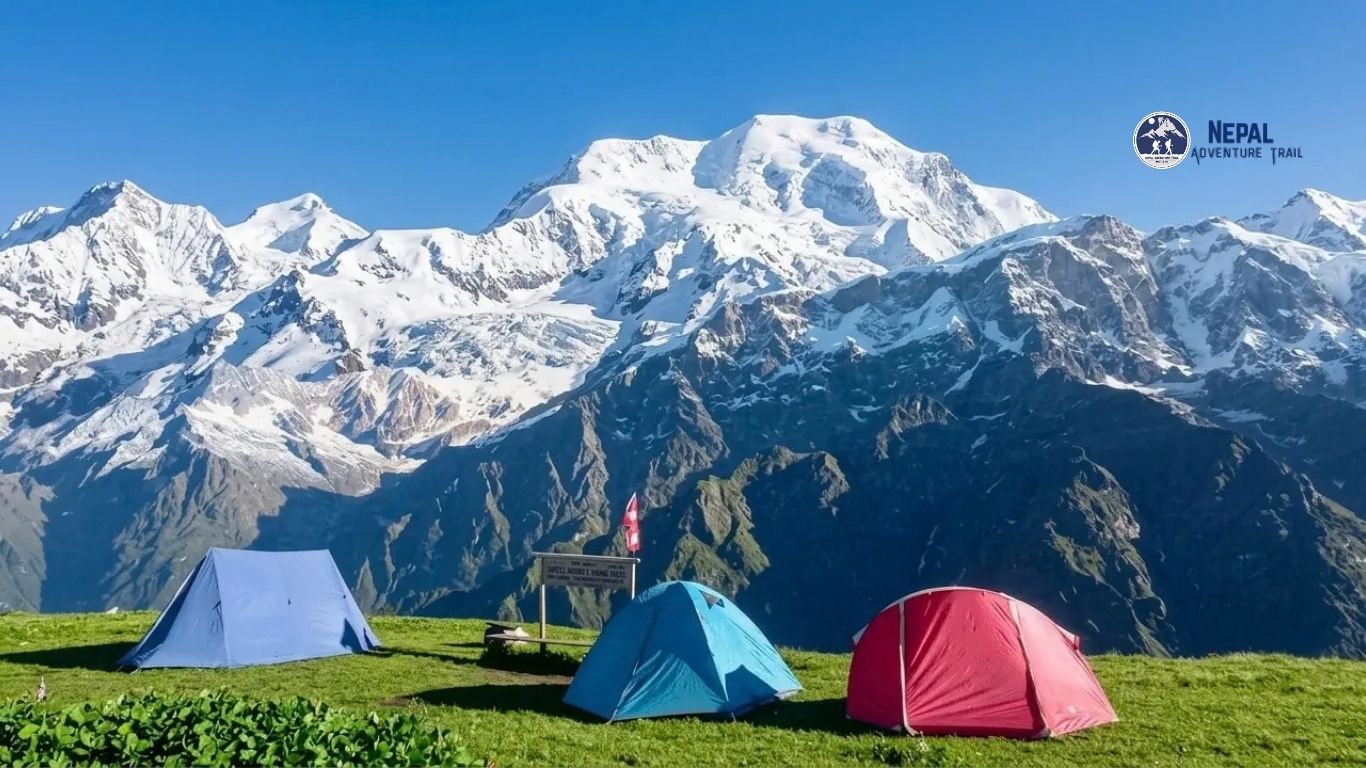
Kori Trek Nepal runs from Sikles, a large Gurung settlement northeast of Pokhara, up through oak and rhododendron forest to Kori Danda, a grazing ridge reported at around 3,800 to 3,870 meters. From the top, Annapurna II, Lamjung Himal, and Machhapuchhre line up across the horizon. The route is short. It can be done in three to five days from Pokhara, or stretched to seven or eight with a detour to Kapuche Lake.
The trail is newly popularised, and that shapes everything. Lodges are fewer. Facilities are simpler. Information online is inconsistent. This guide separates what is widely reported from what varies by operator, so you can plan with realistic expectations.
What Is Kori Trek?
Kori Trek, Kori Danda Trek, Kori Hill Trek and Kori Village Trek are different names for essentially the same route: the climb from Sikles to the Kori Danda viewpoint. “Danda” means ridge. The “village” in some names points to Sikles, the trailhead, rather than to a separate settlement.
What varies is the route and the length.
- Short version: Sikles, Tasa (also spelled Tasha), Kori Danda, and back. Operators sell this as 3 to 5 days from Pokhara.
- Longer version: Sikles, Hugu Goth, Nohtha, Kori Danda, then down. Usually 6 to 10 days with travel days included. Kapuche Lake is often slotted in here.
The trek suits people who want mountain scenery without Poon Hill or Annapurna Base Camp traffic. It is not a teahouse circuit with a lodge every hour. Treat it as a village-to-ridge climb with basic support.
Where Is Kori Danda?
Kori Danda sits in Kaski District, Gandaki Province, in the northeast of the Pokhara valley. Operators and maps place the route inside the Annapurna Conservation Area, which is why the ACAP permit appears on every package. The ridge is reached from Sikles, roughly 40 to 47 km from Pokhara by road depending on the source.
Think of it in layers. Pokhara is the lowland base at about 822 m. Sikles, at about 1,980 m, is the trailhead and a destination in itself. Above it, the trail climbs through forest to the grazing zone around 3,000 m and the ridge above. The ridge faces the Annapurna Himalaya, with Lamjung Himal and the Manaslu direction off to the east.
Why Trek Kori Danda?
Three reasons come up repeatedly.
Quiet. Compared with the well-worn Annapurna routes, trail traffic is light.
Culture. Sikles is among the larger Gurung villages in Nepal. Stone and slate houses, terraced fields, and homestay hosts who have lived here for generations.
A short route with a real viewpoint. You gain about 1,800 m of elevation from Sikles to the ridge. You end up at an altitude that rivals longer treks.
The caveat: “quiet” is relative and can change. As more operators list Kori, the trail will get busier.
Kori Trek Route
Operators agree on the broad shape, then differ on details. Where they differ, the figures below are given as ranges.
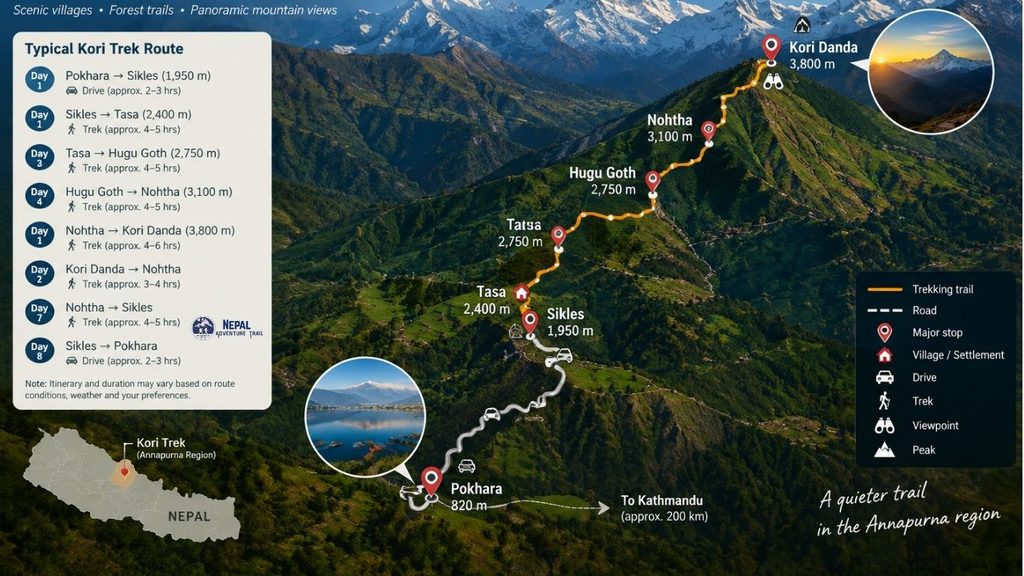
Pokhara to Sikles. A jeep ride on a graded dirt road, about 40 to 47 km. Sources quote anywhere from about 2 to 5 hours. Conditions, vehicle type and the season explain much of the gap.
Sikles (about 1,980 m). The trailhead. Many trekkers sleep here at least once.
Tasa/Tasha (roughly 2,400 to 2,700 m). The short-route overnight. Sources disagree on its elevation, so treat any single figure with caution. The walk from Sikles is described as 5 to 7 hours, with a drop to the river and hydropower station before the climb.
Hugu Goth (about 2,050 to 2,160 m). The long-route stop. Herders’ sheds, now with basic lodging or camping. Reported at 3 to 6 hours from Sikles.
Nohtha (about 3,000 to 3,050 m). A high-pasture stop with very basic lodging. Four to five hours from Hugu Goth through rhododendron, fir and pine.
Kori Danda (about 3,800 to 3,870 m). The summit day from Nohtha is short in distance, about 5 km, but steep. Estimates run from 3 to 6 hours.
Descent. Back to Sikles in 6 to 8 hours, then a jeep to Pokhara.
Kori Trek Itinerary
Short Kori Trek (4 days from Pokhara)
Day 1: Drive Pokhara to Sikles. Walk toward Tasa. Overnight about 2,400 to 2,700 m. Expect a long first day because you drive and climb in one go.
Day 2: Climb Tasa to Kori Danda (about 3,800 to 3,870 m). Some packages sleep at a basic lodge on the ridge. Others return to Tasa the same day.
Day 3: Sunrise at the viewpoint if you slept up top. Descend to Tasa or all the way to Sikles. Descent days are long, 5 to 8 hours.
Day 4: Drive back to Pokhara.
Extended Kori Trek (7 to 8 days with Kapuche Lake)
Day 1: Pokhara to Sikles by jeep. Explore the village.
Day 2: Sikles to Hugu Goth (about 2,050 to 2,160 m). Reported 3 to 6 hours.
Day 3: Hike to Kapuche Lake (about 2,450 to 2,546 m), roughly 2.5 hours up, and return to Hugu Goth.
Day 4: Hugu Goth to Nohtha (about 3,000 to 3,050 m), 4 to 5 hours.
Day 5: Nohtha to Kori Danda and back to Nohtha, or onward depending on the plan. Start early.
Day 6: Descend to Sikles.
Day 7: Drive to Pokhara. Add Kathmandu days if you are starting from there.
Several operators sell 9 to 10 day versions. Most of the added time is Kathmandu to Pokhara travel and buffer days, not extra walking.
Kori Trek Highlights
Sikles. Walk through it before you leave. The village is the cultural anchor of the trip, and a homestay night is the best way to see it.
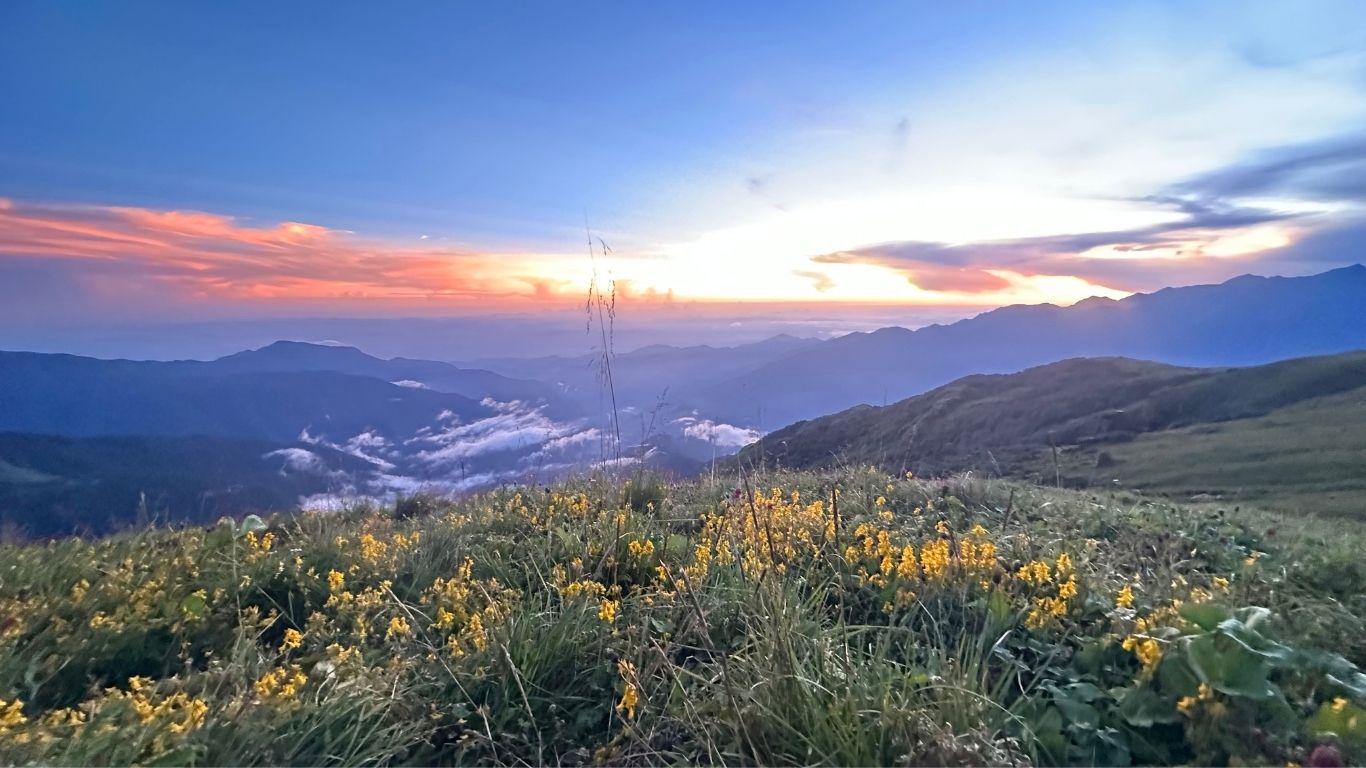
The forest belt. Oak and rhododendron dominate the middle section. The character changes noticeably above the farmland, where shade, moss and cooler air replace terraces.
Alpine pasture. Above about 3,000 m the trees give way to open grazing land. Livestock and seasonal herders use these slopes. The landscape feels exposed, and wind and cloud arrive quickly.
Kori Danda viewpoint. A broad ridge with a wide horizon rather than a single summit. Reaching it at dawn gives the clearest conditions.
Kapuche Lake. Optional. Several operators sell it as a side trip from Hugu Goth, not part of the core Kori Danda climb. It sits at a much lower elevation and is described as frozen in winter. Decide whether you want it, because it adds a day.
Mountains Seen From Kori Danda
Operators consistently report Annapurna II (about 7,937 m), Lamjung Himal (about 6,983 to 6,988 m) and Machhapuchhre (about 6,993 m). Annapurna IV is also commonly named. A few operators mention Manaslu on very clear days, but treat that as a bonus, not a promise.
Visibility depends on timing. Mornings are usually clearest. By midday, cloud often builds on the ridges. In autumn and again in late winter and early spring, haze is lower and the horizon is sharper.
Kori Trek Difficulty
Moderate, with a hard section. That is the honest summary.
The route is not technical. There are no glaciers to cross and no exposed scrambling. But the climb from Sikles to the ridge gains roughly 1,800 m, and the final push from Nohtha is steep. Trails are earthen and rooty in the forest, with rock steps in places. Descents are long, and tired knees pay for them.
Daily walking runs about 4 to 8 hours depending on the day.
- First-time trekkers: Possible if you are fit, walk regularly and are comfortable with long climbing days. The short version compresses the effort, which makes it harder, not easier.
- Experienced trekkers: Straightforward.
- Families and older travellers: Depends on fitness and health, not on age alone. Facilities are basic and evacuation takes time, so plan conservatively.
- Children: Judge by the child’s stamina and the altitude. Sleeping near 3,800 m is a serious step.
Weather, trail condition and personal health matter more than any grade label.
Kori Trek Altitude and Acclimatization
The highest point is reported at 3,800 m by most sources and 3,870 m by a few. Use “around 3,800 to 3,850 m” unless you have a verified survey. One operator listing quotes 4,500 m, which conflicts with every other source and should be disregarded.
Sleeping altitudes matter more than the summit. Nohtha is about 3,000 m. A ridge lodge, if used, is near the top. That is high enough for some people to feel it.
Operators generally describe the risk as low to moderate. That is reasonable, but “low” is not “none.” Altitude affects people unpredictably, and a fast ascent from Sikles raises the odds.
Practical points:
- Climb slowly. Do not race the first day.
- Drink steadily.
- Mild headache, poor sleep and low appetite are common early signs.
- Worsening headache, vomiting, confusion or unsteadiness mean you stop climbing and descend.
- The longer itinerary builds in gradual gain. The short one does not.
Best Time for Kori Trek
There is no single best season. There are trade-offs.
Spring (March to May). Rhododendron forests flower, with April the usual peak. Days warm up, but afternoon haze and cloud can soften distant views.
Monsoon (June to September). Leeches, wet trails, cloud and landslide risk on the road to Sikles. Views are unreliable. Not a good choice for most trekkers.
Autumn (October to November). Clear air, stable weather and the best chance of sharp mountain views. It is also the busiest period, so confirm lodging in advance.
Winter (December to February). Cold nights, possible snow near the ridge, and very quiet trails. Sunrise views can be superb. Lodges may be closed or limited, so check first.
Kori Trek Permits
For foreign nationals, the commonly reported 2026 figures are:
- ACAP (Annapurna Conservation Area Permit): NPR 3,000. SAARC nationals pay NPR 1,000. Children under 10 are free. Issued by NTNC, single entry for the whole trek, and the fee does not change with trip length.
- TIMS: NPR 2,000 for individuals and about NPR 1,000 for groups or SAARC trekkers in most published schedules. Reports on how strictly it is checked in the Annapurna region vary, and it is issued through registered agencies.
Kori is not a restricted-area trek, so no special restricted-area permit applies. ACAP can be arranged through NTB or NTNC counters in Kathmandu and Pokhara, online via the NTNC portal (a card gateway fee applies), or by your agency. Rules change, so confirm both permits with your operator shortly before departure.
How to Get to Kori Trek
Kathmandu to Pokhara. Tourist bus, private vehicle or a short flight. Road travel is usually 6 to 8 hours depending on traffic and conditions.
Pokhara to Sikles. A dirt road, about 40 to 47 km. Operators quote everything from about 2 to 5 hours. Jeeps are the usual choice. Buses and shared vehicles run too but are slower. The surface gets rough after rain.
Sikles to the trail. Walking begins in or just above the village.
Check road conditions before you travel. A washed-out section can add hours or force a change of plan.
Kori Trek Cost
There is no single Kori Trek price. What you pay depends on how you travel.
- Independent or semi-independent: you pay for the jeep, permits, lodging and food, plus a guide if you hire one.
- Private guided package: adds a guide, usually a porter, and logistics.
- Group package: shares guide and vehicle costs.
Cost components to budget:
- Jeep transport Pokhara to Sikles and back
- ACAP and TIMS
- Lodging and meals (basic, so cheaper than major circuits)
- Guide and porter wages
- Travel insurance with high-altitude cover
- Tips and incidentals
Package prices vary widely by season, group size and what is included. Ask any operator for an itemised quote, and compare what is and is not covered.
Accommodation and Food
Expect basic.
- Sikles: homestays and small lodges. Meals are home-style dal bhat and similar.
- Hugu Goth and Nohtha: very simple lodges or camping. Shared rooms, cold bathrooms, limited choice.
- Kori Danda: a small number of basic lodges reported by some operators. Others route you back down.
Hot showers are unreliable or absent higher up. Electricity and phone signal are patchy. Charge devices in Sikles and carry a power bank. Carry cash, because there are no ATMs on the trail.
Some itineraries use camping with a cook crew, especially in the off-season.
What to Pack
- Broken-in trekking boots and spare socks
- Warm layers, thermals, fleece or light down jacket
- Waterproof jacket and trousers
- Hat, gloves, sun hat, sunglasses, sunscreen
- Sleeping bag rated for cold nights (lodges may not supply enough blankets)
- Trekking poles, especially for the descent
- Headlamp
- Water bottle and purification tablets or filter
- Basic first-aid kit and personal medication
- Power bank, passport copies, permits, cash
- Rain cover for your pack
Add insect repellent and leech protection in monsoon. Add a warmer down layer for winter.
Is Kori Trek Safe?
Mostly manageable, with real risks.
- Altitude: low to moderate, but not zero.
- Weather: fast cloud and cold on the ridge. Afternoon storms are possible.
- Trails: steep sections and slippery forest paths. Descents cause many injuries.
- Remoteness: fewer lodges and less passing traffic than on main routes. Help takes longer to reach you.
- Roads: the jeep track to Sikles can be rough or blocked.
- Communication: signal is unreliable. Agree on a plan before you go.
Buy insurance that covers trekking to at least 4,000 m and helicopter evacuation.
Can You Trek Kori Without a Guide?
Two separate questions: what is legally required, and what is sensible.
Legal position. Many operators state that foreign trekkers must now use a licensed guide arranged through a registered agency in Nepal’s conservation areas, including Annapurna, and that TIMS is issued through agencies. Other sources describe this as inconsistently enforced. No clear government statement specific to Kori was found, and the published guidance contradicts itself, so confirm with Nepal Tourism Board, TAAN or a registered agency before you plan to go without one.
Practical position. Even where rules are loose, a guide helps. Lodging on this route is sparse and sometimes unmarked. Trail junctions are not always clear. Weather turns fast. And a guide gives you a way to communicate if someone is hurt.
Kori Trek vs Mardi Himal, Poon Hill and ABC
| Kori Trek | Mardi Himal | Poon Hill | Annapurna Base Camp | |
|---|---|---|---|---|
| Typical length | 3 to 8 days | 5 to 7 days | 4 to 5 days | 7 to 12 days |
| High point | About 3,800 to 3,870 m | Roughly 4,000 to 4,500 m | About 3,210 m | About 4,130 m |
| Crowds | Light, but changing | Moderate to busy | Busy | Busy |
| Lodging | Basic, limited | Established teahouses | Well developed | Well developed |
| Culture | Strong Gurung focus | Mixed | Mixed | Mixed |
| Road access | Rough jeep road | Better | Good | Good |
If your priority is quiet trails and village culture, Kori fits. If you want well-developed lodging and predictable logistics, Mardi Himal, Poon Hill or ABC are easier. If you want the closest mountain views and a longer commitment, ABC delivers that. If you have only a few days and want a real ridge climb, Kori can work.
On Mardi Himal specifically: both give high-ridge views of Machhapuchhre. Mardi Himal has more infrastructure and more trekkers. Kori has less of both. Choose by how much comfort and company you want.
Responsible Trekking on the Kori Trail
When a trail is lightly used, small habits have large effects.
- Stay in Gurung-run lodges and homestays. Money stays in the village.
- Pack out what you carry in. Waste management is thin above Sikles.
- Use a refillable bottle. Bottled water adds plastic that nobody collects.
- Stay on the trail. Alpine turf recovers slowly.
- Give livestock space. Do not chase or feed animals.
- Ask before photographing people and homes.
- Hire local guides and porters, and pay and treat them fairly.
Why Trek Kori with Nepal Adventure Trail?
Kori involves a jeep transfer, a permit stack, uneven lodging and a route with several variations. If you would rather not coordinate that yourself, Nepal Adventure Trail can arrange permits, transport, guide and porter support and accommodation, and adjust the itinerary to your pace and available days.
Who Should Choose Kori Trek?
It suits trekkers who want quieter trails, an interest in Gurung culture, photographers chasing dawn light, and travellers with limited time who still want a proper climb.
Choose something else if you want hot showers, reliable Wi-Fi and dense lodging, if you are nervous about remote terrain, or if you have limited fitness. Poon Hill or a lower-altitude Pokhara hike is a gentler start.
Practical Tips
- Start walking early. Cloud builds by midday.
- Carry enough cash for the whole trek.
- Confirm lodging ahead in quiet months.
- Check road conditions before leaving Pokhara.
- Carry layers even in warm months.
- Expect basic facilities and plan food accordingly.
- Confirm permits and guide rules shortly before departure.
- Build one spare day in for weather.
- Do not underestimate the final ascent. It is short and steep.
Kori Trek FAQs
What is Kori Trek Nepal?
Kori Trek Nepal is a short trek in the Annapurna region that starts at Sikles village, northeast of Pokhara, and climbs to the Kori Danda ridge at around 3,800 to 3,870 m. It combines Gurung village culture, forest, high pasture and Himalayan views. It is sold under several names, including Kori Danda Trek and Kori Hill Trek, and takes anywhere from 3 to 10 days depending on the route.
How high is Kori Danda?
Most sources put Kori Danda at about 3,800 m. A few operators list 3,870 m. Because published figures differ, “around 3,800 to 3,850 m” is the safest way to describe it. Sleeping points are lower, with Nohtha at about 3,000 m and Tasa roughly 2,400 to 2,700 m, depending on the source. Treat any single exact number as approximate.
How difficult is Kori Trek?
It is moderate, with a demanding climb. The trail is not technical, but the ascent from Sikles gains about 1,800 m and the final stretch to the ridge is steep. Daily walking runs roughly 4 to 8 hours. Descents are long and hard on the knees. Reasonable fitness and some previous hiking experience make the trek far more comfortable.
How many days does Kori Trek take?
The short route from Pokhara usually takes 3 to 5 days. The longer route through Hugu Goth and Nohtha takes about 6 to 8 days on foot and road, and operators who include Kathmandu travel sell 9 to 10 day packages. Kapuche Lake adds a day. Weather and road conditions can affect timing, so a spare day is sensible.
What permits are required for Kori Trek?
The Annapurna Conservation Area Permit is the main requirement. Commonly reported 2026 fees for foreigners are NPR 3,000 for ACAP, with a lower rate for SAARC nationals and free entry for children under 10. A TIMS card, about NPR 2,000 for individuals, is also widely listed, though enforcement is reported inconsistently. Kori is not a restricted area, so confirm the current rules with your agency.
What is the best time for Kori Trek?
Autumn, October to November, usually brings the clearest views, and spring, March to May, brings rhododendron flowers. Winter offers crisp air but cold nights, snow near the ridge and limited lodging. Monsoon brings leeches, cloud and road problems. The right season depends on whether you value clarity, flowers or solitude most.
Can beginners do Kori Trek?
Fit beginners can, but it is not an easy first trek. The climb is steep and the facilities are basic. If you have never done multi-day walking, consider the longer itinerary with Kapuche Lake, which spreads the effort out, and train beforehand. Poon Hill is a gentler introduction if you are unsure.
Can you trek Kori without a guide?
Rules appear to be tightening, and many operators state that foreign trekkers must use a licensed guide through a registered agency. Published guidance is inconsistent, so check with Nepal Tourism Board, TAAN or an agency before you go. Practically, a guide is useful on this route because lodging is sparse, junctions can be unclear and help is slower to arrive.
How much does Kori Trek cost?
It depends on how you travel. Independent trekkers pay for jeep transport, permits, lodging and food, plus a guide if required. Guided packages add guide and porter wages and logistics. Group trips reduce per-person costs. Because prices vary with season, group size and inclusions, ask for an itemised quote and check whether permits and transfers are covered.
How do you reach Sikles from Pokhara?
By road, about 40 to 47 km on a graded dirt track, usually in a 4WD jeep. Travel time is quoted anywhere from about 2 to 5 hours depending on the vehicle and conditions. Shared jeeps and buses run too, but fill up and are slower. The road can worsen after rain, so check conditions before leaving.
Is Kapuche Lake included in Kori Trek?
Not always. Kapuche Lake, at roughly 2,450 to 2,546 m, is usually offered as an optional side trip from Hugu Goth on the longer itinerary, not as part of the short Kori Danda climb. It adds a day. Ask your operator whether it is included, because some packages do and others skip it entirely.
What should you pack for Kori Trek?
Pack warm layers, a waterproof jacket, trekking boots, a sleeping bag suited to cold nights, trekking poles, a headlamp and a water bottle with purification. Add sunscreen, sunglasses, a first-aid kit, personal medication, a power bank, documents and cash. Adjust for season: leech protection in monsoon, extra insulation in winter. Avoid overpacking.
Conclusion
Kori Trek Nepal is a short, steep, culturally rooted route with a strong ridge view at the top. It rewards people who are comfortable with simple lodging and a climb that does not let up. Check the permit and guide rules close to your dates, pick the season that fits your priorities, and leave a buffer day for weather and the road.