
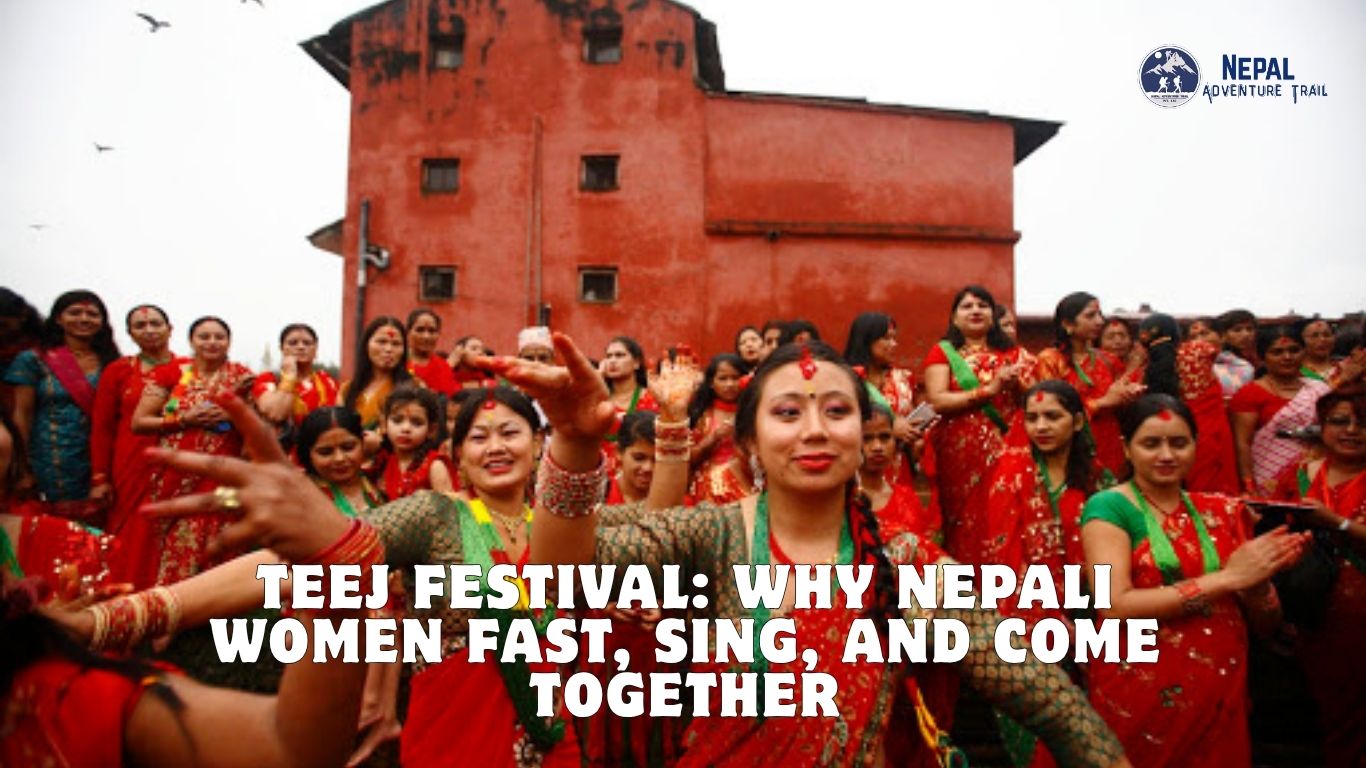
Walk through Kathmandu in late August or September and you will notice it before you understand it. Red saris everywhere. Bangles clinking on wrists. Women singing in courtyards, at bus stops, on the steps of temples. This is Teej festival, and for three days it changes the rhythm of the entire country.
Teej festival is not a spectacle staged for outsiders. It is a lived religious event, built around fasting, prayer, and a reunion of women that has nothing to do with tourists at all. Understanding what is actually happening, rather than just photographing it, is the difference between witnessing Teej and simply passing through it.
This guide breaks down the meaning, the mythology, the physical demands of the fast, and how a visitor can be present for Teej in Nepal without disrupting something that was never designed as entertainment.
Understanding Teej: Why Haritalika Teej is a Cultural Anchor
Ask a Nepali woman what Teej means to her and you will rarely get the same answer twice. For some it is devotion. For others it is the one guaranteed trip home each year. For many it is both at once.
Haritalika Teej traditions center on a single idea: a woman’s fasting and prayer can protect and strengthen her marriage, or, for unmarried women, can help secure a good one in the future. That belief sits underneath everything else you will see during the festival.
But Teej in Nepal has grown into something larger than a religious obligation. It is also a sanctioned pause. Married women travel back to their parents’ homes, sometimes for the only time all year. Sisters who have not seen each other in months sit in the same room again. Old friendships get renewed over shared food and old songs.
The government of Nepal recognizes this weight. Haritalika Teej is an official public holiday for female employees, one of the few holidays in the country reserved specifically by gender. That alone tells you how central this festival is to national life, not just to religious practice.
The Mythology of Teej: Goddess Parvati and Shiva
The story at the heart of Teej comes from Hindu mythology, and it is worth knowing before you watch a single ritual.
Parvati wanted to marry Shiva, but her father had already arranged a different match for her. Rather than accept it, she left, retreated into the forest, and undertook years of extreme fasting and meditation to prove her devotion. Shiva eventually recognized her sacrifice and accepted her as his wife.
Every fasting woman during Teej is, in some sense, retelling that story. Married women fast for the long life and wellbeing of their husbands, echoing Parvati’s devotion after the marriage was secured. Unmarried women fast hoping for a husband with Shiva’s qualities: steady, faithful, worth waiting for.
It is easy to reduce this to folklore, but that misses the point. For the women fasting, the mythology is not background information. It is the reason they are standing in a temple queue for six hours in the heat.
The Rhythms of the Festival: A Day-by-Day Experience
Teej unfolds over three distinct days, and each one has its own mood. The transition between them is sharp: from feasting, to austerity, to cleansing.
Dar: The Pre-Fast Feast
The festival opens with Dar Khane Din, the feast day. Families and friends gather the night before the fast begins, and women eat a rich, celebratory meal, knowing that for the next full day they will consume nothing at all.
Dar is loud in a way the rest of Teej is not. Kitchens fill with the smell of ghee, rice, and sweets. Groups of women eat together, sometimes past midnight, building up reserves before the fasting starts at dawn.
There is a practical logic underneath the celebration. Dar is not indulgence for its own sake. It is preparation for a day that will demand real physical endurance.
The Fast: Rigor, Community, and Devotion
This is the core of Teej fasting in Nepal, and it should not be romanticized. Many women observe a nirjala fast, meaning no food and no water, for the entire day. In late-monsoon heat, that is a serious physical trial, not a symbolic gesture.
Women dress in red saris, apply mehendi, and put on their wedding jewelry, then walk, often for hours, to reach temples dedicated to Shiva. Pashupatinath in Kathmandu draws some of the largest crowds in the country. Waiting in line under a hot sun without a sip of water is common, and it is taken as a mark of devotion rather than a hardship to be minimized.
What makes the fast bearable, according to many women who observe it, is that they are almost never doing it alone. Groups fast together, sing together, dance together in temple courtyards to keep spirits up. The physical strain is real. So is the communal support that carries women through it.
This is also where the festival’s resilience becomes visible. Older women who have fasted for decades stand beside teenagers fasting for the first time. Nobody is forcing anyone to participate at this intensity, and yet year after year, most choose to.
The Final Day: Rishi Panchami (Cleansing)
The festival closes with Rishi Panchami, a day built around ritual purification rather than deprivation. Women take a ceremonial bath, often using red mud and the leaves or twigs of specific plants, and offer prayers to seven sages, or Rishis, honored on this day.
Where the previous day was about restraint, Rishi Panchami is about release. Women eat again, sing again, and the atmosphere across the city visibly loosens. It functions as a kind of decompression after the intensity of the fast.
By the end of Rishi Panchami, the festival has moved through its full arc: gathering, sacrifice, and cleansing. Understanding that arc is part of what makes the significance of Teej click into place for an outside observer.
Seeing Red: The Symbolism of Dress and Dance
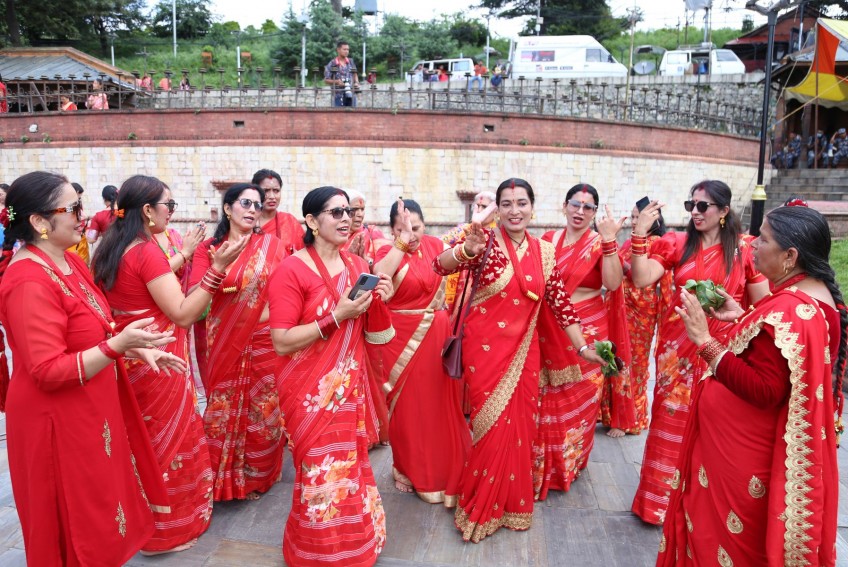
If you only remember one visual from Teej, it will be the color. Streets, temple courtyards, and buses fill with women in red, and the effect at scale, thousands of red saris moving through Kathmandu at once, is genuinely striking.
Why Red? (Significance of the wedding-like attire)
Red is not a random festival color here. It is the color most Nepali brides wear on their wedding day, and wearing it during Teej deliberately echoes that. Married women are, in effect, renewing a symbolic connection to their wedding day each year.
Green bangles and green saris often appear alongside the red, tied to fertility and the lushness of the monsoon season itself. Gold jewelry, sometimes an entire dowry set, gets worn out in public specifically for this occasion.
For unmarried women, wearing the same red attire is an act of anticipation. They are dressing for the marriage they hope to have, styling themselves in the clothing associated with the outcome they are fasting for.
The Role of Music and Traditional Songs
Teej cannot be separated from its songs. Folk songs specific to the festival, often called Teej songs, are sung in courtyards, temples, and homes throughout the three days, and many of them carry lyrics far more complicated than pure celebration.
Traditionally, these songs gave women a rare public outlet to voice things otherwise left unsaid: the hardships of married life, homesickness, frustration with in-laws, longing for a parental home. Underneath the dancing, Teej songs have functioned for generations as one of the few sanctioned spaces for women to speak openly about difficulty.
Modern Teej songs have shifted, and some now lean toward pop-style celebration rather than lament. But the older repertoire is still sung widely, and it is worth listening closely if you get the chance. The joy on the surface often sits over something more complex underneath.
Cultural Etiquette for Travelers
Teej celebration for tourists is possible, and welcomed in most public spaces, but it comes with real boundaries that are easy to miss if you are only thinking about your camera.
Capturing the Moment (Photography protocols)
Public dancing in courtyards and streets is generally fine to photograph. Women dancing together in an open square during Teej are usually aware they are visible and are not disturbed by a respectful photo from a reasonable distance.
Temple prayer is a different situation entirely. Do not photograph women mid-prayer, especially at close range, and never use flash near an altar or shrine. If you are unsure whether a moment is public performance or private devotion, assume it is private and lower the camera.
A simple rule holds up well here: ask before photographing anyone up close, accept a no without pushing, and never block a queue or a walking path to get a better angle. Long lenses from a respectful distance almost always work better than getting physically close to a fasting woman who has already been standing in line for hours.
Participating vs. Observing (Understanding the private nature of the prayer vs. the public nature of the celebration)
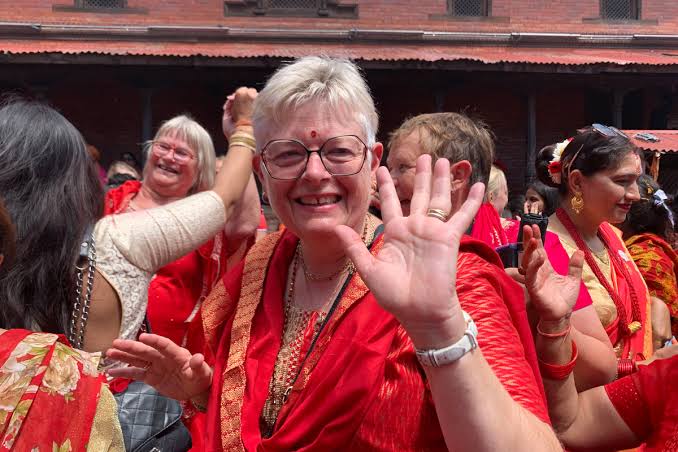
Street dancing, group singing, and the general festival atmosphere are open. Tourists are generally free to watch, and in some casual settings, even join a dance circle if invited.
Prayer at the temple is not open in the same way. This is a devotional act tied to a woman’s marriage or future marriage, carried out after hours without food or water, and it deserves the same distance you would give any serious religious ritual in any country. Standing at the edge and observing quietly is appropriate. Inserting yourself into the ritual space is not.
The general principle: celebration is shared, prayer is personal. Read the space before deciding how close to get.
What to Expect in Kathmandu (Pashupatinath Temple)
Pashupatinath becomes one of the most intense places in Kathmandu during Teej. Thousands of women converge on the temple complex, most in red, many having walked a considerable distance already before the queue even starts.
The smell of incense sits thick in the air, mixed with marigold and the smoke from small fires along the Bagmati River. Lines stretch for hours, and the temple staff and volunteers manage crowds that can run into the tens of thousands over the fasting day alone.
For a visitor, the outer courtyards and the areas along the river offer a clear view of the scale of the event without requiring entry into restricted inner sections, some of which are closed to non-Hindus regardless of the day. Arriving early in the morning gives the best sense of the atmosphere before the heat and the crowds peak.
If you plan to be near Pashupatinath during Teej, expect closed roads, heavy foot traffic, and very limited vehicle access nearby. Walking is the only realistic way to get close, and patience is part of the experience whether you are fasting or just watching.
Experience Teej With Local Insight
Teej is a powerful window into the social fabric of Nepal. It is a day of intense color, song, and devotion that shifts the energy of every town. At Nepal Adventure Trail, we help you understand the deeper cultural cycles of Nepal beyond the hiking trails. If you are planning to be in the country during the monsoon season, let us help you find the best way to witness this celebration with genuine respect and local insight.