
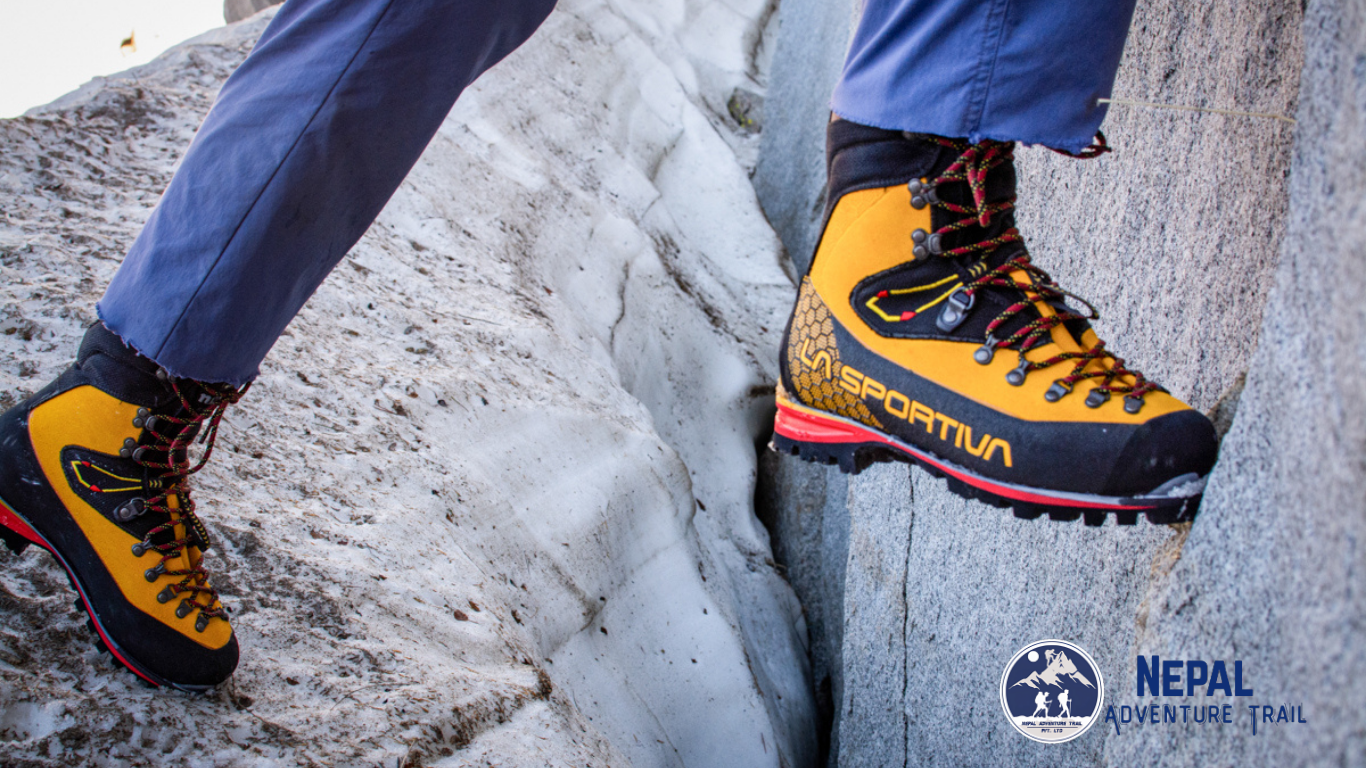
In the Khumbu, reputation is not built in shops or spec sheets. It is built on broken moraine, frozen mornings, and long days above 5,000 meters where gear either holds or fails. The La Sportiva Nepal Evo GTX has stayed in that conversation for years. Guides still use it. Climbers still trust it. Not because it is new, but because it works when conditions turn strict.
When people say La Sportiva Nepal, they usually mean this line of boots. The Evo GTX is one of the most proven high altitude boots for climbing, especially for Himalayan terrain where rock, ice, and mixed ground appear in the same ascent.
This is not a light trekking shoe. It is a structured mountaineering boot built for crampon use, glacier travel, and technical approaches in Nepal.
Construction: built for control, not comfort trends
The La Sportiva Nepal Evo GTX is a stiff, precision-focused boot designed for alpine environments.
Weight sits in the expedition category, roughly around 1.8–2.0 kg per pair depending on size. That weight is intentional. It stabilizes the foot under crampon load and reduces torsion on uneven terrain.
The upper uses high-quality leather reinforced with protective rubber edging. This matters in Nepal, where repeated contact with rock and ice quickly destroys softer materials.
Inside, Gore-Tex insulation provides waterproofing and breathability control. It is not just about keeping water out. It is about managing internal moisture during long ascents and cold descents.
The internal structure uses a rigid midsole designed for edging and crampon compatibility. On crampon compatible boots, stiffness is not optional. It is what keeps your foot stable when front-pointing on ice or traversing exposed ridges.
The Vibram outsole provides grip on mixed terrain. In the Himalaya, you are constantly switching surfaces—rock, ice, frozen soil, and loose moraine. The Evo GTX handles that transition without losing traction stability.
Where the Evo GTX performs in Nepal
The La Sportiva Nepal Evo GTX is not for casual trekking. It is built for altitude work and technical movement.
It performs best in:
- 5,000m–6,500m peaks in Nepal
- Glacier travel routes like Khumbu Icefall training zones
- Technical trekking in Nepal involving mixed terrain
- Climbs such as Island Peak, Mera Peak, and Lobuche East
This is where mountaineering boots for Nepal need to balance stiffness with walking efficiency. Too soft and crampons become unstable. Too stiff and long approaches become exhausting. The Evo GTX sits in a controlled middle zone.
On steep ice, the boot holds crampons firmly. On rock, it still allows enough precision to edge safely. That balance is why it remains widely used in Himalayan expeditions.
Where it is not ideal:
- Low altitude trekking below 3,000m
- Hot valley walks in summer conditions
- Long, easy hiking routes where flexibility matters more than rigidity
This is not a general hiking boot. It is a mountain tool.
Fit: where most mistakes happen
The La Sportiva Nepal Evo GTX fits differently than standard trekking boots. This is where many first-time users go wrong.
It has a technical fit profile:
- Narrow to medium last
- Strong heel lock
- Reduced toe box volume for precision control
This design improves crampon stability but reduces casual comfort.
Practical sizing guidance:
- Go at least half size larger than your everyday shoes
- Always test with thick expedition socks
- Expect foot swelling above 4,000 meters in Nepal
- Prioritize heel stability over toe comfort
At altitude, your feet change. They swell. They heat up differently. A perfect fit in Kathmandu becomes tight in Dingboche or Lobuche. That is how black toenails and pressure pain start.
In the Himalaya, a slightly roomy boot is safer than a tight one.
Performance in real Himalayan conditions
In real use across Nepal’s trekking and climbing routes, the Evo GTX shows why it has lasted so long in the market.
Cold performance
The insulation system handles sub-zero conditions well for its category. It is not an extreme 8,000m double boot, but for best boots for 6000m peaks, it performs reliably in most Himalayan seasons.
It works well in:
- Early morning ascents below -10°C
- Wind-exposed ridges near Lobuche
- Static belay situations during glacier travel
Crampon performance
As a crampon compatible boot, it performs cleanly with automatic crampons. The rigid sole prevents flex under load, which is critical during front-pointing on ice.
This stability is one of its strongest features.
Mixed terrain control
The Evo GTX is especially strong on mixed ground:
- Rock edging is precise
- Scree descents feel controlled
- Ice-to-rock transitions remain stable
This matters in Nepal, where terrain rarely stays consistent for long.
Comparison: why climbers choose it
To understand the La Sportiva Nepal Evo GTX, you need to compare it to other boot categories.
Lightweight trekking boots
- Better for comfort and warm-weather hiking
- Faster break-in
- Lower weight
But:
- No crampon reliability
- Poor insulation above 4,000m
- Weak ankle support on technical terrain
Heavy double boots
- Superior for extreme cold above 7,000m
- Maximum insulation
But:
- Heavy and slow
- Less precise on rock
- Overkill for most Nepal trekking peaks
Where the Evo GTX sits
The Evo GTX sits in the controlled technical range:
- Strong enough for glacier use
- Light enough for long approaches
- Precise enough for mixed terrain climbing
That balance is why it remains a standard technical trekking boot Nepal climbers still rely on.
FAQ
Are they overkill for the Everest Base Camp trek?
Yes. For standard trekking in Nepal, they are more boot than necessary. EBC does not require crampon stiffness unless combined with technical peaks.
How do I break them in before Nepal?
Use long hikes, stair climbs with weight, and uneven terrain walking. Aim for at least 20–40 hours of use before arrival.
Are they compatible with automatic crampons?
Yes. They are designed for full automatic crampon systems and perform well on steep ice.
Do I need special socks?
Yes. Use merino wool expedition socks. Avoid cotton completely. In colder conditions, double-layer systems are sometimes used.
How long do they last?
Typically 3–5 climbing seasons depending on terrain exposure and maintenance. Rock-heavy use reduces lifespan.
Can I buy them in Kathmandu?
Sometimes available, but sizing and stock are inconsistent. Most climbers prefer buying before arriving in Nepal.
Final thoughts
The La Sportiva Nepal Evo GTX is not a lifestyle boot. It is a controlled, technical platform designed for altitude, ice, and mixed Himalayan terrain. It stays relevant because it does not try to do everything. It focuses on stability, crampon performance, and durability in real mountain conditions.
The La Sportiva Nepal line continues to be trusted in the Khumbu for one reason: it performs when the terrain stops being forgiving.
The La Sportiva Nepal Evo GTX is a serious tool for a serious environment. But the right gear is only half the battle. If you want to ensure your gear is matched to your specific climbing itinerary, Nepal Adventure Trail helps trekkers dial in their equipment requirements and logistical needs for successful summits.