
The first sign that Indra Jatra has begun isn’t a sight; it’s a sound. Somewhere near Basantapur Durbar Square, a dhimay drum starts up, that deep, rolling double beat that Newar musicians have played at this exact festival for centuries, and within minutes the old city’s narrow streets fill with people moving toward it. Incense smoke curls up past carved wooden windows. Butter lamps flicker in doorways. Somewhere ahead, a chariot creaks forward on wooden wheels older than most of the buildings around it.
Indra Jatra is Kathmandu’s biggest and strangest street festival, and calling it merely a religious observance undersells what actually happens during these eight days. It’s part harvest ritual, part royal history, part living folklore, and part genuine civic identity for the Newar people who built the Kathmandu Valley long before it was a kingdom’s capital. Understanding the celebration properly means understanding two festivals layered on top of each other, one considerably older than the other.
What is Indra Jatra? Understanding the Festival’s Dual Identity
Long before anyone called it Indra Jatra, the Newar residents of the Kathmandu Valley celebrated Yenya, a name that simply means “Kathmandu festival” in Newar language, tied to the end of the monsoon and the gratitude owed for a successful harvest. Yenya predates the Shah dynasty’s arrival in the valley, and its rituals, the pole raising, the masked dances, the processions through the old city, developed organically out of Newar Buddhist and Hindu practice long before any king had a say in it.
When Prithvi Narayan Shah conquered the Kathmandu Valley in 1768, the timing happened to coincide with Yenya, and the new rulers folded the festival into their own mythology, foregrounding the story of Indra and rebranding the public face of the celebration around his imprisonment and release. The Newar name Yenya Punhi never disappeared, and locals still use it interchangeably with the newer name, but the Shah-era layer added the Kumari Jatra chariot procession and cemented Basantapur Durbar Square as the festival’s political and religious center, since it sat directly in front of the royal palace at Hanuman Dhoka.
This layered history of Indra Jatra is worth knowing before you show up expecting a single, tidy story. Ask three different Newar elders how the festival began and you’ll likely get three slightly different answers, each true in its own way, since the celebration absorbed centuries of local memory rather than springing from one official account.
That dual identity is worth carrying with you as you watch the festival unfold. What looks like a single, unified celebration is actually two traditions stacked together, one belonging to the valley’s original inhabitants and one layered on by a conquering dynasty centuries later, and both are still visibly present in the rituals today.
The Mythology: Why the God of Rain Was Imprisoned
The story locals tell to explain Indra Jatra involves a fairly undignified moment for the king of the heavens. Indra’s mother, sometimes called Dagini and sometimes Basundhara depending on which telling you hear, needed parijat flowers, a fragrant night-blooming jasmine, for a ritual she was performing. The flowers grew only in a particular garden in the Kathmandu Valley, so Indra descended to earth in human disguise to gather them himself.
The residents of the garden caught him mid-theft. Not recognizing the god standing in front of them, they tied him up and paraded him through the streets as an ordinary thief, which is precisely the humiliation that gives the festival its edge of dark comedy even now. It took his mother descending to search for him, a search still reenacted each year in the nighttime Dagin procession, before the truth came out and the valley’s residents realized who they’d actually captured.
Rather than punishing the people who’d wronged a god, the story goes the other way. Indra, moved by their honesty and lacking any real grudge, forgave them and promised something valuable in return for his release: that the coming winter months would bring gentle morning dew and mist to nourish the valley’s crops even without direct rainfall. That promise of winter dew is why farmers historically saw the festival as marking the safe transition from monsoon dependence into the drier months ahead, a genuine agricultural anxiety wrapped inside a myth about celestial embarrassment.
The Eight Days of Rituals: A Day-by-Day Experience
Day 1: Yosin Thanegu (Raising the Lingam Pole)
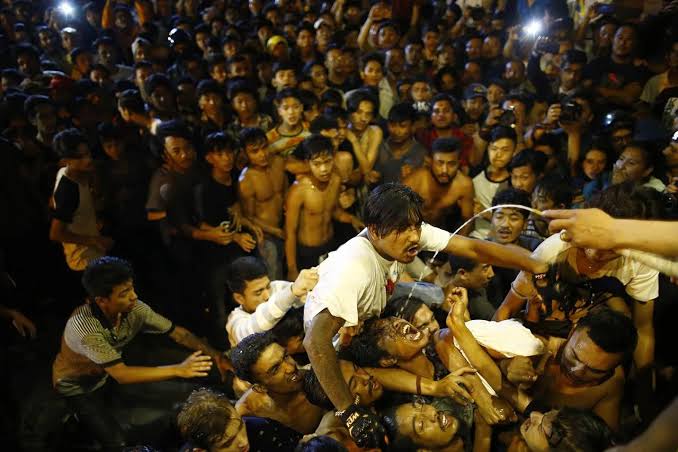
The festival opens with the raising of the Yosin, a towering wooden pole selected from a specific pine tree in the forest and carried into Basantapur Durbar Square by teams of local men pulling it upright with rope, chanting as they go. The pole represents Indra’s flag and his descent to the valley, and the physical effort required to raise it, dozens of people hauling in coordinated bursts, is itself part of the spectacle.
Once upright, the Yosin stands through the entire festival, and its eventual lowering on the final day carries its own superstition: the direction the pole falls as it’s brought down is read as an omen for the country’s fortune in the year ahead.
The Processions: Kumari, Bhairav, and Ganesh
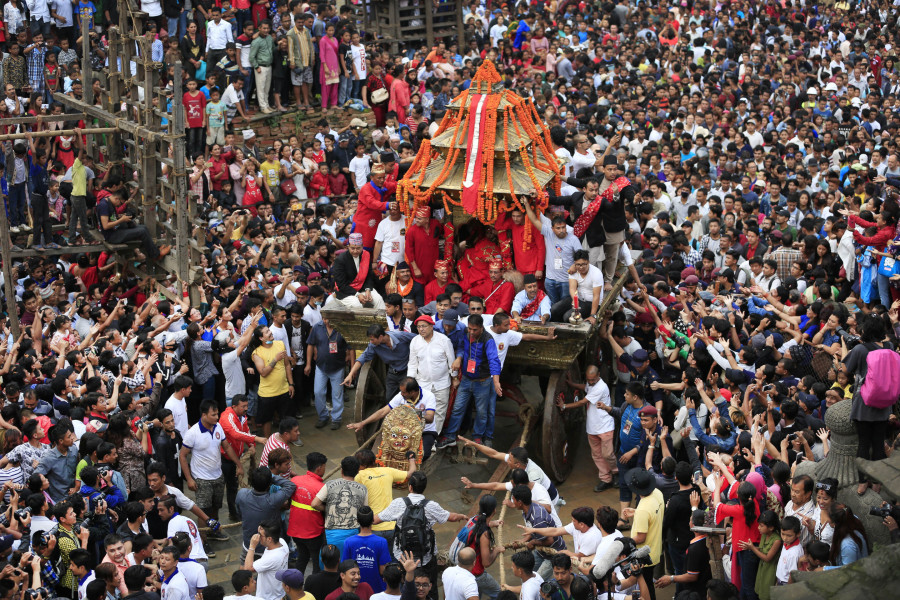
A day or so after the pole raising, the festival’s most photographed moment arrives with the Kumari Jatra. Three wooden chariots, one carrying the Kumari, Kathmandu’s living goddess, and two smaller ones carrying representations of Ganesh and Bhairav, are pulled by hand through the streets of the old city over the following days, following routes established generations ago.
Crowds pack the narrow lanes the chariots pass through, and getting a clear view requires arriving well before the procession starts, since the wheels move slowly and the whole event can take hours to work through even a short stretch of street. This is also when the Kathmandu Durbar Square festival atmosphere peaks, with vendors, musicians, and onlookers packed shoulder to shoulder for the better part of an afternoon.
Sacred Dances: Pulu Kisi, Majipa Lakhey, and Sawa Bhakku
Threaded through the procession days are the festival’s mask dances, and they’re where the celebration earns its reputation as a genuine spectacle rather than a solemn religious duty. Pulu Kisi is a large bamboo-and-cloth elephant, representing Indra’s mount Airavata, operated by several men hidden inside its frame, and it charges through crowds with a comic, lumbering energy that always draws laughter even from people who’ve seen it every year of their lives.
These mask-dance Kathmandu has preserved for centuries turn what could be a solemn procession into something closer to street theater, and they’re one of the defining features that make the Indra Jatra festival Nepal celebrates each September so visually distinct from anything else in the region.
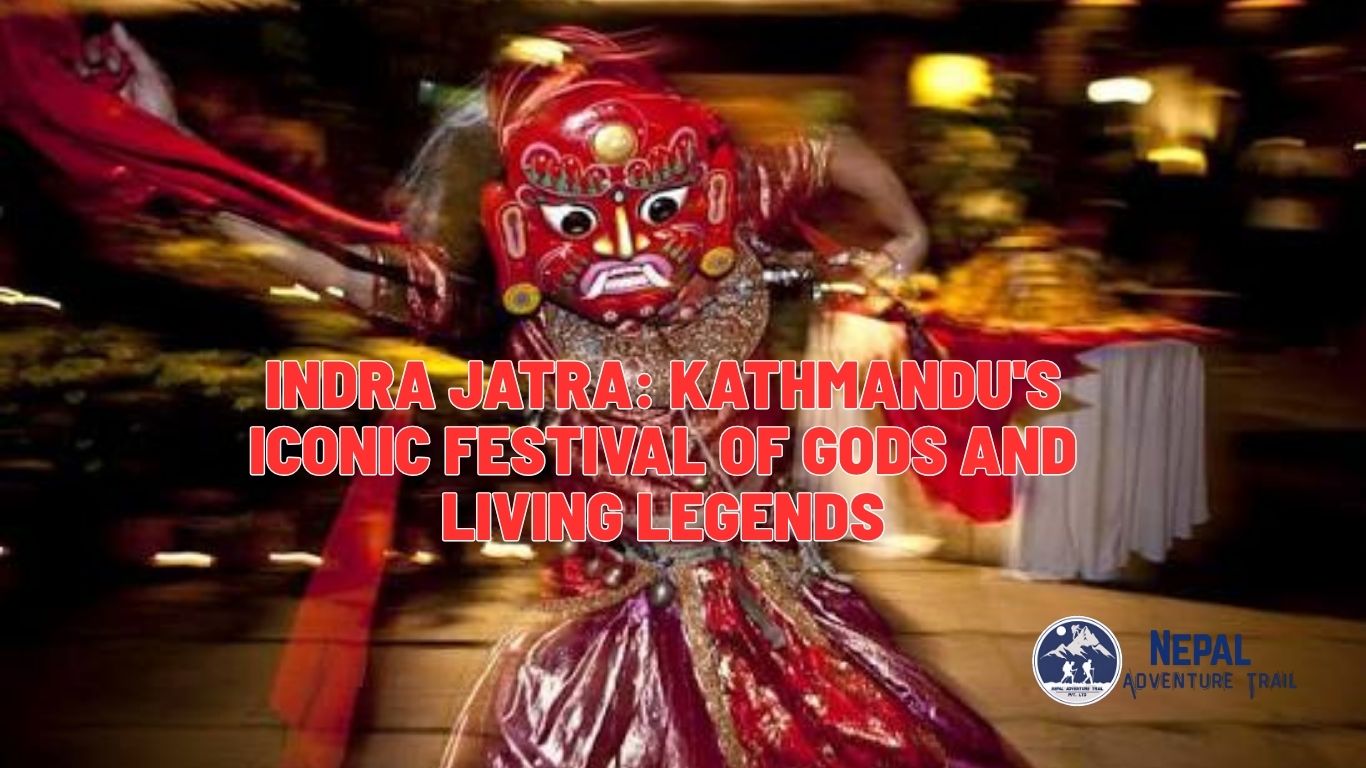
Majipa Lakhey cuts a sharper contrast. The dancer wears a fierce red mask with bulging eyes, prominent fangs, and a wild mane, moving through the streets with aggressive, unpredictable choreography meant to drive off evil spirits ahead of the sacred chariots. Despite his demonic appearance, the Lakhey is regarded as a protector of children, and residents place offerings before him as he passes, a contradiction that captures something genuinely moving about how the Newar tradition handles fear and protection as two sides of the same figure.
Sawa Bhakku, a Bhairav mask dance performed by dancers from Halchowk, adds another layer to the visual chaos, alongside smaller neighborhood performances like Devi Pyakhan that pop up across different squares throughout the eight days. Each neighborhood guards its own version of these dances jealously, passed down within specific families or guthi associations for generations, and the choreography, the drumming patterns, even the exact cut of a mask’s mane can differ noticeably from one part of the old city to another. Locals can often tell you which neighborhood a particular dancer trained in just by watching how he moves.
The dhimay and dha drums that accompany every dance and procession deserve their own mention. Played in tight, overlapping rhythms by teams of musicians walking alongside the performers, they’re what actually holds the whole sprawling event together acoustically, letting people blocks away know exactly which dance or chariot is approaching before they can see anything at all.
The Kumari Jatra: Honoring the Living Goddess
The Kumari occupies a unique position within Nepali religious life, a young girl selected through a rigorous traditional process and worshipped as the living incarnation of the goddess Taleju for the duration of her tenure. Indra Jatra is one of the rare occasions when she leaves the Kumari Ghar, her residence just off Basantapur Durbar Square, to be seen in public by the crowds who otherwise only glimpse her briefly at a window.
Her chariot procession isn’t simply ceremonial pageantry. Within Newar religious understanding, her public appearance during the festival reaffirms the valley’s connection to divine protection and, historically, renewed the ruling monarchy’s legitimacy, since Nepali kings traditionally received tika from the Kumari during this festival as a mark of her blessing over their rule. Watching her chariot pass, surrounded by attendants and moving at a deliberate, unhurried pace through streets packed with thousands of onlookers, is one of the more quietly powerful moments the festival offers.
Cultural Etiquette for Travelers
Photographing the Kumari from a respectful distance during her public procession is generally accepted, since this is precisely the moment she’s presented to public view. Photographing her inside the Kumari Ghar courtyard, or attempting to photograph her directly at close range during private moments, is not, and guards and attendants will intervene if that line gets crossed.
Sacred spaces around Basantapur, including temple platforms and shrine bases where people are sitting to watch the festival, aren’t simply public seating. Ask before stepping onto a plinth or stone platform that others are using as a viewing spot, and remove your shoes if you enter any temple threshold, even briefly.
Manage your expectations around the crowd itself. Indra Jatra draws enormous numbers of people into a genuinely compact old-city footprint, and the atmosphere runs closer to a packed street festival than an orderly ceremony. Keep a hand on your bag, stay aware of the people around you as the chariots approach, and accept that you’ll likely be jostled, pressed against strangers, and unable to move freely for stretches at a time. That’s simply the honest texture of attending Indra Jatra as a tourist, not a flaw in the experience.
Practical Logistics for Your Visit
Arrive at Basantapur Durbar Square at least ninety minutes before a scheduled procession if you want any real chance at a clear sightline. The raised plinths around the Kasthamandap and the Trailokya Mohan temple steps offer some of the better vantage points, though they fill early and locals often have informal claims on specific spots they’ve used for years.
For photographers, the upper floors of nearby cafes and guesthouses overlooking the square offer a genuinely useful alternative to fighting the street-level crowd, and several have made a modest business out of charging a small fee for rooftop access during the festival.
Try samay baji while you’re there. It’s the traditional Newar festival platter, beaten rice, spiced potatoes, black soybeans, ginger, and buffalo meat or egg for those who eat it, traditionally eaten during Newar celebrations and widely available from small stalls and restaurants around the old city during the festival window. It’s as close as you’ll get to tasting the same food Newar families have shared at Yenya for generations.
When is Indra Jatra exactly? Timing your trip requires checking the Nepali lunar calendar each year, since the festival falls on the full moon of Bhadra, typically landing sometime in early to mid-September on the Gregorian calendar, with the exact dates shifting annually. Unlike fixed-date holidays, there’s no shortcut here beyond confirming the specific dates for your travel year a few months out, ideally through the Nepal Tourism Board or a local operator who tracks the lunar calendar as part of their regular planning work.
Experience Indra Jatra With Local Guidance
Experiencing Indra Jatra is a deep dive into the soul of the Kathmandu Valley. However, navigating the city during the festival requires insider knowledge of the routes and ritual timing.
At Nepal Adventure Trail, we help you secure the best viewing spots and interpret the complex cultural significance of the processions. Let us help you plan a trip that honors the history and spirit of Kathmandu, so the eight days of Indra Jatra become something you understand as you watch, not just something loud and colorful happening around you.