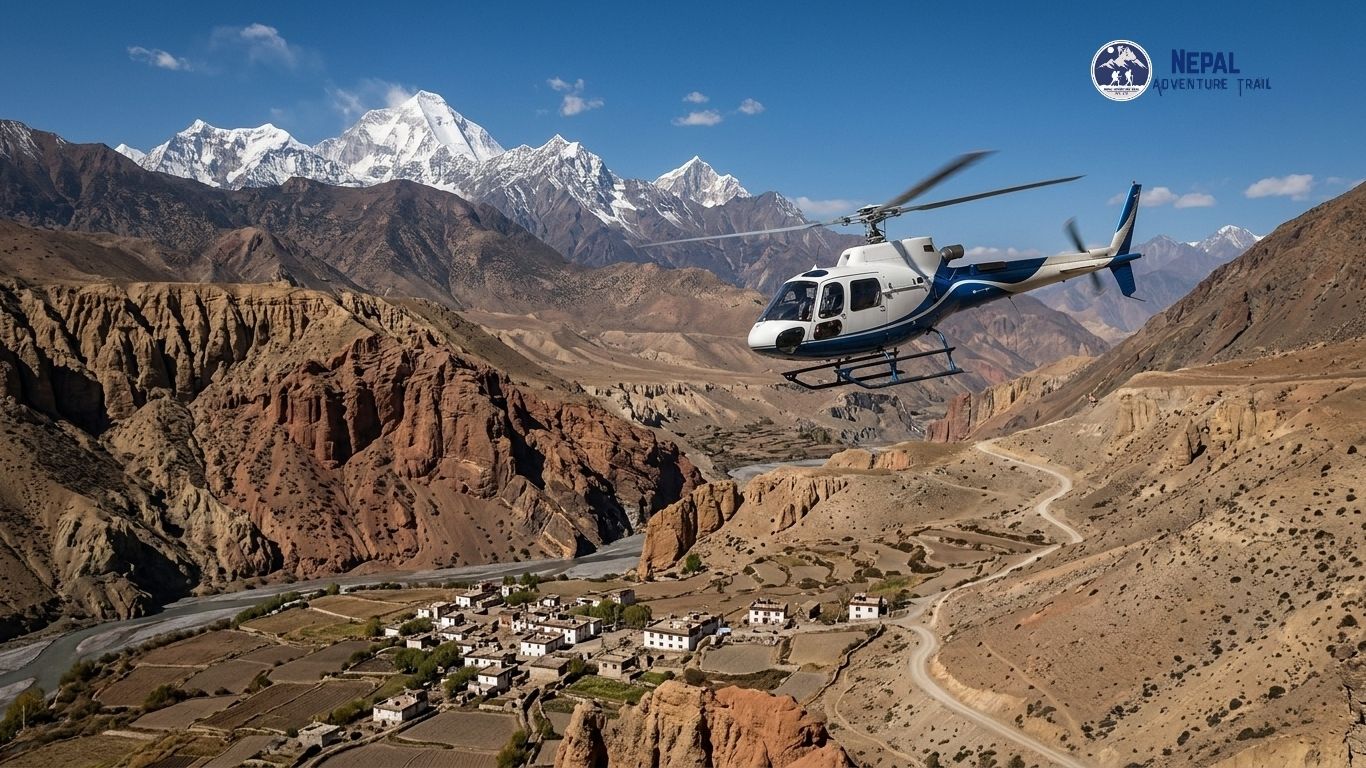
From the air, Mustang announces itself slowly. Out of Pokhara the land is still green, with terraced hills and rhododendron ridges. Then the Kali Gandaki gorge opens and the color drains. Slopes turn the shade of old brick and parchment, the river spreads into pale braids across a wide valley, and on either side, Annapurna and Dhaulagiri stand higher than the cloud that was following you. This is a rain-shadow landscape, dry and wind-cut, where villages sit on ledges and the old walled capital of Lo Manthang waits further north.
A Mustang helicopter trip in Nepal brings that country within reach of people who do not have a week for a jeep ride or ten days for a trek. It also suits pilgrims, many of them elderly, who want to reach the temple at Muktinath without a long road journey. Yet the phrase covers very different trips. A morning flight to Muktinath is not a charter to Lo Manthang, and the permits, prices, ground time and rules are not the same.
This guide separates the options, explains the routes and costs as they are currently advertised, and sets out what to confirm before you pay. Nepal Adventure Trail wrote it for travelers who want to compare properly, not just read a brochure.
What Is a Mustang Helicopter Tour?
A Mustang helicopter tour is a flight from Pokhara or Kathmandu into the Mustang region, either as a scenic flight, as a pilgrimage trip to Muktinath, or as a private charter further north into Upper Mustang. Operators use the same words for all of them, which is where confusion starts.
The main versions are these:
- Muktinath helicopter tour. A return flight to the temple area in Lower Mustang, with time on the ground for darshan.
- Upper Mustang charter. A private flight to a destination in the restricted area, most often Lo Manthang, with a limited stop if permission is granted.
- Scenic flight. A flight over the Kali Gandaki valley and the high ranges, with no guarantee of a landing.
- Point-to-point transport. A one-way charter, for example from a trek end or a high camp, which is transport and not sightseeing.
- Shared or private. A few operators list shared-seat departures for some routes, but many Mustang tours are sold only as whole-aircraft charters.
A flight toward a place does not automatically include a landing, and a landing does not automatically include time to explore. Always ask which of the two you are buying.
Why Explore Mustang by Helicopter?
Travellers choose this option for practical reasons.
Time. The road to Jomsom and Muktinath can take days from Kathmandu. One operator describes the helicopter version as a round trip of about three hours in the air for the Jomsom and Muktinath route. A trek to Lo Manthang normally takes about ten days.
Pilgrimage convenience. For devotees who find a long journey physically hard, a flight and a short walk can make Muktinath possible.
Aerial perspective. Mustang’s geology is easier to read from above. You see how the gorge widens, where glacial valleys meet the river and how the rain shadow dries the land north of the Annapurna range.
Photography. Low-angle morning light on dry cliffs and snow peaks is a draw, though cloud and haze can limit what you get.
Selected remote sites. A charter can reach places that otherwise take days, subject to permits and conditions.
There are limits to bear in mind. A helicopter gives you the view and a short visit, not the slow encounter with villages, apple orchards, wind-blown trails and teahouses that road travel or trekking offers. High-altitude stops are demanding, and the whole day depends on weather.
Best Mustang Helicopter Tours in Nepal
Muktinath Helicopter Tour
Muktinath is a sacred site for both Hindus and Buddhists, set at roughly 3,700 to 3,800 metres below the Thorong La. Hindu pilgrims visit the temple and its spring-fed water spouts, and Buddhist visitors know the place as Chumig Gyatsa. It lies in Lower Mustang, below the restricted-area boundary at Kagbeni.
Operators sell the tour from both Kathmandu and Pokhara. The Pokhara flight is shorter and cheaper, and one operator quotes about 45 minutes each way. Quoted flying times from Kathmandu vary a great deal between sources, from under an hour to two hours each way, partly because routes differ and some include a stop at Pokhara or Jomsom. Treat any single figure with caution and ask for the planned route in writing.
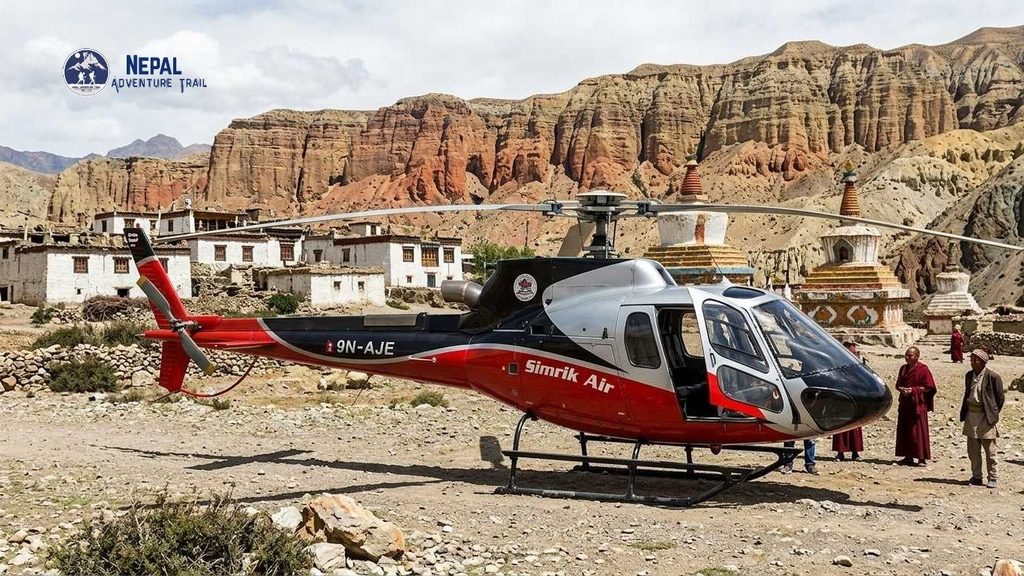
The helicopter flight and the pilgrimage are separate things. One operator’s page says a private helicopter lands about 800 metres from the temple, which means a short walk at altitude. How long you may stay, and how far you must walk, depends on the package and the local arrangements. Do not assume a fixed number of hours at the temple.
Upper Mustang Helicopter Tour
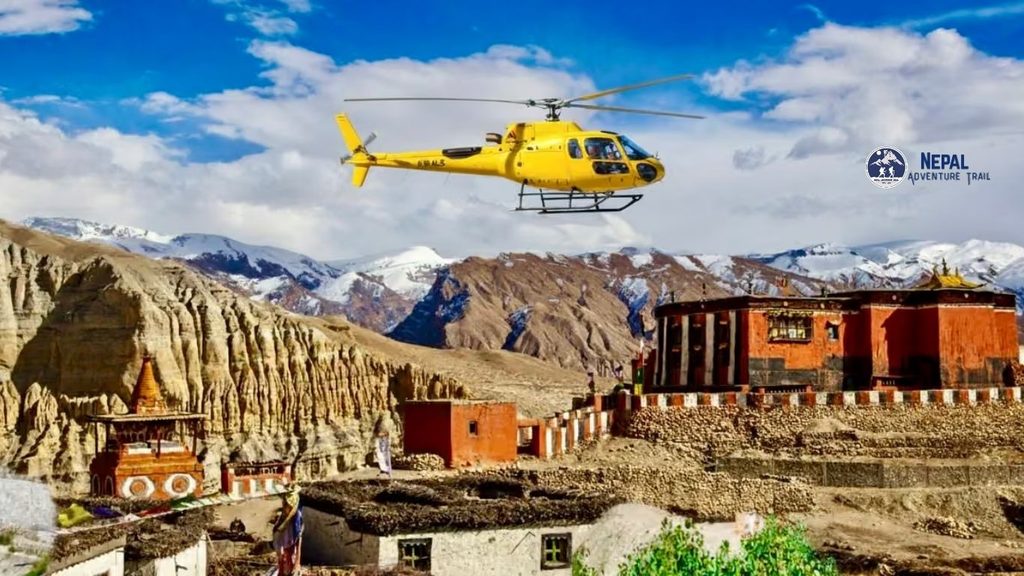
North of Kagbeni lies Upper Mustang, the former Kingdom of Lo, open to foreign visitors only since 1992. It is a high desert of eroded cliffs, whitewashed gompas, cave dwellings and fortified settlements, with a culture closely tied to the Tibetan plateau.
A helicopter charter gives a different view of this region than the jeep track or the trail. It is also more regulated than the Muktinath trip. Upper Mustang is a restricted area, and operators describe permit steps, a separate landing permission and advance notice that do not apply to Lower Mustang. Most trips fly from Kathmandu or Pokhara via Jomsom, and an operator may need a stop for operational reasons. Whether the itinerary lands at Lo Manthang or another approved point, and for how long, depends on the charter agreement, permission, weather and aircraft limits.
A helicopter does not remove the need to follow Upper Mustang’s entry rules. More on that in the permits section.
Lo Manthang Helicopter Tour
Lo Manthang, at about 3,700 to 3,800 metres, was the capital of the Kingdom of Lo. A walled town of whitewashed houses, it contains old monasteries and a royal palace complex, with barren hills and the Tibetan border country behind. It is the destination most Upper Mustang charters name.
Operator descriptions differ. One lists a Kathmandu to Lo Manthang charter with about 3.5 hours of block flying time and roughly one hour on the ground, and describes it as a drop-and-pick arrangement. Another sells it as a longer sightseeing day. The right question is not “do you go to Lo Manthang” but “where do we land, how long may we stay, who is allowed out of the aircraft, and what happens if the landing is refused.”
Jomsom Helicopter Charter
Jomsom is the main gateway to Lower Mustang and the base for the Muktinath road. Scheduled fixed-wing flights run between Pokhara and Jomsom. Those are airline seats on a set timetable, and they are a different product from a helicopter charter. A charter can fly from Pokhara or Kathmandu to Jomsom and beyond, on your schedule, for the cost of the aircraft, and it may be used as part of a Muktinath or Upper Mustang itinerary.
Jomsom is also known for wind. Afternoon winds strengthen along the Kali Gandaki gorge, which is why flights tend to be planned for the morning. Treat that as a reason to start early and keep a spare day.
Mustang Scenic Helicopter Flight
A scenic flight suits travellers who mainly want the landscape and mountain views and are comfortable without landing. One operator describes views of the Annapurna and Dhaulagiri ranges, the Kali Gandaki river and Lo Manthang. The exact flight path, duration and scenery depend on the confirmed route and the weather. Do not expect particular peaks or villages on every flight.
Mustang Helicopter Tour Routes and Departure Points
The table below summarises routes as operators currently describe them. It is a guide, not a schedule. Operator pages differ and many are undated, so confirm every row before you plan around it.
| Route | Main purpose | Approximate flying time (as quoted) | Landing or ground visit | Important considerations |
|---|---|---|---|---|
| Pokhara to Muktinath | Pilgrimage, scenic flight | About 45 minutes each way (one operator) | Landing near the temple, short walk | Shorter and cheaper than the Kathmandu route |
| Kathmandu to Muktinath | Pilgrimage | Quoted from about 45 to 50 minutes to Jomsom up to about 2 hours each way, depending on the source | Landing near the temple | Total excursion often described as 3 to 5 hours |
| Pokhara to Upper Mustang | Lo Manthang charter | Shorter than from Kathmandu | Possible landing, short ground time | Restricted-area permits and landing permission |
| Kathmandu to Upper Mustang | Lo Manthang charter | One operator lists about 3.5 hours block flying | About one hour on the ground (one operator) | Highest price, more fuel and a possible stop |
| Routes via Jomsom | Transfer, part of a longer itinerary | Varies | Depends on the plan | Do not confuse with scheduled airline flights |
| Custom charter | Photography, special requests | Set by agreement | By agreement | Subject to permissions and operational limits |
Flying time is not trip time. Check-in, transfers, ground time, any stop and the return all add to the total. Operators describe Muktinath days of roughly three to five hours overall and Upper Mustang days of four to five hours or longer, which shows how much the figures vary.
Mustang Helicopter Tour Itinerary
Sample Muktinath Helicopter Tour
This sample is illustrative and follows what operators generally describe.
- Hotel transfer to the airport, if included, usually early in the morning.
- Check-in, passenger checks and a safety briefing.
- Helicopter departure from Pokhara or Kathmandu.
- Flight toward Mustang, following the confirmed route, with views of the Annapurna and Dhaulagiri ranges when cloud allows.
- Landing at the approved site near Muktinath, if included.
- Walk to the temple and time for darshan, within the time allowed.
- Return flight.
- Transfer back to the hotel, if included.
No standard departure time or number of hours at the temple applies to every operator.
Sample Upper Mustang Helicopter Charter
An Upper Mustang charter usually flies north via Jomsom, crosses the Kali Gandaki valley into the restricted area and, if permitted, lands for a limited visit in Lo Manthang or another approved place before returning. The details, including where and how long you stay, depend on the charter agreement, the permits, the weather and the aircraft’s limits. This is a bespoke arrangement and not a routine daily package, so do not treat any sample as guaranteed.
Mustang Helicopter Tour Cost and Price
Mustang Heli Tour prices vary more than most helicopter routes, and quotes are often not comparable. The figures below come from operator pages checked in October 2026. Some pages are undated or older, and many give a price per helicopter, not per person.
What drives the price: departure point, destination, flying time, shared seat versus private charter, number of passengers, aircraft capacity and weight limits, technical stops, permits and fees, landing arrangements, transfers and meals, and season and demand.
Muktinath (whole-helicopter prices). One operator lists about USD 2,900 for the whole helicopter from Pokhara and about USD 4,800 from Kathmandu, and says the tour is not normally run on a sharing basis. A second operator’s Kathmandu listing also shows about USD 4,800 per charter for up to five passengers, with a duration of four to five hours.
Upper Mustang and Lo Manthang. Quotes are wide. Charter prices listed on operator pages run from about USD 3,500 to 5,000 from Pokhara and from about USD 5,000 to 6,500 from Kathmandu. One operator lists a Kathmandu to Lo Manthang charter at USD 8,750, with one hour on the ground and a separate landing permit paid by the client. Some pages show per-person prices such as USD 1,200 to 1,500, which usually reflect a full aircraft of five divided among passengers, not a ticket you can buy alone.
| Trip | Price basis | Operator-listed range |
|---|---|---|
| Pokhara to Muktinath | Whole helicopter | About USD 2,900 (one operator) |
| Kathmandu to Muktinath | Whole helicopter | About USD 4,800 (two operators) |
| Pokhara to Upper Mustang | Whole helicopter | About USD 3,500 to 5,000 |
| Kathmandu to Upper Mustang | Whole helicopter | About USD 5,000 to 8,750 |
| Upper Mustang, per person | Aircraft cost divided among a full group | About USD 1,200 to 1,500 at five passengers; much higher for fewer |
Never compare a divided per-person figure with a whole-aircraft price without checking the assumed group size. A “per person” quote of USD 1,200 may become USD 6,000 if you travel alone.
What Is Included in a Mustang Helicopter Package?
Inclusions differ. Muktinath packages commonly list the flight, transfers and some permits. Upper Mustang packages may include the restricted-area permit, the conservation-area fee and a landing permit, or may leave one or more of them to you. Check each item against the written itinerary, since one operator’s “permits included” may not match another’s.
Additional Expenses to Consider
- Restricted-area and conservation permits, where not bundled
- A separate helicopter landing permit for Upper Mustang, which one operator lists as chargeable to the client
- Airport transfers, accommodation and meals outside the package
- Travel insurance and personal expenses
- Special charter requests
- Costs from schedule changes, where your booking terms make you responsible
Ask for an itemised quotation and written confirmation of inclusions before you pay.
Best Time for a Mustang Helicopter Tour
Mustang sits in the rain shadow of the Annapurna and Dhaulagiri ranges, so it is drier than most of Nepal. The weather at the destination is only half of the question, though, because the flight crosses the wetter middle hills before it reaches the dry valley.
Spring: March to May
Clear mornings are common, temperatures are comfortable and the lower hills are in bloom. Haze can build later in the day, and winds in the gorge rise through the afternoon.
Autumn: September to November
Post-monsoon air is often at its clearest, and this is the most popular season for Muktinath pilgrimages. Book early, and expect better visibility, not a guarantee.
Winter: December to February
Expect cold, frost and possible snow at the destination, and confirm access and landing conditions for your chosen site before you commit.
Monsoon: June to August
Cloud and rain on the southern approach can delay or cancel flights, and visibility changes quickly. This does not mean all helicopter tours stop for the season. Operators fly when conditions allow, and Mustang’s dry climate can leave the north clear when the south is not. Keep your plans flexible.
No month guarantees a flight. Early departures, a spare day and an operator who explains cancellation terms matter more than the calendar.
Mustang Helicopter Tour Permits and Entry Requirements
The rules differ sharply between Lower and Upper Mustang, and this is where outdated pages mislead.
Lower Mustang (Jomsom, Muktinath). The Annapurna Conservation Area permit is the main entry requirement, and operators commonly include it in Muktinath packages. Confirm that yours does.
Upper Mustang. Everything north of Kagbeni is a restricted area. Agency pages in 2026 report that the restricted-area permit changed from a flat USD 500 for ten days to USD 50 per person per day, and that the two-person minimum was removed on 22 March 2026. These are agency reports. At least one source notes that some Department of Immigration pages still show the earlier fee structure, so check the current rate and the number of permit days you need with the Department of Immigration or a registered agency before booking.
Helicopter landing permission. Operators describe a separate landing permit for Upper Mustang. One lists it at USD 265 and says a trekking permit is required first. Another says permits need about a week and that a government representative may travel on the aircraft. These details come from operator pages and are not confirmed by an official source here, so ask your operator to explain the process in writing.
A helicopter does not automatically exempt you from entry rules. Equally, do not assume that a flight over the region needs the same permits as a ground visit. The requirement depends on where you land and what the current rules say. You will need your passport, a valid visa and any documents your operator requests.
Is a Mustang Helicopter Tour Safe?
Flying in mountain terrain carries real risk, and no operator can promise a tour is risk-free or guaranteed to operate. Mustang adds particular conditions: strong afternoon winds in the Kali Gandaki gorge, thin air at landing sites and fast-changing cloud on the approach.
Sensible practice includes:
- Choosing a licensed operator and asking who actually flies the aircraft.
- Accepting weather decisions, including delay, reroute or cancellation.
- Respecting passenger weight and baggage limits, which matter more at altitude.
- Following pilot and crew instructions, especially around the rotors.
- Keeping spare days, since remote destinations rarely run to the minute.
- Buying travel insurance that covers helicopter flights at altitude, and reading the exclusions.
Distinguish a cancelled flight from an emergency evacuation. A tour operator’s cancellation policy is a booking matter. An evacuation is a medical and insurance matter, and you should not assume the operator provides one unless it says so in writing.
Altitude Considerations for Muktinath and Upper Mustang
Muktinath lies at roughly 3,700 to 3,800 metres, and Lo Manthang and some Upper Mustang sites are similar or higher. One Upper Mustang operator lists a maximum altitude of 4,380 metres on its trip. Flying from Pokhara at about 800 metres, or Kathmandu at about 1,400, you reach these heights within an hour or two with no gradual acclimatisation.
Possible symptoms of altitude illness include headache, nausea, dizziness and unusual tiredness. A short visit does not remove the risk. If you feel unwell, tell the pilot and crew at once, and do not stay on for a temple visit out of politeness. People with heart, lung or blood conditions, high blood pressure or pregnancy should consult a doctor before booking. Follow the operator’s guidance, and do not assume a helicopter landing suits everyone.
What to Wear and Pack for a Mustang Helicopter Tour
Mustang can be cold and windy even on a bright day, and temperatures differ sharply from Kathmandu or Pokhara. Dress in layers.
- Warm layers, such as a fleece or light down jacket
- A wind-resistant jacket
- Comfortable walking shoes with grip, since you may walk on uneven ground or steps
- Sunglasses and strong sun protection, as the air is thin and dry
- A hat and gloves
- A camera or phone, secured, with a spare battery
- Personal medication
- Passport and booking documents
- A small bag within the operator’s weight limit
You do not need trekking equipment for a one-day flight.
Mustang Helicopter Tour vs Road Travel
| Helicopter | Road | |
|---|---|---|
| Time | Hours | Days from Kathmandu or Pokhara |
| Cost | High, especially for private charters | Lower, spread across transport and lodging |
| Landscape | Aerial, wide, brief | Ground-level, changing, extended |
| Remote sites | Selected sites, subject to permission | Reaches many villages, with permits for Upper Mustang |
| Culture | Limited contact | Villages, food, markets, monasteries |
| Flexibility | Weather dependent, little room to wander | Also weather and road dependent, with more room to adjust |
The helicopter shortens access and gives a view of the Kali Gandaki corridor you cannot get from the ground. The road lets you stop, eat apples in a roadside orchard, talk to people and watch the landscape shift over several days. Neither is inferior. Choose by time, budget, interests and how well you handle long vehicle journeys at altitude.
Who Should Choose a Mustang Helicopter Tour?
- Pilgrims visiting Muktinath, including those who find a long road journey hard
- Travellers with limited time who still want Mustang
- Photographers interested in aerial views and dry-landscape light
- Families, subject to age, health and operator requirements
- Travellers interested in Upper Mustang’s landscape and heritage who can accept a short visit and a high price
- Visitors combining Mustang with a wider Nepal itinerary
Health, mobility, tolerance of altitude, budget and the landing arrangement should all shape the decision. A helicopter does not remove the physical demands of a high-altitude stop, and walking from the helipad to a temple can be hard for some people.
Plan Your Mustang Helicopter Tour with Nepal Adventure Trail
A Mustang trip involves more detail than most helicopter days. Muktinath and Upper Mustang follow different rules, prices are quoted on different bases, and permit details change. Planning ahead helps you compare options, understand what each package includes and fit the flight into your wider Nepal itinerary.
Nepal Adventure Trail can help you work through those questions and coordinate your travel plans around your chosen route. When you enquire, tell us your preferred destination, departure point, travel dates and group size, so the options can be checked against your needs before you commit.
Frequently Asked Questions About Mustang Helicopter Nepal
What is a Mustang helicopter tour in Nepal?
It is a helicopter trip into the Mustang region, usually from Pokhara or Kathmandu. The main versions are a Muktinath pilgrimage flight, a private charter into Upper Mustang toward Lo Manthang, and a scenic flight over the Kali Gandaki valley. Landing, ground time and permits differ for each, so confirm exactly what your booking includes before you pay.
How much does a Mustang helicopter tour cost?
It depends on the route. Operators list roughly USD 2,900 from Pokhara and USD 4,800 from Kathmandu for a whole helicopter to Muktinath, and about USD 3,500 to 8,750 for Upper Mustang charters. Many prices are per aircraft, not per person. Ask for an itemised quote stating the currency, group size and inclusions.
Can I visit Muktinath Temple by helicopter?
Yes. Operators run Muktinath helicopter tours from Pokhara and Kathmandu, with a landing near the temple and a short walk. Time on the ground varies, and one operator says the helicopter lands about 800 metres away. Altitude and weather affect the day, so ask what time you can spend there and what happens if landing is not possible.
Can I fly to Upper Mustang and Lo Manthang by helicopter?
Operators offer charters to Lo Manthang, but they are private, regulated trips. They need restricted-area permits and, according to operators, a separate landing permission with advance notice. Ground time can be as short as an hour. Landing depends on permission, weather and aircraft limits, so ask for the permit process in writing.
What is the difference between a Muktinath helicopter tour and an Upper Mustang helicopter tour?
Muktinath lies in Lower Mustang and is mainly a pilgrimage trip with a landing near the temple. Upper Mustang lies north of Kagbeni in a restricted area, and its charters involve additional permits, longer flights and higher prices. The destinations, rules, ground time and cost differ considerably, so treat them as separate products.
Can I book a Mustang helicopter tour from Kathmandu?
Yes, operators sell Muktinath and Upper Mustang tours from Kathmandu. The flight is longer and the price higher than from Pokhara, and some routes include a stop at Pokhara or Jomsom. Ask for the planned route and the total excursion time, since quoted flying times from Kathmandu vary widely between sources.
Is a Mustang helicopter tour available from Pokhara?
Yes. Pokhara is the closer base, and operators describe a shorter and cheaper flight, such as about 45 minutes each way to Muktinath in one operator’s description. Upper Mustang charters from Pokhara are also listed. Availability depends on the operator, season and weather, so confirm dates directly.
How long does a Mustang helicopter tour take?
Operators describe Muktinath days of about three to five hours overall and Upper Mustang days of four to five hours or longer. Flying time is shorter than the full trip, which also includes check-in, transfers, ground time and the return. Treat quoted durations as estimates and leave buffer around any onward travel.
What is the best time for a Mustang helicopter tour?
Spring and autumn are generally the most reliable, with autumn often offering the clearest air. Winter is cold, and the monsoon can disrupt the southern approach even though Mustang itself is dry. No month guarantees a flight. Fly early, since winds in the gorge strengthen later in the day, and keep a spare day.
Do I need permits for an Upper Mustang helicopter tour?
Operators and agencies say yes. Agency pages report a restricted-area permit now charged at USD 50 per person per day, plus a conservation-area permit and a separate helicopter landing permission, but some official pages may still show older fees. Confirm the current rules with the Department of Immigration or a registered agency before booking.
Is a Mustang helicopter tour safe?
It carries real risks from terrain, wind, cloud and altitude, and no operator can promise absolute safety. Choose a licensed operator, accept weather decisions, respect weight limits and follow crew instructions. Ask about the aircraft and pilots, the cancellation policy and insurance, and be wary of any guarantee of landing or good weather.
Can elderly travellers visit Muktinath by helicopter?
Many elderly pilgrims do. The flight avoids a long road journey, but altitude and the walk from the landing site still matter, and not everyone tolerates 3,700 metres or more. Speak to a doctor if you have heart, lung or blood conditions, and ask the operator how far the walk is and what assistance is available.
What happens if bad weather cancels the flight?
Policies differ. Operators commonly offer to reschedule or to refund in whole or part, but terms vary. Ask in advance how much notice you will receive, whether a different day is possible, and whether any extra costs fall on you. Keep a spare day in Pokhara or Kathmandu, particularly in the monsoon.
What should I wear for a Mustang helicopter tour?
Wear layers, including a fleece or light down jacket and a windproof outer layer, plus a hat, gloves, sunglasses and sun protection. Choose comfortable shoes with grip, because you may walk on uneven ground. Mustang can be cold and windy even in sunshine. Pack light, since baggage limits are tight.
What is included in a Mustang helicopter tour package?
It varies. Muktinath packages often list the flight, transfers and some permits. Upper Mustang packages may include the restricted-area permit, the conservation-area fee and a landing permit, or may charge some of them separately. Common exclusions are insurance, accommodation and extra meals. Ask for a written list of inclusions and exclusions.
Conclusion
A Mustang helicopter trip can turn days of travel into a morning and reveal a landscape that is hard to read from the ground. It will not replace the slow pleasures of the road or the trail, and it will not guarantee a landing or a clear sky. The best trips come from knowing which Mustang you are buying, whether that means a pilgrimage to Muktinath or a regulated charter to Lo Manthang, and from checking permits, ground time and prices in writing. To compare your options and check them against your dates, contact Nepal Adventure Trail with your destination, departure point and group size.