
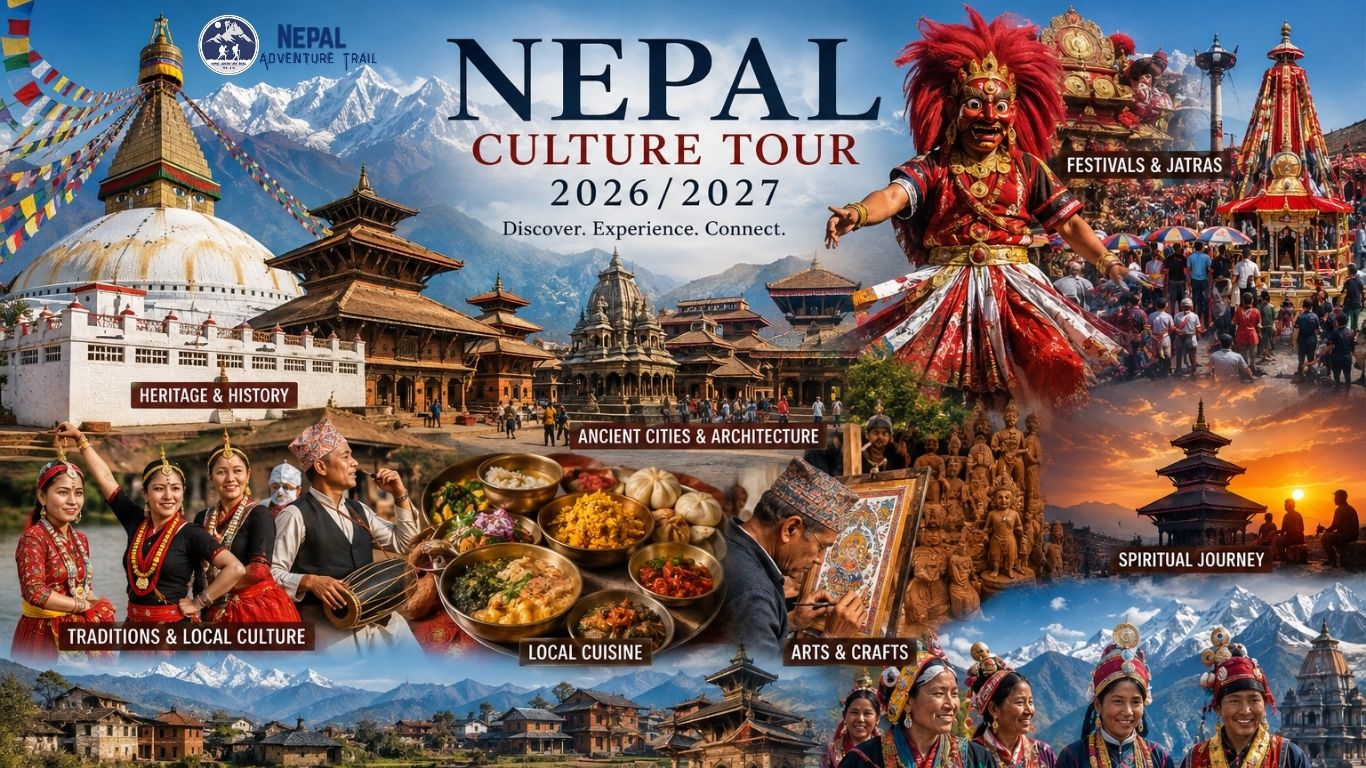
A woman in Bhaktapur sets out a tray of black clay pots to dry in the sun outside her house, the same way her mother did and her grandmother before that. Twenty meters away, a group of teenagers photograph the pots for a social media reel. Neither activity looks staged. Both are just Tuesday in a city where pottery has been a family trade for centuries and a smartphone is now part of daily life too.
That overlap, old craft and new habit sitting comfortably in the same square, is closer to what most first-time visitors actually encounter in Nepal than the image of a solitary trekker silhouetted against Everest. For travelers weighing a Nepal cultural tour in 2026/2027, that overlap is the whole appeal. You don’t need a headlamp, trekking poles, or three weeks of altitude acclimatization to spend meaningful time here. You need a walking pace slower than your phone’s step counter wants you to keep.
This guide is built around that idea. It covers where cultural travel in Nepal actually happens, what a realistic week or ten days looks like, which festivals are worth planning a trip around, and how to think sensibly about monsoon-season travel without treating Nepal as either a disaster zone or a theme park. Nepal’s weather can be unpredictable in the second half of the monsoon, and 2026 in particular has seen some serious regional disruption, which we’ll address honestly later in this guide. None of that changes the basic fact that most of the country’s heritage towns, temples, and festivals are open, functioning, and going on with daily life as they always have.
What Is a Nepal Cultural Tour?
A cultural tour in Nepal isn’t a single product so much as a different lens on the same country most people already want to visit. Instead of measuring the trip in altitude gained or passes crossed, you measure it in temples visited, meals shared, and mornings spent watching a city wake up.
Practically, that means walking through brick-paved squares that still function as neighborhood gathering points, not photo backdrops. It means sitting in a courtyard while a metalworker finishes a repoussé relief the way his guild has for generations, watching a Bhaktapur potter’s wheel spin on nothing but a hand-push and momentum, and eating food that reflects a specific valley’s history rather than a menu translated into six languages. It also means timing at least part of the trip around a festival that would be happening whether or not you showed up to watch it.
Religion, architecture, food, and craft aren’t separate categories in Nepali cultural life; they overlap constantly. A single Newari courtyard, or bahal, might contain a Buddhist shrine, a family shop, drying laundry, and a carved window frame older than most countries’ constitutions, all within twenty square meters. A cultural tour is really just permission to slow down enough to notice all four at once.
Why Choose a Nepal Cultural Tour in 2026/2027?
The honest case for cultural travel isn’t that trekking has gotten worse. It’s that cultural travel has always been underrated relative to how much of Nepal’s identity actually lives in its valleys and market towns rather than its mountain passes.
A cultural itinerary asks less of your body and more of your attention. Daily walking distances in most heritage towns run to a few kilometers of flat or gently sloped ground, a different proposition from a Himalayan pass at 5,000 meters, which makes this style of travel more accessible for older travelers, families with young children, or anyone with eight or nine days rather than three weeks.
It also handles disruption better than a fixed trekking itinerary. A trek locks you into a specific route and string of overnight stops; missing one day at altitude can unravel the whole schedule. A cultural tour built around Kathmandu Valley and nearby towns absorbs a delay or a spontaneous detour far more easily, since most sites sit within an hour or two of each other by road.
For 2026/2027 specifically, festival timing lines up well. Indra Jatra, Dashain, and Tihar all fall within the same September-to-November window that already brings the year’s most stable weather, so a well-timed cultural trip can double as a front-row seat to some of the region’s most visually dramatic events.
The Best Cultural Experiences in Nepal
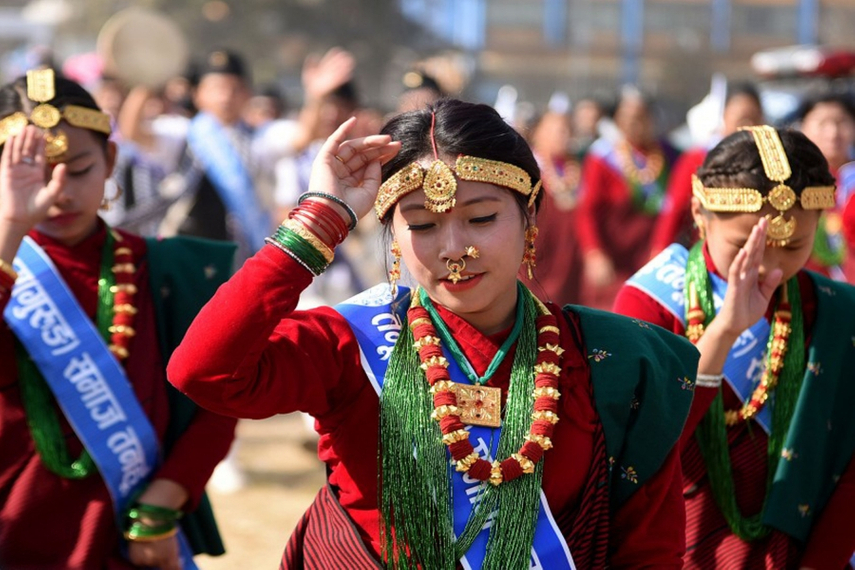
Kathmandu Valley: Living Heritage, Not a Museum
Kathmandu Valley holds the country’s densest concentration of heritage sites, and it’s worth saying plainly: this isn’t preserved history behind rope barriers. Pashupatinath Temple, on the Bagmati River, remains an active cremation site and pilgrimage destination, not a monument staged for visitors. Swayambhunath, the hilltop stupa locals call the Monkey Temple, and Boudhanath, one of the largest stupas in the world, both function as daily places of worship, with pilgrims circling clockwise every morning regardless of tourist traffic.
Kathmandu’s own Durbar Square anchors the valley’s densest cluster of Malla-era palaces and temples, including the residence of the Kumari, the living child goddess who occasionally appears at an upper window to bless the square below. This cluster, together with the durbar squares of Patan and Bhaktapur, the stupas of Swayambhunath and Boudhanath, and the temples of Pashupatinath and Changu Narayan, makes up the seven monument zones inside the Kathmandu Valley UNESCO World Heritage Site — one of just four World Heritage listings in the country, alongside Lumbini, Sagarmatha National Park, and Chitwan National Park.
Patan and Bhaktapur: Craft, Squares, and Everyday Urban Life
Patan, just across the Bagmati from Kathmandu, carries its own identity built on centuries of metalwork, wood carving, and paubha painting, the traditional Newari style of religious scroll art. Its durbar square is dense enough with carved temples that a single afternoon barely covers it, and the surrounding bahals still function as working neighborhoods, with artisans hammering repoussé copper panels in workshops backing directly onto family living quarters.
Bhaktapur retains the strongest intact urban fabric of the three valley cities, helped by staying largely closed to vehicle traffic. Pottery Square, with clay vessels drying in open courtyards, is the obvious draw, but Taumadhi and Dattatraya squares each carry their own character. Bhaktapur’s version of Bisket Jatra, the Newari New Year chariot festival, is generally considered the valley’s most dramatic, involving a tug-of-war over a massive wooden chariot and the raising of a towering ceremonial pole.
Kirtipur, Bungamati, and Khokana: The Quieter Villages
A handful of settlements just outside the main tourist circuit preserve a slower version of valley life. Kirtipur, on a ridge southwest of Kathmandu, carries a more fortified architectural character than Kathmandu or Patan, a legacy of its resistance during the Gorkha unification of Nepal. Bungamati, closely associated with the deity Rato Machhindranath, and neighboring Khokana, still known for traditional mustard oil pressing, both move at village pace, with narrow brick lanes, working farms at the edges, and far less English signage than the main squares.
Panauti and Bandipur: Two Overlooked Heritage Towns
Panauti, about ninety minutes from Kathmandu, sits at the confluence of two rivers and holds one of the region’s best-preserved historic cores, home to the Indreshwar Mahadev Temple, among the oldest surviving temple structures in the valley area. Bandipur, on the old trade route toward Pokhara, offers a different register entirely: a pedestrianized ridge-top main street lined with restored Newari-style buildings, now mostly guesthouses and cafes, with clear mountain views on good days. Both towns work well as a half-day or full-day addition to a longer itinerary.
Janakpur, Lumbini, and Pokhara Beyond the Main Circuit
Janakpur, in the southern Terai, sits at the heart of Mithila cultural identity and is associated in Hindu tradition with the birthplace of Sita. Its most distinctive contribution is Mithila art, a vivid, geometric painting style traditionally created by women on home walls and now also sold through local cooperatives, and the elaborate white Janaki Mandir temple complex anchors the town’s religious life.
Lumbini, roughly 300 kilometers west of Kathmandu, is where Buddhist tradition holds Siddhartha Gautama was born, marked by the Maya Devi Temple, the Ashoka Pillar, and the surrounding sacred garden. Its Monastic Zone hosts dozens of monasteries built by Buddhist communities worldwide, each reflecting its home country’s architectural style, and Buddha Jayanti draws its largest ceremonies here.
Pokhara is best known as a trekking gateway, but carries its own cultural layer worth slowing down for: the Gurkha Memorial Museum and International Mountain Museum cover Nepal’s history in more depth than most visitors expect, and the city’s sizable Tibetan refugee community maintains active monasteries and carpet-weaving workshops open to visitors. A slow morning at Phewa Lake, with the temple island of Tal Barahi in view, offers a different register of Pokhara than the paragliding launches above it.
Festival and Jatra Experiences
Nepal runs on a lunar and cultural calendar dense enough that more than fifty distinct festivals occur across the year, spread among the country’s Hindu majority, Buddhist communities, and more than 125 recognized ethnic groups. Because most of these follow the Bikram Sambat lunar calendar, exact Gregorian dates shift annually, and some sources publish slightly different date ranges depending on how they calculate the lunar cycle. Treat every date below as a strong planning estimate, and confirm the final dates against a current Nepali calendar close to your travel dates.
Teej, in early September, is the great festival of Nepali women: three days of fasting and prayer at Shiva temples, with women in red saris an unmissable sight at Pashupatinath.
Indra Jatra, an eight-day September festival, transforms Kathmandu Durbar Square with masked dances and the public appearance of the Kumari, the living goddess, paraded through the old city in a wooden chariot—one of the few times this tradition becomes visible to the general public.
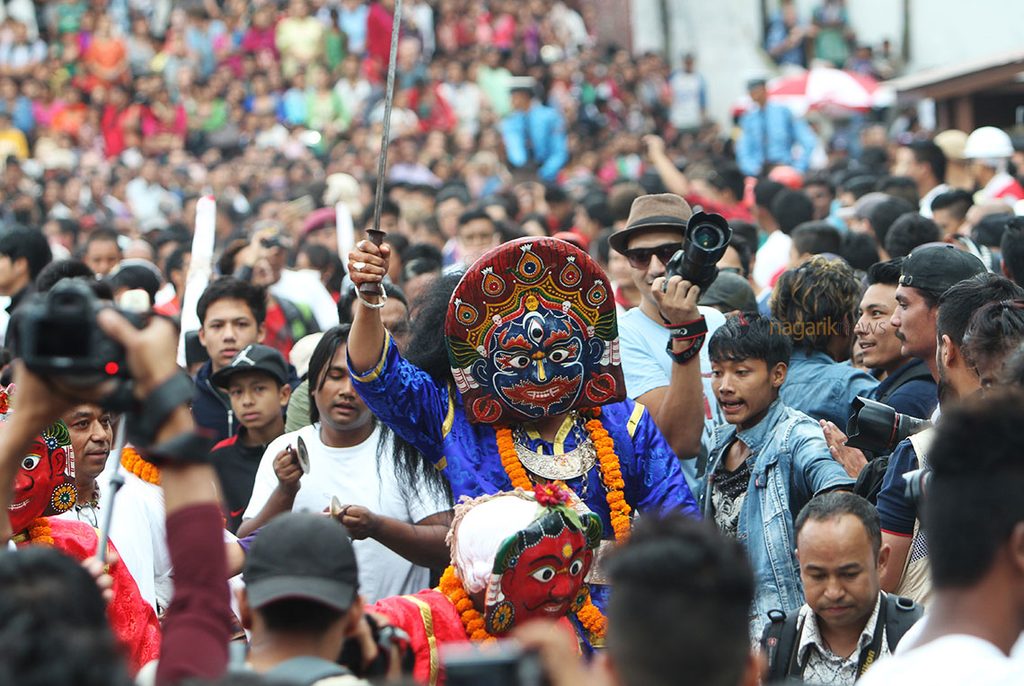
Dashain, running through most of October, is Nepal’s longest national holiday: fifteen days celebrating the goddess Durga’s victory over evil, during which Kathmandu empties as families travel home. Expect shops and permit offices to close or run reduced hours during peak days, and transport to book out well ahead.
Tihar, two to three weeks after Dashain, is Nepal’s festival of lights, honoring crows, dogs, cows, and finally the bond between siblings, with oil lamps and marigold garlands lighting up the valley’s older neighborhoods after dark.
Bisket Jatra, Bhaktapur’s Newari New Year festival, falls in mid-April and features a chariot tug-of-war between two halves of the city and the raising and toppling of a large ceremonial pole; neighboring Thimi answers with Sindur Jatra, the throwing of vermilion powder.
Rato Machhindranath Jatra, centered in Patan, is a lengthy chariot festival dedicated to a deity associated with rain and agricultural fortune, remaining functionally important to farming communities rather than existing purely for spectacle.
Gai Jatra, the festival of cows, mixes genuine mourning with sanctioned satire: families who lost a relative in the past year lead processions, often joined by costumed performers and pointed social commentary.
Losar, the Tibetan New Year, is really three related celebrations: Tamu Losar for the Gurung in December, Sonam Losar for Tamang communities around January-February, and Gyalpo Losar for Sherpa and Tibetan communities in February-March. Boudhanath is the most reliable place to see public celebrations, with masked dances and family groups circling the stupa in fresh dress.
Maghe Sankranti, one of the few festivals on a fixed solar date, falls January 14th or 15th, with ritual bathing at river confluences like Devghat drawing crowds before sunrise.
Buddha Jayanti, on the Baisakh full moon (generally May), marks the Buddha’s birth, enlightenment, and death together. Lumbini hosts the largest ceremonies, while Swayambhunath and Boudhanath fill with butter lamps and pilgrims.
For any of these festivals, the etiquette that matters most is simple: ask before photographing individuals or family rituals up close, avoid using flash near religious processions, don’t block chariot routes or ritual pathways to get a better shot, and treat mourning-linked events like Gai Jatra with the sensitivity you’d bring to a funeral procession anywhere else in the world. Many travelers find that watching respectfully from the edge of a crowd, rather than pushing toward the center for photographs, actually produces a better experience and better photographs both.
Sample Cultural Tour Itineraries
A five-day trip built entirely around Kathmandu Valley can cover Kathmandu Durbar Square, Swayambhunath, and Boudhanath over the first two days, Patan’s durbar square and artisan quarters on day three, and Bhaktapur, ideally with an overnight stay, across days four and five.
A seven-day version adds Panauti or Kirtipur as a quieter counterpoint, a full day in Bungamati and Khokana, and a stop in Bandipur, especially useful if the trip continues toward Pokhara.
A ten-day immersion tour spends the first four days across the valley’s core heritage towns, travels overland to Pokhara for two days covering the Tibetan settlements and museums rather than just the lakeside, then flies to Lumbini for two to three days focused on the Monastic Zone before returning to Kathmandu.
A festival-focused trip anchors the middle of the schedule around the festival dates, arriving two to three days early to see the squares in their normal rhythm and staying at least one day after, since related rituals and neighborhood celebrations often continue past the main event.
Cultural Experiences Worth Adding to Any Itinerary
A few add-ons consistently reward the extra half-day they require: a Newari cooking class run out of a family kitchen, a pottery session in Bhaktapur that makes clear how physically demanding hand-thrown clay work is, and a heritage walking tour in Patan or Bhaktapur, where a local guide can surface details about a carved window or courtyard shrine that would otherwise stay invisible.
Village homestays, where available through community-based tourism programs, offer a level of access to daily household life no hotel replicates. Monastery visits around Boudhanath or Pokhara’s Tibetan settlements, arranged respectfully through a guide, sometimes include brief meditation sessions. Local markets in smaller towns like Panauti or Bandipur tend to be more rewarding than curated craft shops, since nobody there is selling specifically to tourists.
Food and Culture
Food carries as much regional identity in Nepal as architecture does. Newari cuisine, distinct from the broader dal bhat tradition, includes yomari, a steamed rice-flour dumpling filled with molasses or sesame, traditionally made for the Yomari Punhi festival, and chatamari, a rice-flour crepe often called Nepal’s answer to pizza. Bara, a lentil-flour patty, and various pickled vegetables round out a full Newari feast, or bhoj, which can run to a dozen small dishes served in a set order.
Momos, found across nearly every Nepali town, owe much of their popularity to Tibetan culinary influence. Sel roti, a ring-shaped sweet rice bread fried for Tihar, and thukpa, a Tibetan-influenced noodle soup common around Boudhanath, both carry specific seasonal or ethnic associations. In Janakpur and the wider Terai, Mithila cuisine leans on fish, lentils, and rice preparations shaped by proximity to the Gangetic plain.
None of these dishes appear everywhere, and a menu listing all of them at once is usually cooking for tourists. Asking a guesthouse owner what’s actually being cooked that day tends to produce a more honest meal than reading a laminated menu.
Cultural Tour vs. Trekking Holiday
These aren’t really competing forms of travel. A trekking holiday demands sustained physical effort and basic teahouse living at altitude, in exchange for landscape and physical achievement on a scale cultural touring doesn’t offer. A cultural tour trades that intensity for depth of access to history, food, craft, and living tradition, with more comfortable accommodation and a schedule that’s far easier to adjust on short notice.
Plenty of travelers combine both in one trip, often opening with a shorter trek like the Poon Hill loop before closing with several days of slower cultural travel. Others choose culture outright because they’re traveling with children or older relatives, have a week rather than three, or simply find more meaning in a carved temple doorway than a mountain pass. Nepal doesn’t require picking a single identity for a trip.
Traveling During Nepal’s Weather, Floods, and Road Disruptions
Any honest guide to travel in Nepal has to address the monsoon directly, and 2026 has been a year worth addressing carefully. Nepal’s monsoon runs roughly June through September and regularly brings the kind of heavy rainfall that triggers landslides and localized flooding, particularly in hill and mountain districts; this is a normal, expected feature of the season in any year, not unique to 2026.
That said, this year has also seen a genuinely serious event: a major flash flood struck the Rasuwagadhi-Timure-Syabrubesi corridor in Rasuwa district on August 26, 2026, causing significant loss of life and severe infrastructure damage along the Bhote Koshi and Trishuli river systems. The current U.S. State Department guidance advises against any travel to that specific corridor while search, recovery, and rebuilding work continues, and that guidance should be taken seriously by any traveler with a route that passes through the area.
It’s worth being precise about what that disaster does and doesn’t affect. Kathmandu Valley was not directly affected. The Kathmandu-Pokhara road axis, the main Annapurna trailheads, and the Everest approach routes have not been reported as damaged, and Tribhuvan International Airport has continued normal operations throughout. For a cultural tour built around Kathmandu Valley, Bhaktapur, Patan, Bandipur, Pokhara, or Lumbini, this disaster does not sit on your route.
What does apply, regardless of this specific flood, is Nepal’s ordinary monsoon unpredictability: highways like the Prithvi Highway can see temporary landslide closures at known hotspots during heavy rainfall weeks, and domestic flights can face individual weather delays even while running normally as a system. The sensible approach is straightforward — build a buffer day or two into any multi-city itinerary, confirm road and flight status with a local operator close to departure, and consider travel insurance covering weather-related interruption. None of this should discourage a cultural trip to Nepal in 2026 or 2027; it should just inform how you build the schedule.
Best Time for a Nepal Cultural Tour
Autumn, from roughly late September through November, is Nepal’s most popular travel season for good reason: skies clear as the monsoon retreats, temperatures stay comfortable across the valley towns, and the calendar is packed with major festivals, including Indra Jatra, Dashain, and Tihar, all falling within this window in 2026.
Winter, December through February, brings cold mornings and occasional haze in the valley but generally clear, stable days well suited to sightseeing, with the added benefit of thinner crowds at major heritage sites. Losar celebrations across several Himalayan communities fall within this season.
Spring, March through May, offers pleasant daytime temperatures and its own festival calendar, including Holi in March and Buddha Jayanti in May, making it a strong second option to autumn for a heritage-focused trip.
Monsoon, June through September, brings rain, greenery, and noticeably thinner tourist crowds at major sites, along with a real possibility of localized transport disruption as detailed above. Cultural touring handles monsoon uncertainty better than trekking does, since most heritage sites sit within short driving distances of each other rather than requiring multi-day approaches on foot, but flexibility still matters more during these months than at any other time of year.
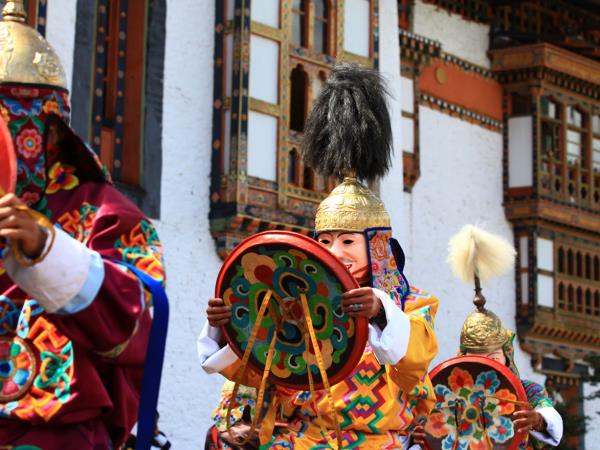
Who Is a Nepal Cultural Tour Best For?
Cultural touring in Nepal tends to suit couples looking for a slower, more conversational travel pace; families traveling with children who can’t manage multi-day trekking; older travelers who want meaningful engagement with a place without demanding physical exertion; first-time visitors who want a genuine introduction to the country before deciding whether trekking interests them; and photographers, architecture enthusiasts, and food travelers whose primary interest lies in built environment and daily life rather than landscape. It also suits anyone working with a tighter vacation window, since a rewarding cultural trip can run five to seven days in a way that a serious trek generally cannot.
Practical Planning Notes
Most Kathmandu Valley heritage sites charge a modest entry fee for foreign visitors, generally a few hundred to just over a thousand Nepali rupees, though figures should be confirmed locally. No special trekking permits are needed for a cultural-only itinerary confined to the valley, Pokhara, or Lumbini, though a local guide adds real value, since so much meaning behind a carving or ritual object isn’t posted on any sign.
Comfortable walking shoes matter more than hiking boots here, given the cobblestone streets and temple steps. Modest dress, covering shoulders and knees, is expected at most temples, and non-Hindus should expect to be restricted from the innermost sanctum at temples like Pashupatinath. Cash remains the norm outside larger hotels, so carry rupees in useful denominations. During Dashain especially, book transport and accommodation well ahead, since much of the country travels home to family villages at the same time tourists are moving through the valley.
Responsible and Community-Based Tourism
Cultural tourism done well puts money directly into the hands of the people maintaining these traditions, rather than routing it entirely through large hotels. Choosing local guides, booking homestays where genuinely available, buying craft directly from the artisans who made it, and eating at family-run restaurants all send resources toward the communities whose culture is the actual draw of the trip.
Photography etiquette matters too. A shrine used daily by a specific family or neighborhood is not a photo backdrop; asking before photographing people, especially during private rituals, costs nothing and preserves a basic level of respect. Supporting registered craft cooperatives, particularly in places like Janakpur where Mithila art has become an important income source for local women, has a more direct community benefit than buying similar items from a generic tourist market.
Planning Your Cultural Journey Through Nepal
A Nepal cultural tour built around Kathmandu Valley, the surrounding heritage towns, Lumbini, and a well-timed festival window offers a genuinely different way to know this country, one built on temples still in daily use, food tied to specific communities, and festivals that would happen with or without a single visitor watching. At Nepal Adventure Trail, we build itineraries around exactly this kind of pacing, whether that means a short valley-focused trip, a longer heritage circuit through Bandipur and Pokhara, or a festival-timed journey planned around Indra Jatra or Dashain. If a slower, more immersive introduction to Nepal sounds like the right trip for 2026 or 2027, we can help put the details together around whichever season and festivals interest you most.
Frequently Asked Questions
What is a Nepal cultural tour?
A Nepal cultural tour is a trip built around heritage towns, temples, festivals, food, and daily community life rather than mountain trekking. It typically centers on Kathmandu Valley’s historic cities, along with towns like Bandipur, Panauti, or Janakpur, and can include Pokhara and Lumbini depending on trip length.
Is Nepal good for a cultural holiday in 2026?
Yes. Kathmandu Valley and the country’s other major cultural destinations were not affected by the August 2026 flooding in Rasuwa district, and the autumn 2026 festival calendar, including Indra Jatra, Dashain, and Tihar, lines up well with a cultural-focused itinerary.
What are the best cultural places to visit in Nepal?
Kathmandu, Patan, and Bhaktapur form the core of most itineraries, with Kirtipur, Bungamati, Khokana, and Panauti offering quieter alternatives nearby. Bandipur, Janakpur, Lumbini, and parts of Pokhara add further regional and religious variety for longer trips.
Which Nepal festivals are worth visiting in 2026/2027?
Indra Jatra and Dashain in October, followed by Tihar in November 2026, offer some of the most visually striking festival experiences of the year. Bisket Jatra in April and Buddha Jayanti in May are strong options for a 2027 spring trip, and exact dates should be confirmed against a current lunar calendar closer to travel.
Can I visit Nepal without trekking?
Yes, easily. A cultural tour confined to Kathmandu Valley, Pokhara, and Lumbini requires no trekking permits, no altitude acclimatization, and involves daily walking distances comparable to sightseeing in any historic city.
What is the best time for a cultural tour in Nepal?
Autumn, from late September through November, offers the clearest weather and the densest festival calendar. Spring, from March through May, is a strong second choice, while winter suits travelers who prioritize thinner crowds over festival timing.
Is Kathmandu Valley enough for a cultural tour?
For a five-to-seven-day trip, yes. The valley’s three durbar squares, major stupas, and surrounding towns like Bungamati and Panauti offer enough depth to fill a week without repetition, though longer trips benefit from adding Pokhara or Lumbini.
How long should a Nepal cultural tour be?
Five days covers Kathmandu Valley’s core sites comfortably. Seven days allows for quieter towns like Panauti or Bandipur. Ten days or more allows a realistic addition of Pokhara and Lumbini without rushing between them.
Is Nepal suitable for a relaxed family holiday?
Cultural touring in Nepal generally suits families well, since daily walking distances stay modest and accommodation options range from basic guesthouses to considerably more comfortable hotels, particularly in Kathmandu and Pokhara.
Can I plan a Nepal cultural tour during monsoon?
Yes, with some added flexibility built into the schedule. Cultural touring handles monsoon-season uncertainty better than trekking does, since most heritage towns sit close together by road, though travelers should still confirm current conditions before departure and build in a buffer day or two for any multi-city itinerary.