
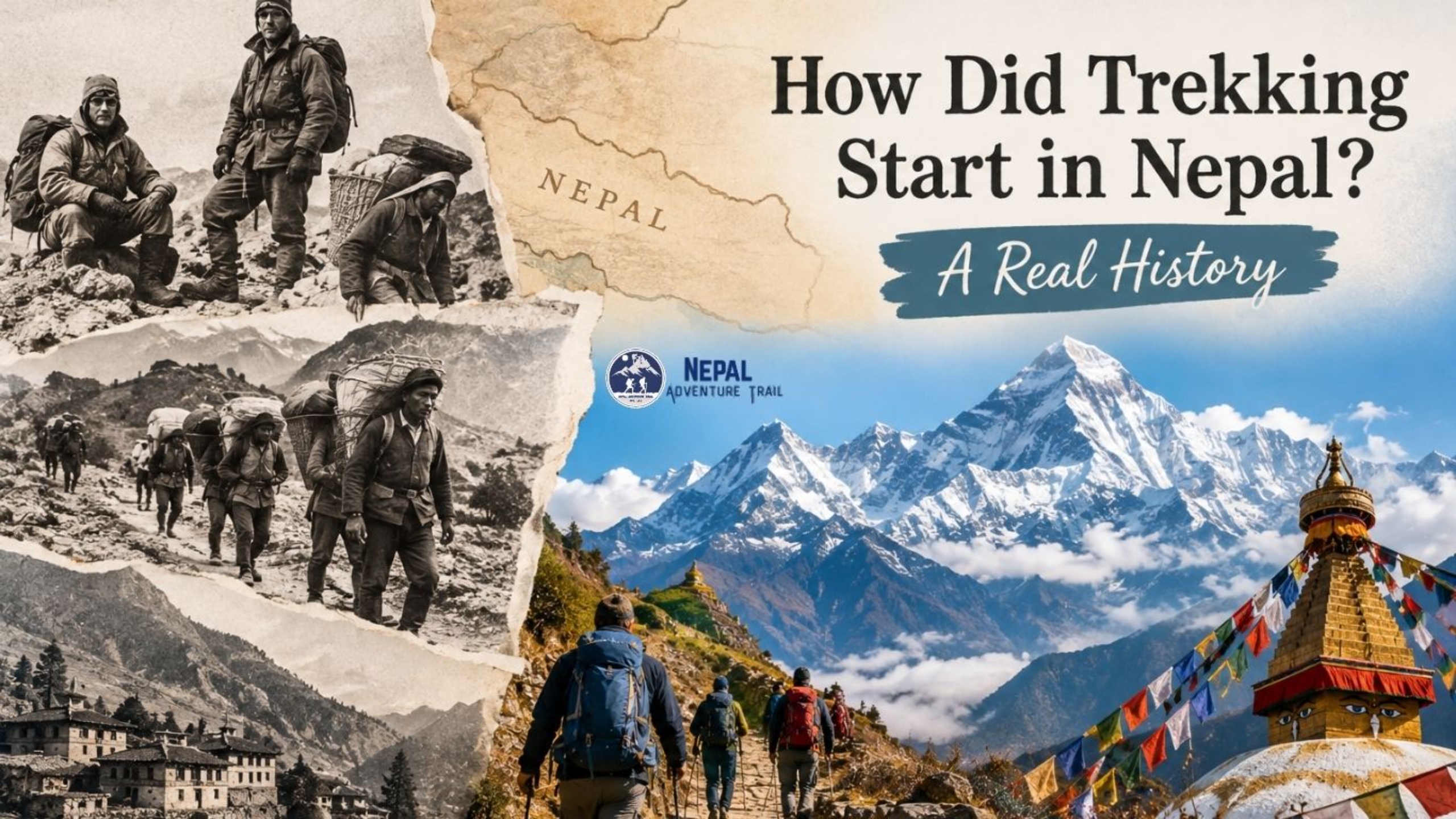
Nepal did not invent trekking on a single date. What we now call trekking grew out of three separate things that happened to collide in the same mountains: centuries of trade and pilgrimage trails used by local communities, a decade of foreign mountaineering expeditions that mapped and tested those same trails after 1949, and one retired British Army officer who, in 1964, looked at what climbers had been doing for fun on approach marches and realized ordinary travelers might pay to do the same thing.
Here is how that actually unfolded.
How Did Trekking Start in Nepal?
The short answer: trekking as an organized, paid activity started in 1964 and 1965, when Colonel Jimmy Roberts registered Mountain Travel, Nepal’s first trekking agency, and led his first paying clients, three American women, on a walk to the Everest region. But that event only makes sense against fifteen years of buildup. Nepal had opened cautiously to foreign mountaineers in 1949, after more than a century under Rana rule that kept the country closed to outsiders. Expedition after expedition walked in from India on foot between 1949 and 1964, using the same village trails that farmers, traders and pilgrims had walked for generations. Roberts had spent those years on approach marches himself. He simply noticed that the walking was often more enjoyable than the climbing, and that other people might want to buy that experience without the climbing part.
What Was Travel in Nepal Like Before Modern Trekking?
Long before any foreigner used the word “trek” in a Nepali context, the trails existed and were busy. Salt caravans moved between Tibet and the mid-hills for centuries, carrying salt and wool south and grain north, a trade that only lost its economic logic in the 1950s once iodized salt from India became cheap and roads improved. Pilgrims walked the same corridors for different reasons. Muktinath, above the Kali Gandaki gorge, drew Hindu and Buddhist pilgrims to a site regarded as a place of liberation. Gosaikunda, a lake sacred to Lord Shiva, still pulls thousands of pilgrims north of Kathmandu every August during Janai Purnima, using a route that later became a standard trekking add-on to Langtang.
None of this was recreational in the modern sense. People walked because walking was how goods and prayers moved. But those same footpaths, river crossings and village guesthouses became the physical skeleton that trekking tourism would later use without needing to build anything new.
How Nepal’s Opening to Foreigners Changed Mountain Travel
For more than a hundred years, from 1846 to 1951, the Rana family ruled Nepal and kept it closed. Pre-war Himalayan expeditions avoided the country entirely, approaching the range instead through Tibet or British India. That changed only when geopolitics forced the Ranas’ hand. Communist gains in China worried the ruling family enough that Nepal opened diplomatic contact with the United States in 1946, and the following years saw a slow, grudging relaxation. Scientific travelers got in first: an Indian survey party reached the Kosi Valley in 1948, and Swiss scientist Arnold Heim was allowed to fly over Annapurna and Dhaulagiri to photograph them.
Pure mountaineering requests were still refused. Both Switzerland and Britain asked for climbing permission in 1948 and were turned down. It was only in 1949 that the Ranas agreed to let mountaineers in, and even then only if they traveled with a scientist attached. The explorer Bill Tilman used that narrow opening to make several treks through the Helambu, Kali Gandaki and Everest regions, becoming one of the first Western travelers to walk Nepal’s hill trails for their own sake rather than for trade or worship. The Rana regime itself ended in 1951, and the country’s borders loosened further from there. It’s worth being precise here: 1949 marks when a handful of foreigners could enter for exploration, not when trekking as an industry began. Those are two different milestones, fifteen years apart.
The 1950s and the Rise of Himalayan Expeditions
Once the door opened even slightly, expeditions arrived fast. A French team led by Maurice Herzog summited Annapurna on 3 June 1950, the first ascent of any peak above 8,000 meters anywhere in the world. American and British teams scouted Everest’s approaches in 1950 and 1951. Then, on 29 May 1953, Edmund Hillary and Tenzing Norgay reached the summit of Everest with John Hunt’s British expedition, a result timed almost exactly with Queen Elizabeth II’s coronation and reported by newspapers worldwide within days.
By 1964, ten of the world’s fourteen peaks above 8,000 meters had been climbed, the last being Shishapangma, scaled that year by a Chinese team. This decade and a half of expeditions did something beyond the climbing itself. Every team that walked from Kathmandu or Jiri toward Everest, or up the Kali Gandaki toward Annapurna, needed porters, food, local knowledge and route information. Foreign climbers learned Nepal’s mountain geography step by step, alongside the Sherpas and other local crews who already knew it. That accumulated knowledge, not any single ascent, is what made organized trekking possible once someone decided to sell the walking on its own.
Who Helped Develop Trekking in Nepal?
Credit for trekking’s development belongs less to any single mountaineer than to the Sherpa guides, porters and lodge families of the Khumbu, Solu, Annapurna and Langtang regions, whose knowledge of terrain, weather and altitude made every expedition and every early trek survivable. Roberts himself said as much: his first commercial trek in 1965 was led on the ground by Ang Temba Sherpa, and Mountain Travel’s early staff included Dawa Norbu Sherpa alongside British and Nepali colleagues. Sherpa guides who started as high-altitude porters on expeditions in the 1950s and 1960s, men like Pertemba, who began working at Lukla airport before joining Mountain Travel as a porter and later becoming a sirdar, went on to lead some of trekking’s defining decades.
Sir Edmund Hillary’s contribution ran alongside the trekking industry rather than through it directly. His Himalayan Trust, founded in 1960, built the region’s first school at Khumjung in 1961, then a hospital at Khunde in 1966, and the Lukla airstrip in 1964, which turned a two-to-three-week walk from Kathmandu into a 45-minute flight. That airstrip did more to open the Everest region to mass trekking than almost anything else built in the twentieth century, even though Hillary built it to supply schools and hospitals, not to launch a tourism industry. He was reportedly uneasy about the flood of visitors it eventually brought.
When Did Organized Trekking Begin in Nepal?
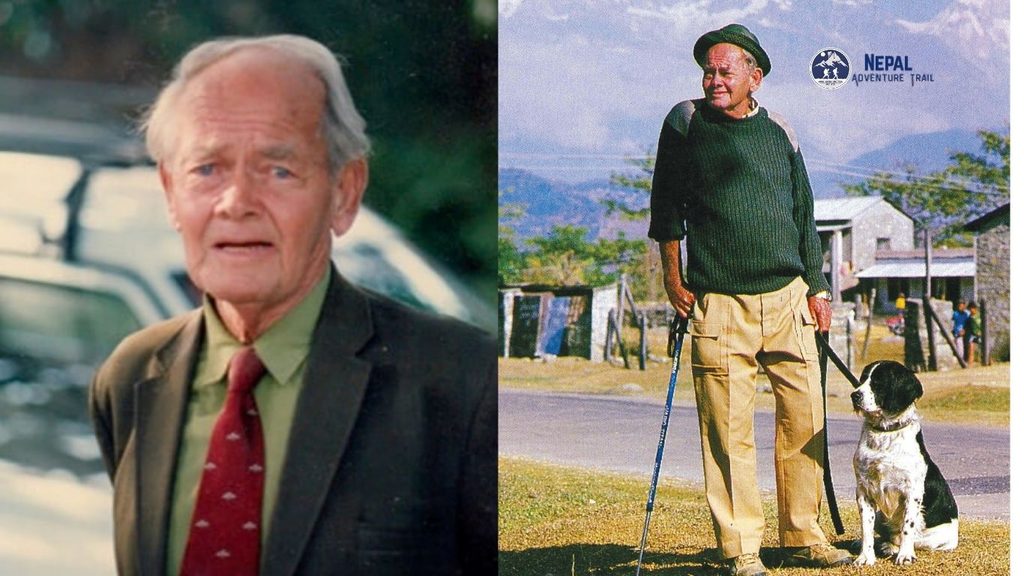
Toward the end of 1964, Jimmy Roberts registered Mountain Travel with Nepal’s Industry and Commerce Department, the first travel company formally registered in the country under its new Tourism Act. His own notes describe the moment plainly: a company with no typewriter, run out of a small office, waiting to see if the idea would work. It did. His first paying clients, three American women living in Calcutta, whom Roberts later called “a sporting trio of enthusiastic and appreciative ladies,” trekked to the Everest region in the early spring of 1965 on a fully supported camping expedition, complete with a sirdar, cooks, kitchen staff and porters carrying tents and food. Some published accounts round this off to a clean “1964” or “1965” depending on whether they’re counting the registration or the first trek. Both are correct; they’re just marking different moments in the same launch.
Mountain Travel had the field to itself for four years. No second trekking agency registered in Nepal until 1968. Roberts’ early partners, Leo LeBon and Allen Steck in the United States and Warwick Deacock of Australia’s Ausventure, began sending clients on a regular basis, and what started as one man’s idea became, within a decade, “trekking tourism,” a term and an industry that did not exist anywhere else in the world before Nepal built it.
The Development of Nepal’s Major Trekking Routes
Everest Region
The Khumbu became internationally known through the same expeditions that eventually made it a trekking destination. Once Lukla’s airstrip opened in 1964, the region that had taken weeks to reach from Kathmandu became a short flight away, and Everest Base Camp trekking grew directly out of the approach routes climbers had already been using for a decade.
Annapurna Region
Annapurna’s trails carried a different kind of traffic first: the Kali Gandaki, the world’s deepest gorge, was a working trade corridor between Tibet and India long before Herzog’s 1950 ascent brought Western attention to the massif above it. The Annapurna Circuit and the trails into the Annapurna Sanctuary developed later, largely without an airstrip shortcut, which is part of why the region built a denser network of teahouses along its longer approach walks.
Langtang Region
Langtang developed as the more accessible Himalayan option closer to Kathmandu, a day’s drive rather than a flight. Its national park status, granted in 1976, and its pilgrimage route to Gosaikunda gave it a dual identity from early on, part trekking destination, part sacred site, that it still carries today.
Other regions, Manaslu, Kanchenjunga, Dolpo, Upper Mustang, developed later still and mostly under restricted-area rules, opening to trekkers gradually from the 1990s onward as the government balanced tourism revenue against border sensitivity and conservation limits.
How Trekking Tourism Expanded in Nepal
Growth after 1965 was steady rather than sudden. Nepal recorded roughly 2,051 tourist arrivals in 1958; by 1970, international arrivals by air had reached nearly 46,000, with annual growth exceeding 30 percent through much of the late 1960s. Trekking agencies multiplied after Mountain Travel’s four-year monopoly ended in 1968. Guides, porters, cooks and lodge owners built a support economy around routes that had, a generation earlier, seen only traders and expedition teams. Government permit systems, conservation area fees and, later, registered-guide requirements developed alongside this growth, aiming to manage the environmental and safety pressure that came with rising visitor numbers.
The Role of Conservation in Nepal’s Trekking Industry
Trekking’s early growth put real pressure on the regions it moved through, deforestation for firewood and lodge construction being the most visible problem, and conservation planning followed close behind. Sagarmatha National Park, covering the Everest region, was announced at a WWF congress in 1973 and formally established in 1976, then inscribed as a UNESCO World Heritage Site in 1979. Langtang National Park was established the same year, in 1976, Nepal’s first national park in the Himalayan region specifically. The Annapurna Conservation Area followed a different model entirely: launched in 1986 as a pilot project in Ghandruk covering roughly 200 square kilometers, it expanded through the following years and was formally gazetted in 1992 at its present size, built from the start around local community management rather than the stricter separation used in national parks. It remains Nepal’s largest protected area.
These conservation frameworks did more than protect forest and wildlife. They shaped how trekking itself is run today, from park entry fees that fund local development to guide and porter welfare standards that trekking associations continue to push for.
When Did Trekking Become Popular in Nepal?
There is no single year worth pointing to. Popularity built in stages: the 1960s established the model, the 1970s brought conservation infrastructure and Lukla’s growing flight schedule, and the 1980s and 1990s saw teahouse trekking replace fully-supported camping as the default way to walk the Everest and Annapurna trails, lowering the cost and logistics enough that independent trekkers, not just clients on organized camping expeditions, could realistically attempt them. By the 1990s, trekking permits numbered in the tens of thousands annually, a scale Roberts’ original three clients could not have imagined.
How Trekking in Nepal Has Changed Over Time
Then: Roberts’ early treks moved like small expeditions. Tents, a full camp crew, a sirdar managing porters and cooks, and a fixed itinerary set by the agency. Trekkers carried little and decided almost nothing once the trek began.
Now: Most trekkers on Nepal’s main routes sleep in teahouses rather than tents, arrange permits and guides in Kathmandu or Pokhara rather than through a single monopoly agency, and can choose everything from a fully organized package to an independent walk with a hired guide. Flights, mobile signal along much of the Everest and Annapurna trails, and online permit processing have replaced weeks of approach walking and paperwork done by hand. The routes are largely the same trails traders and pilgrims used a century ago. Almost everything else around them has changed.
Why Is Nepal Now Known as a Major Trekking Destination?
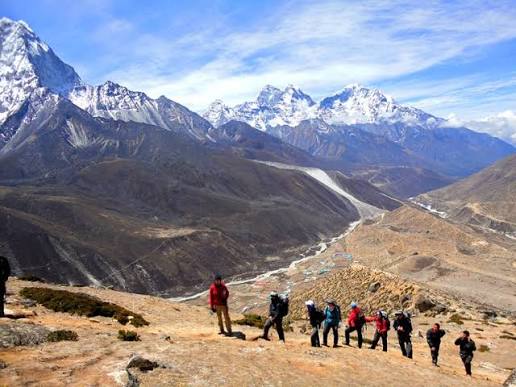
Geography did the initial work: eight of the world’s fourteen highest peaks sit inside or along Nepal’s borders, packed into a country roughly the size of Arkansas. But geography alone doesn’t explain the industry. What Nepal built on top of it, teahouse networks, conservation areas that fund themselves through tourism, generations of Sherpa and Tamang guiding families, and a permit and trail system that, however bureaucratic it sometimes feels on the ground, keeps routes maintained and monitored, is what turned a set of very tall mountains into a place people can actually walk through safely for two or three weeks. Mountaineering put Nepal on the map. Trekking is what let ordinary travelers follow.
Frequently Asked Questions
When did trekking start in Nepal?
Organized, commercial trekking began in 1964 and 1965, when Jimmy Roberts registered Mountain Travel and led his first paying clients to the Everest region. Recreational foreign travel on Nepal’s trails goes back further, to Bill Tilman’s expeditions starting in 1949.
Who started trekking in Nepal?
Colonel Jimmy Roberts, a retired British Army Gurkha officer, founded Mountain Travel in 1964, Nepal’s first commercial trekking agency. Sherpa guides, including Ang Temba Sherpa, who led Roberts’ first trek, were central to making it work.
How did trekking become popular in Nepal?
Popularity grew in stages across the 1960s through 1990s, driven by Lukla airstrip’s 1964 opening, conservation area development in the 1970s and 1980s, and the rise of teahouse trekking, which made independent travel affordable and practical.
What was trekking like in Nepal before tourism?
Before tourism, the same trails carried salt traders moving goods between Tibet and India, and pilgrims traveling to sites like Muktinath and Gosaikunda. There was no recreational trekking in the modern sense, but the paths and village support systems already existed.
When did Nepal open to foreign tourists?
Nepal allowed limited mountaineering access starting in 1949, after the Rana rulers relaxed their closed-door policy. The Rana regime itself ended in 1951, after which the country opened more broadly to foreign visitors.
What role did Sherpas play in the development of trekking?
Sherpa guides, porters, sirdars and lodge owners supplied the route knowledge, altitude experience and logistical support that made both expeditions and early commercial treks possible, and many went on to lead trekking companies and guiding operations themselves.
When did organized trekking begin in Nepal?
Mountain Travel registered with Nepal’s government toward the end of 1964 and ran its first commercial trek in early 1965. It remained the country’s only trekking agency until 1968.
What is the oldest trekking route in Nepal?
No single trail claims that title outright, since many routes, including the Kali Gandaki corridor and the paths into Langtang and the Khumbu, were trade and pilgrimage routes centuries before any foreign trekker walked them.
How did Everest trekking develop?
Everest region trekking developed out of expedition approach routes used from 1950 onward, then accelerated sharply after Edmund Hillary’s Himalayan Trust built the Lukla airstrip in 1964, cutting the approach from weeks to a 45-minute flight.
Why did Nepal become famous for trekking?
Nepal combines an unmatched concentration of high peaks with trails, guiding traditions and village support systems that already existed before tourism arrived, plus a conservation and permit structure built specifically around sustaining trekking as an industry.