
The Poon Hill trek is one of the shortest Himalayan routes in Nepal, but the weather still decides whether you get a clean mountain panorama or stare into a wall of cloud at sunrise. The trail itself is straightforward. The timing is not. Pick the wrong month, and the famous Ghorepani Poon Hill sunrise view disappears behind rain, fog, or winter storms.
This is not an 8,000m expedition. You are not dealing with glacier crossings or technical climbing. But the Annapurna region creates fast weather shifts, especially around dawn. The difference between October and July is the difference between seeing Dhaulagiri, Annapurna South, Machhapuchhre, and Hiunchuli clearly or seeing nothing at all.
Most trekkers underestimate the route because of the altitude. That is a mistake. The trail climbs thousands of stone steps through Ulleri and Ghorepani. Your legs will feel it. Weather compounds the problem. Wet trails, icy staircases, or heavy afternoon rain can turn a simple trek into an exhausting slog.
The best time for Poon Hill trek depends on one thing: visibility. Temperature matters. Crowds matter. Rhododendron blooms matter. But if the mountain line is hidden, you lose the main reason people wake up at 4 AM and climb to the viewpoint in the dark.
The Reality of the Poon Hill Trek
The Poon Hill route sits inside the Annapurna Conservation Area, Nepal’s largest protected area, managed by the National Trust for Nature Conservation (NTNC). Most itineraries start from Nayapul, Tikhedhunga, or Ulleri and loop through Ghorepani, Tadapani, and Ghandruk before returning to Pokhara.
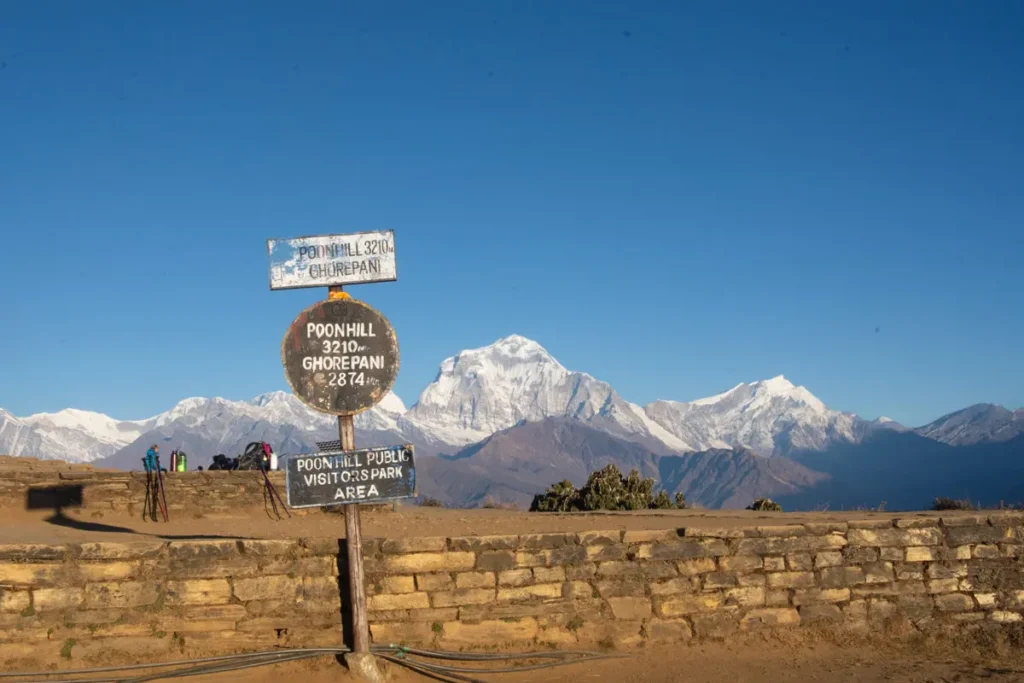
Altitude is moderate by Himalayan standards. Poon Hill itself sits at around 3,210 meters. That reduces the risk of severe altitude sickness compared to Everest or Annapurna Base Camp routes. But moderate altitude does not mean easy trekking.
The hardest part for most people is the staircase climb. Ulleri alone has thousands of steep stone steps. In dry weather, it is manageable. During monsoon or after snow, those same steps become slippery and punishing.
The trail is also crowded during peak Annapurna trekking season, which the Nepal Tourism Board consistently lists among the country’s most visited trekking regions. October mornings can feel like a queue line near the summit viewpoint. If you expect solitude, you are choosing the wrong trek.
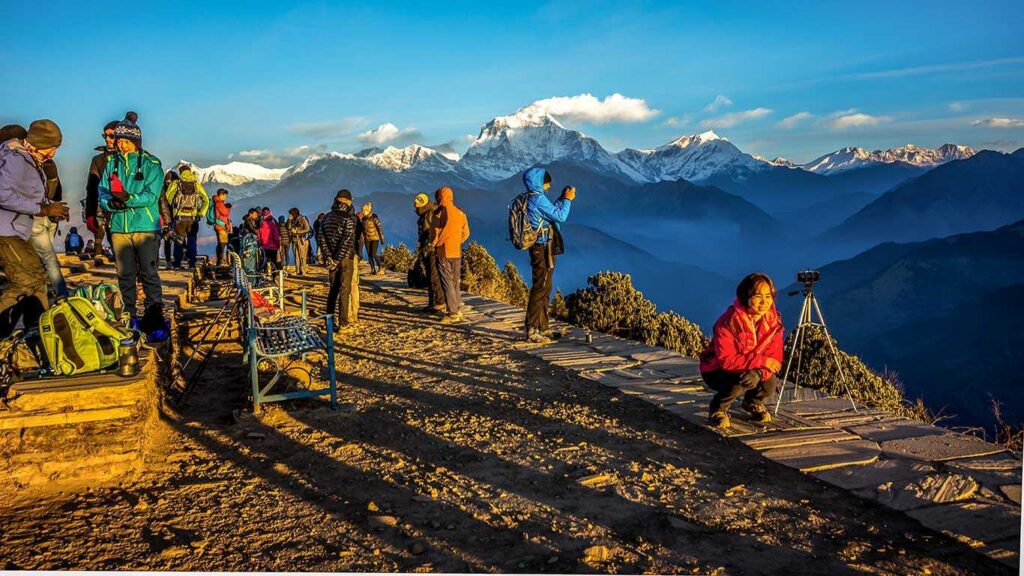
Still, there is a reason the route remains popular. The sunrise angle from Poon Hill gives direct views across the Annapurna and Dhaulagiri ranges. On a clear morning, the first light hits the peaks while the valleys remain dark below. That contrast is what people come for.
The Best Time for the Poon Hill Trek (Seasonal Breakdown)
Spring (March–May): The Rhododendron Bloom and Temperature
Spring is one of the best months for Nepal trekking, especially for shorter mid-hill routes like Poon Hill.
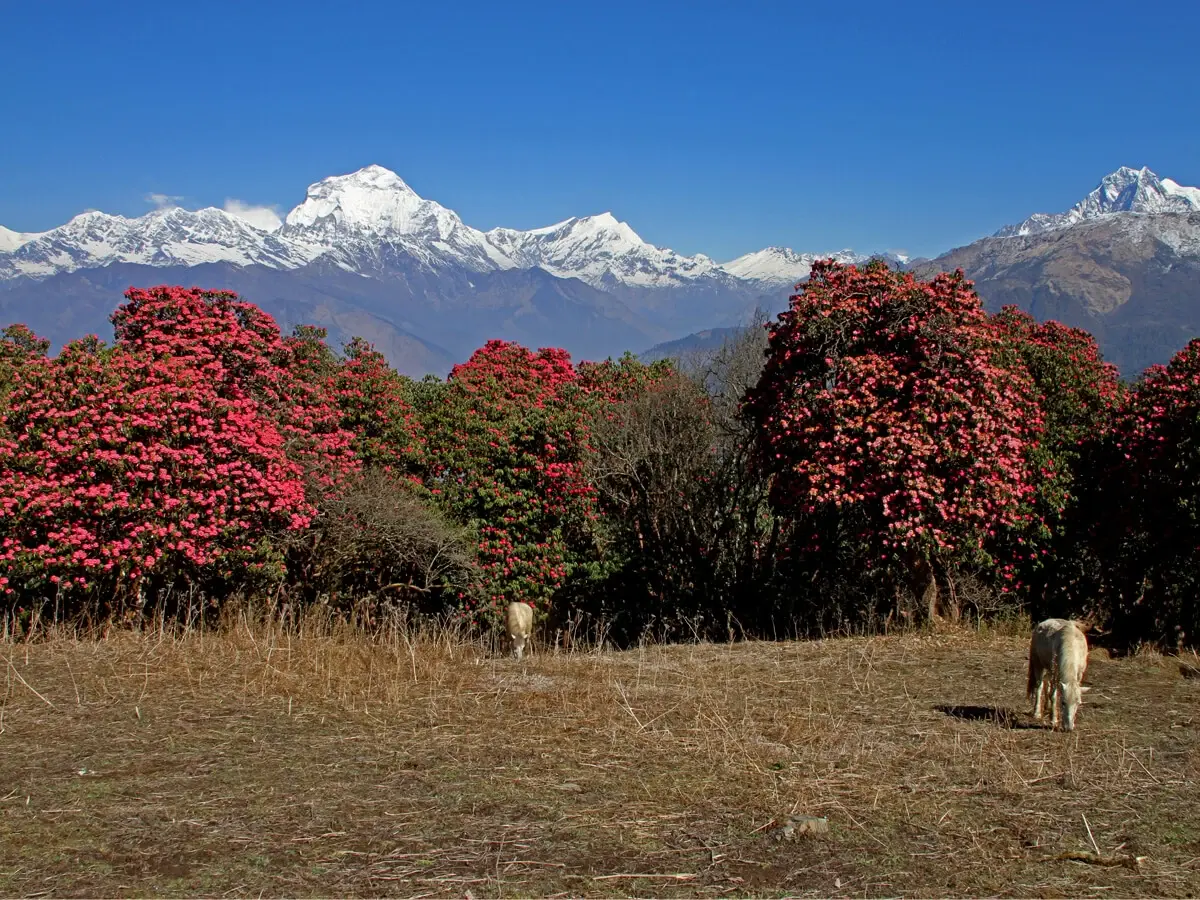
Temperatures are stable. Daytime trekking is comfortable. Nights are cold but manageable without extreme winter gear. More importantly, the forests between Banthanti and Ghorepani explode with rhododendron blooms in March and April — Nepal’s national flower, the lali gurans.
The forests are not subtle during peak bloom. Entire hillsides turn red, pink, and white. Combined with snow-covered Annapurna South behind them, the contrast is sharp.
Morning visibility in spring is usually good. Afternoon cloud buildup becomes more common by late April and May. This matters because mountain views are strongest before 9 AM. After midday, haze often rolls into the valleys.
Spring conditions:
- Daytime temperatures: 10°C to 20°C
- Night temperatures near Ghorepani: 0°C to 5°C
- Stable trails with low snow risk
- Good tea house availability
- Moderate to heavy crowd levels
If you care about photography, early April is usually the sweet spot. The rhododendrons peak while visibility still remains relatively stable.
By May, heat and haze increase. You can still trek successfully, but the mountains often lose sharp definition in afternoon light.
Autumn (September–November): The Clear Sky Window
Autumn is the strongest season for the Poon Hill trek. This is the post-monsoon window when the atmosphere clears and visibility reaches its best condition, a pattern confirmed by the Department of Hydrology and Meteorology, Nepal, which tracks the country’s seasonal rainfall retreat each year.
September starts wet. Trails can still be muddy from leftover monsoon rain. Leeches remain active in lower forests. But by late September and October, conditions improve dramatically.
October is the prime month for the Ghorepani Poon Hill sunrise view. Monsoon dust and pollution get washed out of the air. The Himalayan skyline becomes sharper and more detailed.
You will see the difference immediately at sunrise. Dhaulagiri stands clean against the western horizon while the Annapurna range catches the first orange light from the east.
Autumn conditions:
- Daytime temperatures: 12°C to 18°C
- Night temperatures: 0°C to 5°C
- Lowest rainfall levels
- Strongest visibility
- Peak trekking traffic
November remains excellent, especially early in the month. Later in November, mornings become colder and frost appears regularly near Ghorepani.
This season also has the busiest tea houses. Bookings matter if you are trekking during Nepal’s Dashain and Tihar festival periods.
If your priority is mountain visibility, autumn is the best time for Poon Hill trek. No other season matches its consistency.
Winter (December–February): The Cold Reality
Poon Hill trek in winter works if you prepare properly.
The upside is clear skies and fewer trekkers. The downside is cold mornings, frozen water pipes, and occasional snowstorms blocking the higher trail sections.
Most people underestimate how cold the sunrise climb becomes. You leave Ghorepani before dawn, often around 4:30 AM. Wind exposure near the viewpoint can push temperatures well below freezing.
Winter conditions:
- Daytime temperatures: 5°C to 12°C
- Night temperatures: -5°C to 0°C
- Frequent frost and ice
- Possible snowfall above Ghorepani
- Thin crowds and quieter tea houses
The trail itself remains accessible most winters. Heavy snow occasionally disrupts movement for a day or two, but long-term closures are rare.
Do not rely on tea house blankets alone in January. Bring a proper sleeping bag rated for sub-zero temperatures.
Traction matters too. Frozen stone staircases near Ulleri and Ghorepani become dangerous before sunrise. Lightweight microspikes help more than bulky crampons on this route.
Winter gives excellent visibility, but comfort drops sharply.
Monsoon (June–August): Why to Avoid
This is the worst trekking in Nepal weather window for Poon Hill.
The problem is not just rain. It is visibility, humidity, trail condition, insects, and cloud cover combined.
Monsoon mornings often begin clear for an hour before the valleys fill with fog. By afternoon, heavy rain becomes common. Leeches cover wet forest sections below Ghorepani.
The mountain views disappear for days at a time.
Monsoon conditions:
- Heavy daily rainfall
- Slippery stone staircases
- High humidity
- Frequent cloud cover
- Leeches in forested sections
People sometimes ask whether the route stays “green and beautiful” during monsoon. Yes, the forests become lush. But the mountains are the point of the trek. If Annapurna and Dhaulagiri remain hidden behind cloud, the trade-off is poor.
Avoid June through August unless you specifically enjoy rainy-season trekking.
Why Visibility Matters (The Sunrise Factor)
Poon Hill exists for one reason: sunrise.
The viewpoint works because of geography and timing. You stand above the surrounding ridges while the eastern sunlight hits the Annapurna and Dhaulagiri massifs directly.
That effect lasts maybe 30 to 45 minutes.
Clouds ruin it immediately. Even thin haze reduces the sharpness of the peaks. Monsoon moisture completely kills the long-range visibility.
This is why experienced guides push trekkers out of bed before dawn regardless of temperature. Waiting until sunrise itself is too late. You need to reach the viewpoint before first light.
Bring:
- A headlamp
- Gloves
- A thermal layer
- A windproof jacket
- Water that will not freeze overnight
The climb from Ghorepani to Poon Hill takes around 45 minutes to 1 hour depending on pace. The trail is steep but direct.
Do not carry your full backpack for the sunrise push. Leave heavy gear in the tea house.
Physical Difficulty & Preparation
People constantly ask about Poon Hill trek difficulty because the route is marketed as “easy.”
That description is misleading.
Technically, the trek is simple. There are no ropes, glaciers, or exposed ridgelines. Physically, it is a long stair-climb.
The Ulleri ascent alone can crush inexperienced trekkers. Continuous stone steps punish knees and calves, especially in humid weather.
You should comfortably handle:
- 5 to 7 hours of daily walking
- Repeated uphill stair climbing
- Cold morning starts
- Basic tea house conditions
Is Poon Hill trek good for beginners? Yes—if the beginner has reasonable fitness and realistic expectations.
You do not need mountaineering experience. You do need leg endurance.
Training advice:
- Stair climbing helps more than flat-road running
- Train with a loaded backpack
- Break in your boots before arriving in Nepal
- Trekking poles reduce knee strain significantly
The route is also shorter than Annapurna Base Camp. That is why many trekkers compare Poon Hill trek vs Annapurna Base Camp before booking.
Poon Hill gives:
- Shorter duration
- Lower altitude
- Easier logistics
- Less altitude risk
Annapurna Base Camp gives:
- Bigger mountain immersion
- Higher elevation
- Longer trekking days
- More physical fatigue
If your priority is a quick Himalayan experience with reliable mountain views, Poon Hill is the better entry-level option.
Permitting and Logistics for Your Dates
You need two permits for the route:
- ACAP permit (Annapurna Conservation Area Permit)
- TIMS card (Trekkers’ Information Management System)
These are checked at multiple points along the trail.
Permits can be arranged in Kathmandu or Pokhara before departure. Bring passport copies and passport-size photos. Foreign nationals should also confirm current visa rules through Nepal’s Department of Immigration before arrival.
Tea houses remain open year-round on the main route. But availability tightens during October and April. If you are trekking in peak season, secure accommodation early.
Electricity and Wi-Fi exist in most villages, but reliability drops with altitude and bad weather.
Cash is critical. Do not expect card payments in Ghorepani or Tadapani. Carry enough Nepali rupees for the full trek.
Typical itinerary length:
- 4 to 5 days from Pokhara
- 6 days with a slower pace
- 3 days only if you move aggressively
The shorter the itinerary, the harder the daily climbs become.
FAQ: The Real Questions
Is Poon Hill trek beginner-friendly?
Yes, but only for beginners with decent fitness. The route is non-technical, but the stair sections are demanding.
Do I need crampons in winter?
Usually no. Lightweight microspikes are enough for icy mornings. Full crampons are unnecessary unless there is an unusual snowstorm.
How many days do I need for the best experience?
Five days is the ideal balance. It gives enough time for gradual climbing without rushing the sunrise section.
Can I do it solo?
Yes. The trail is well-marked and heavily used during peak Annapurna trekking season. Solo trekking is common, though weather and navigation become harder during winter and monsoon.
What is the hardest section?
The Ulleri staircase. Most first-time trekkers underestimate it.
When is the absolute best month?
October. Visibility is strongest, rainfall is low, and temperatures remain stable.
Final Advice
The Poon Hill trek is a short-duration expedition, but timing determines if you see the peaks or just the clouds. At Nepal Adventure Trail, we track the seasonal weather patterns to ensure your itinerary lands on the clearest windows. We handle the logistics, so you can focus on the sunrise.