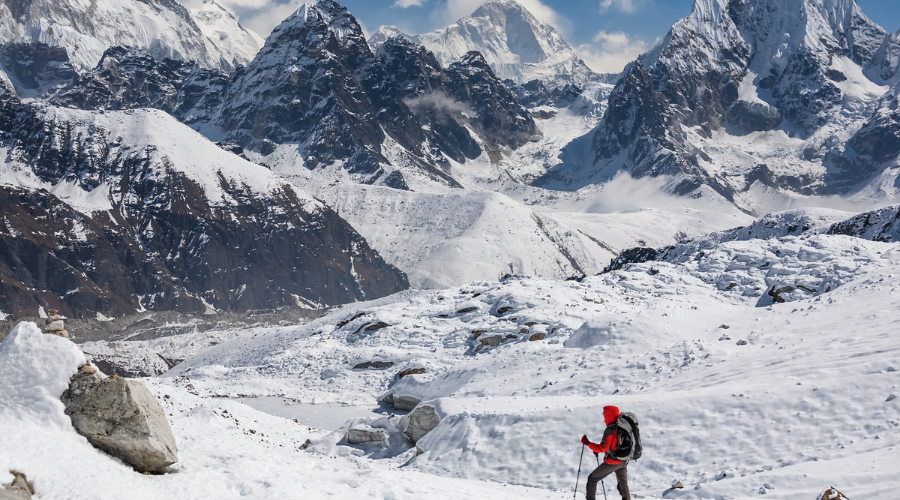
Most trekkers flying into Lukla follow the same trail. The route from Lukla to Namche Bazaar and onward to Everest Base Camp has become so popular that many guides jokingly call it the “Everest Highway.” There is nothing wrong with that route; it offers world-class mountain scenery. But if you’re looking for solitude, bigger challenges, and a deeper understanding of the Khumbu region, the standard Everest Base Camp trek only scratches the surface.
The Three Passes Trek Nepal is what happens when you connect the entire high-altitude network of valleys, passes, glaciers, and Sherpa settlements into one enormous circuit. It takes you beyond the crowds and into terrain where every pass must be earned. You cross three major Himalayan passes above 5,300 meters, sleep in remote villages many trekkers never reach, and experience a side of the Everest region that feels significantly wilder.
This is not a casual trek. It is a demanding mountain journey that rewards preparation, patience, and respect for altitude.
Where is the Three Passes Trek Located?
The Three Passes Trek Nepal takes place inside Sagarmatha National Park, a UNESCO World Heritage Site located in northeastern Nepal near the border with Tibet.
Unlike the standard Everest Base Camp route, which follows a relatively straightforward valley system, the everest three passes trek forms a giant high-altitude loop around much of the upper Khumbu region.
The route links three major valleys:
- The Imja Valley
- The Gokyo Valley
- The Bhote Koshi Valley
Instead of trekking directly to Everest Base Camp and returning the same way, trekkers cross mountain passes that connect these valleys into one continuous circuit.
The route traverses landscapes shaped by glaciers, alpine lakes, rocky moraines, and centuries-old Sherpa settlements. It also offers access to several of the most famous viewpoints in the Himalayas, including Kala Patthar and Chhukung Ri.
At its highest point, the elevation of three passes trek Nepal reaches 5,535 m (18,159 ft) at Kongma La.
The Ultimate Counter-Clockwise Circuit & Map Breakdown
Many trekkers underestimate how much route direction matters.
After guiding this circuit multiple times, I strongly recommend a counter-clockwise approach. It allows gradual altitude gain through the Bhote Koshi Valley before tackling the more demanding sections of the route.
The body adapts better. Recovery improves. Decision-making remains sharper when the altitude starts to bite.
Why Counter-Clockwise Works Better
Approaching Renjo La first provides a gentler introduction to high-altitude acclimatization compared to attacking Kongma La early in the trek.
Advantages include:
- Slower altitude progression
- Better adaptation before crossing technical terrain
- Reduced risk of exhaustion
- Stronger preparation for Cho La and Kongma La
Best Itinerary for Everest Three Passes
Lukla (2,860m)
Namche Bazaar (3,440m)
Thame Village (3,800m)
Lungden (4,380m)
Renjo La Pass (5,360m)
Gokyo Lakes (4,790m)
Ngozumpa Glacier Crossing
Cho La Pass (5,420m)
Dzongla (4,830m)
Lobuche (4,910m)
Gorak Shep (5,164m)
Everest Base Camp (5,364m)
Kala Patthar (5,545m)
Lobuche
Kongma La Pass (5,535m)
Chhukung (4,730m)
Dingboche (4,410m)
Namche Bazaar
Lukla
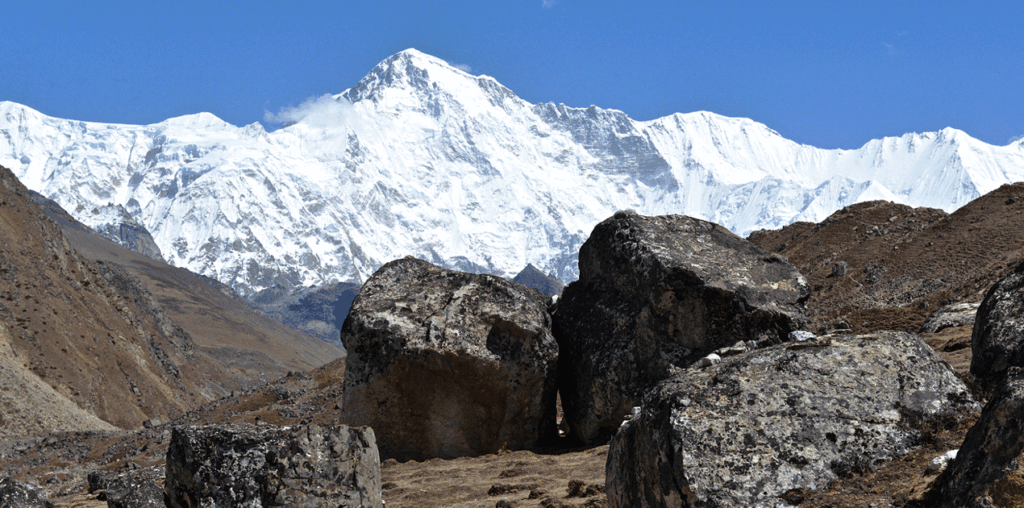
The Hidden Beauty of Thame
Most Everest Base Camp trekkers never visit Thame village.
That is a mistake.
The trail feels quieter almost immediately after leaving Namche. Stone-walled fields replace crowds. Ancient monasteries sit above the valley. The atmosphere feels closer to traditional Khumbu life than the busier settlements further east.
Lungden: Last Stop Before Renjo La
Lungden often surprises trekkers.
The village itself is tiny, but the night before Renjo La carries a certain energy. Everyone knows what comes next.
Before dawn, trekkers step outside into freezing air. Water bottles may be partially frozen. The wind cutting down from the pass can feel brutal before sunrise.
Then the climb begins.
Deconstructing the Three High Passes
Each pass has its own character.
Treating them as identical challenges is a mistake.
Renjo La (5,360m / 17,585ft)
Renjo La is often the favorite.
Not because it is easy.
Because the reward is outrageous.
After a long ascent from Lungden, the summit reveals one of the finest mountain panoramas in Nepal. Everest, Lhotse, and Makalu align above the turquoise waters of the Gokyo Lakes.
On a clear autumn morning, the contrast between dark mountains, blue lakes, and snow-covered summits looks almost unreal.
The descent into the Gokyo Valley is steep but straightforward.
Many experienced trekkers consider this the most scenic pass of the circuit.
Cho La (5,420m / 17,782ft)
Cho La is different.
This is where the trek starts demanding concentration.
Among the three passes, Cho La is generally considered the most technical.
The western approach from Dzongla involves rocky terrain, loose moraine, and sections that can become icy depending on recent weather conditions.
The glacial section changes from season to season.
One year a path may be obvious. The following season it can look completely different.
This is why microspikes for Cho La pass are often carried even during peak trekking seasons.
The crossing requires:
- Careful foot placement
- Attention to weather
- Early departures
- Respect for ice and snow conditions
Once over the pass, the route drops toward the famous Ngozumpa Glacier.
And this is where many trekkers discover a different kind of suffering.
Not altitude.
Boulder hopping.
The crossing of the Ngozumpa Glacier—Nepal’s longest glacier—is endless. Large rocks, uneven footing, and constant balance adjustments punish tired legs.
The hot sherpa stew waiting in Gokyo or nearby teahouses suddenly becomes one of life’s greatest luxuries.
Kongma La (5,535m / 18,159ft)
Kongma La is the highest pass.
It is also the one many trekkers fear most.
There are no villages between Lobuche and Chhukung. No teahouses. No easy escape routes.
Just rock, altitude, and isolation.
The climb begins before sunrise. Progress feels slow. Every step demands effort.
Unlike Renjo La, there are fewer obvious landmarks.
Unlike Cho La, there is no glacier crossing to break up the day.
Just sustained climbing at high altitude.
The summit sits at 5,535 meters (18,159 feet), making it the highest point of the entire trek.
The reward?
Massive views over the Khumbu Glacier, Nuptse, Lhotse, Makalu, and the surrounding peaks.
The descent toward Chhukung feels endless, particularly on tired legs.
But reaching the valley below delivers a genuine sense of accomplishment.
No photograph captures that feeling.
Logistical Reality Check: Permits, Season, and Gear
Success on this trek depends heavily on logistics.
Trekking Permits for Khumbu
Trekkers currently require:
Sagarmatha National Park Entry Permit
- Required for all foreign trekkers
- Purchased in Kathmandu or Monjo
- Mandatory throughout the national park
Khumbu Pasang Lhamu Rural Municipality Permit
- Local government entry fee
- Usually obtained near Lukla or Monjo
- Required in addition to national park permits
Permit requirements can occasionally change, so checking current regulations before departure remains essential.
Best Season
If someone asks me the best season for the Three Passes Trek, my answer is simple.
Autumn or spring.
Nothing else.
Autumn (September–November)
Advantages:
- Stable weather
- Dry trails
- Excellent visibility
- Predictable pass conditions
October is often considered prime season.
Spring (March–May)
Advantages:
- Longer daylight hours
- Warmer temperatures
- Stable mountain weather
- Excellent climbing and trekking conditions
April frequently provides the best balance of weather and trail conditions.
Why Winter Is Risky
Winter introduces a serious problem.
Whiteouts.
Fresh snow can completely obscure trails on all three passes. Route finding becomes difficult. Ice conditions become unpredictable.
Many teahouses in remote sections may also close.
Monsoon Problems
Heavy rain, poor visibility, flight delays, and unstable trail conditions make summer a poor choice for most trekkers.
Essential Gear
The Three Passes Trek Nepal is not the place to cut corners.
Critical equipment includes:
- Four-season sleeping bag
- Down jacket
- Layered clothing system
- Trekking poles
- Waterproof shell
- Sunglasses
- Headlamp
- Power bank
- Water purification system
For pass crossings:
- Microspikes
- Lightweight crampons (season dependent)
- Gaiters after snowfall
Many trekkers ask, “How difficult is the Three Passes Trek?”
The answer depends heavily on preparation.
A fit Everest Base Camp trek veteran will still find this route significantly harder due to:
- Multiple 5,000m+ passes
- Longer trekking days
- Glacier crossings
- Greater altitude exposure
- Consecutive high-effort days
This is one of the toughest teahouse trekking Nepal experiences available without technical climbing.
Conclusion
The Three Passes Trek Nepal is not simply a longer version of the Everest Base Camp trek. It is an entirely different experience. You move through isolated valleys, cross three serious mountain passes, navigate glacial terrain, and spend days far from the busiest trekking corridors. The challenge is real, and so is the reward.
If you’re debating the three passes trek vs classic EBC, ask yourself a simple question: do you want to visit the Everest region, or do you want to truly explore it?
For trekkers ready to take on the complete Khumbu circuit, Nepal Adventure Trails can help design a carefully acclimatised itinerary, arrange permits, experienced guides, logistics, and mountain support that gives you the best possible chance of completing one of Nepal’s finest high-altitude journeys.