
I once shared a dining room in Ghandruk with a Danish backpacker who’d budgeted eight dollars a day for his entire Annapurna trip. By day four he was borrowing noodles from a Korean couple and asking strangers if they had spare Snickers bars. He wasn’t stupid. He’d just read one too many blog posts that treated “cheap” as a fixed number instead of a set of trade-offs you make one teahouse at a time.
The cheapest trek in Nepal isn’t a single trail with a magic price tag stapled to it. It’s a moving target shaped by season, altitude, how far you are from a road, and whether you’re willing to eat what the locals eat instead of what’s printed on the tourist menu. I’ve spent years running treks out of Kathmandu and Pokhara, watching trekkers get this right and watching plenty of them get it wrong, and I can tell you the honest numbers, the traps, and which routes actually deliver Himalayan scenery without gutting your bank account.
People searching for the cheapest trek in Nepal usually land on one of two extremes. Either they find a listicle promising a fifteen-dollar-a-day fantasy that hasn’t been accurate since teahouse pricing reset a few years back, or they find an agency site quietly steering every budget inquiry toward a mid-range package because that pays the bills better. Neither is honest, and both waste your planning time. What follows is closer to what I’d tell a friend over a beer in Thamel the night before they set off: the actual arithmetic, region by region, plus the mistakes I watch repeat every season.
What “Budget” Actually Means on the Trail
Budget trekking Nepal isn’t backpacking Southeast Asia with mountains attached. You can’t always haggle a room down to nothing, because most teahouses run on razor-thin margins already. The family that built that stone lodge in Ghorepani probably carried half the materials up on their own backs. What you’re really balancing is accommodation, food, permits, transport, and whether you hire help.
A realistic daily spend for an independent trekker on a popular route sits between $25 and $40 once you strip out flights and gear. That covers a basic twin room, three plates of food, and the odd cup of milk tea. Push toward $20 and you’re eating dal bhat exclusively, skipping hot showers, and sleeping in rooms with a shared squat toilet down the hall. That’s not deprivation. It’s just how low-cost Himalayan trails actually operate, and plenty of seasoned trekkers prefer it that way.
Accommodation: The Part People Overestimate During Cheapest Trek in Nepal
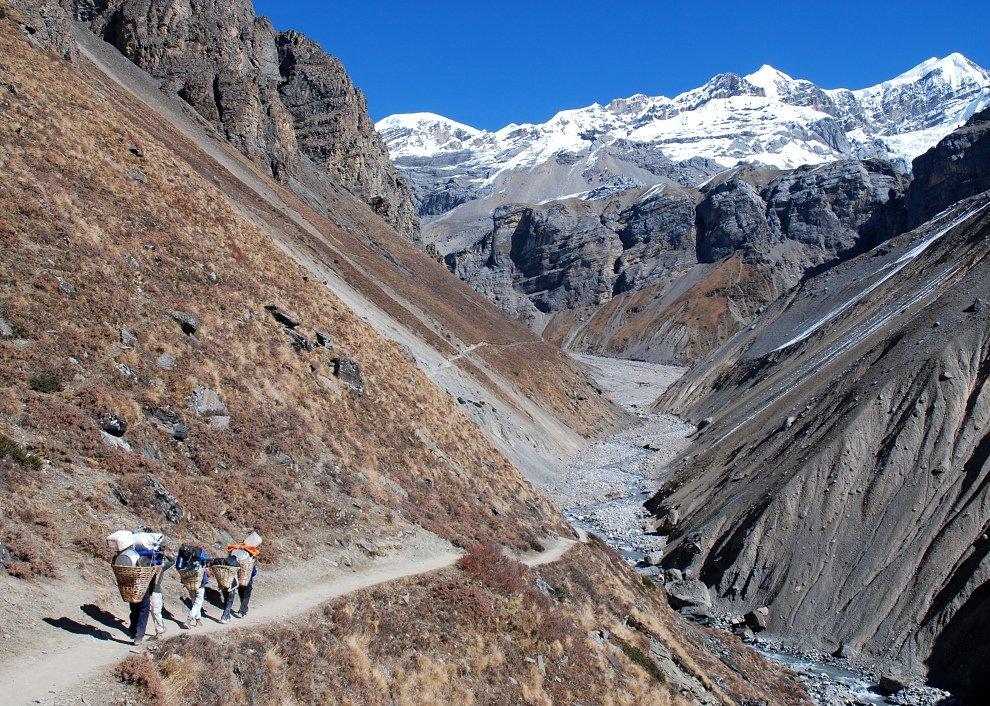
Rooms are the cheapest line item on most trails, which surprises first-timers who expect lodging to eat their budget. In the lower and middle stretches of the Annapurna Circuit, in villages like Bhulbhule, Jagat, and Tal, a basic twin room runs somewhere around $4 to $8 a night. Push higher, into Manang or Yak Kharka, and thinner competition plus yak-train delivery costs push that toward $10 to $17. Many teahouses will hand you a free room if you commit to eating breakfast and dinner there. That’s the unwritten rule of teahouse economics. They make their money on food, not beds.
Meals: Where Your Money Actually Goes
Dal bhat is the backbone of affordable teahouse treks for a reason beyond nostalgia. It’s usually refillable, it’s built from ingredients grown or raised nearby, and at $4 to $8 a plate depending on altitude, it’s the best calorie-to-cost ratio on the mountain. Pizza, pasta, and anything with “chocolate” in the name gets shipped or carried in from lower elevations, so ordering it above Manang or Dingboche, is basically paying a porter’s day wage for a slice of imported comfort. I’ve watched trekkers blow $15 a day on snacks alone without realizing it. Order what the family eats, not what’s aimed at you.
Permits: The Fixed Cost You Can’t Negotiate
Permit fees Nepal trekking requires vary by region, and this is where a lot of budget guides get sloppy with outdated figures. For the Annapurna region you’ll need an ACAP permit, which runs around $30 for foreign nationals, alongside a TIMS-equivalent local fee. Everest treks require a Sagarmatha National Park entry permit near $30 plus a Khumbu Rural Municipality permit around $20, both purchasable at the checkpoints in Monjo. Langtang needs a similar national park permit in the $30 range. Restricted regions like Manaslu are a different animal entirely. Expect $75 to $100 for the first week depending on season, on top of a conservation area fee, and you’ll need to book through a registered agency since solo entry isn’t legally permitted there.
Transport: The Line Item That Wrecks Budgets
This is where I’ve seen more trekking budgets quietly implode than anywhere else. Flying into Lukla for Everest Base Camp can run $350 to $400 round trip, and it gets pricier and less predictable the closer you book to peak season. Weather delays have stranded trekkers in Lukla for days, burning through their food budget while they wait. Compare that to the bus-and-jeep combination to Besisahar or Syabrubesi for Annapurna or Langtang, which runs $8 to $20 depending on whether you take a crowded local bus or spring for a tourist coach. If cost is genuinely your priority, routes reachable by road rather than short-takeoff aircraft are where the real savings live.
The Hidden Costs Most Blog Posts Skip
Nobody warns you clearly enough about the small charges that stack up. Hot showers cost $2 to $5 the higher you climb, since someone has to burn wood or run a gas geyser to heat that water at 4,000 meters. Wi-Fi, where it exists, runs a similar range and is often slower than dial-up. Charging your phone or power bank can cost $1 to $3 per device, and at higher villages like Gorak Shep or Thorong Phedi, that adds up fast if you’re carrying a camera, phone, and power bank that all need juice.
Bottled water is the silent budget killer. A liter near Everest Base Camp can cost close to $5, and buying it daily for two weeks turns into real money, not to mention the plastic waste problem it creates in villages with no way to process it. A steripen, purification tablets, or a filter bottle pays for itself within four or five days. It’s the single easiest hidden cost to eliminate entirely.
Then there’s the guide-and-porter question, which changed meaningfully in recent years. Nepal’s tourism authorities have tightened rules requiring foreign trekkers to use a licensed guide in most national park and conservation areas, which shifts the old independent-versus-guided budget trek calculation. A guide runs roughly $25 to $35 a day, a porter $20 to $25. That’s a real cost, but splitting a guide between two or three trekkers brings the per-person hit down close to what solo trekking used to cost anyway, and you gain someone who knows which teahouse actually has hot water tonight.
Safety: Where Cutting Corners Stops Being Frugal
There’s a real line between smart frugal choices and decisions that put you in danger, and it’s worth naming plainly. Skipping travel insurance to save $60 isn’t frugal. It’s a gamble against a helicopter evacuation that can cost $5,000 or more if altitude sickness turns serious above Thorong La or the Everest high camps. Rationing food to stretch a budget at altitude is a bad trade too, because your body burns dramatically more calories fighting cold and thin air than it does at sea level, and being underfed makes you more vulnerable to altitude sickness, not less.
I’d also gently push back on trekkers who skip acclimatization days to save a night’s lodging cost in the cheapest trek in Nepal. Rushing the ascent schedule on Annapurna Circuit or Everest Base Camp to shave two or three days off your itinerary is the single most common mistake I see, and it’s the one most likely to end a trip early, either from illness or from a forced, expensive evacuation. The teahouse you skip sleeping in to save money might have cost you $8. The rescue insurance claim from ignoring altitude symptoms costs thousands, if it works out at all.
Five Genuinely Affordable Routes, Compared
Here’s how the real contenders stack up, based on actual 2024 to 2025 trail pricing rather than recycled estimates.
| Route | Difficulty | Duration | Estimated Total Cost (excl. flights to Nepal) |
|---|---|---|---|
| Ghorepani Poon Hill | Easy to Moderate | 4-5 days | $180-$260 |
| Langtang Valley | Moderate | 7-8 days | $280-$400 |
| Mardi Himal | Moderate | 5-6 days | $220-$320 |
| Annapurna Circuit (shortened, jeep to Chame) | Moderate to Challenging | 10-12 days | $450-$650 |
| Everest Base Camp | Challenging | 12-14 days | $1,100-$1,500 (Lukla flight included) |
Ghorepani Poon Hill wins on pure economy. No restricted permit, no expensive flight, and villages like Ulleri and Tadapani have enough teahouse competition to keep prices honest. Langtang Valley is the most underrated pick on this list. It sits close enough to Kathmandu that a local bus to Syabrubesi replaces an expensive flight entirely, and the Tamang villages along the way, especially Lama Hotel and Kyanjin Gompa, offer some of the friendliest, least commercialized teahouse culture left in Nepal, largely because tourism here rebuilt slowly after the 2015 earthquake. Mardi Himal sneaks up on you with sanctuary-style views for a fraction of the ABC price tag, since it’s shorter and requires only the standard ACAP permit.
The Annapurna Circuit stays affordable if you accept a jeep ride to Chame or Manang instead of walking the lower, road-damaged sections. That’s a controversial shortcut among purists, but a legitimate one for anyone weighing cheap Annapurna trek options against limited vacation days. Everest Base Camp, frankly, is never going to be the cheapest trek in Nepal because of the Lukla flight alone, which is why so many budget-focused trekkers now look at inexpensive Everest Base Camp alternatives like Gokyo Ri via the Jiri road-walk approach, or skip Everest altogether in favor of the region’s lower-cost cousins.
If you’re the type who stares at that table and can’t tell whether the extra few hundred dollars for Annapurna buys you meaningfully more than Mardi Himal does for your specific fitness level and timeframe, that’s a conversation worth having before you book anything. A mismatched route is a more expensive mistake than any single line item above.
When “Cheap” Turns Into Dangerous
The trekkers I worry about aren’t the ones counting rupees carefully. They’re the ones treating every cost as optional. I’ve met people attempting Manaslu without a guide despite the legal requirement, hoping to slip past a checkpoint. That’s not resourceful, that’s a fine and a forced turnaround waiting to happen, plus zero support if something goes wrong in a region with genuinely limited rescue infrastructure. I’ve also met trekkers sharing altitude sickness medication without medical guidance to avoid buying their own, which can mask symptoms rather than treat them.
Smart frugality looks different. Carrying a water filter instead of buying bottled water. Choosing Langtang over Everest because the value is simply better for your goals. Trekking during the shoulder season, early December or late February through early March, when teahouses drop prices to fill rooms and the trails empty out, without hitting the genuinely risky deep-winter conditions of peak January in the high passes. That’s the cheapest time to trek Nepal without gambling on weather that could close Thorong La entirely.
How We Actually Help Trekkers Get This Right
At Nepal Adventure Trail, we’ve been arranging treks out of Kathmandu long enough to watch these patterns repeat year after year, and most of what we do for budget-conscious trekkers isn’t about discounting. It’s about sequencing decisions correctly. We’ll tell a trekker with 8 days and $500 that Mardi Himal fits their situation better than a rushed, underfed attempt at Annapurna Base Camp, even when that’s the less profitable recommendation for us. We group solo trekkers together specifically so the mandatory guide fee splits three or four ways instead of landing on one person’s shoulders. We know which teahouses in Chhomrong, Kyanjin Gompa, and Ghorepani run honest kitchens at fair prices, because our guides have slept in most of them.
Cost-effective trekking packages only work if the person building them has actually walked the trail in the shoulder season, negotiated a room rate in Nepali, and watched what happens when a trekker’s shortcut backfires. That’s the value we bring to Nepal backpacker trails and frugal mountain adventures alike. Not the lowest number on a quote sheet, but a plan that survives contact with the actual mountain.
If you’re weighing routes right now and the math isn’t adding up cleanly, it’s worth a short conversation before you commit. Tell us your dates, your fitness level, and your real ceiling on spending, and we’ll map out which trail gets you the most mountain for the money without setting you up for a costly mistake three days in.
We do this planning conversation for free, and it usually takes fifteen minutes over WhatsApp or email. Long enough to walk through your dates, your budget ceiling, and whether you’re chasing the single cheapest trek in Nepal or the best value one, which, as you’ve probably gathered by now, aren’t always the same trail. Send us your rough numbers before you book anything, and we’ll tell you straight whether they hold up on the actual trail, not just on paper.
One Last Thing About Budget Trekking Culture
There’s an odd honesty ritual that happens in teahouse dining rooms once the sun goes down and the stove’s lit. Trekkers start comparing what they paid for things. Someone got a room for $3 in Bamboo. Someone else swears the same room cost them $10 the week before. Nobody’s lying. Prices genuinely shift with a lodge owner’s mood, the weather forecast, and how many empty rooms they’re staring at that night. I’ve come to think this constant, slightly competitive bargain-comparing is its own small culture within trekking, a shared game everyone plays without quite admitting they’re playing it. Next time you’re up there, ask your dining-room neighbors what they paid for their room. You’ll learn more about the real cost of trekking Nepal from that conversation than from any budget breakdown, including, probably, this one.