
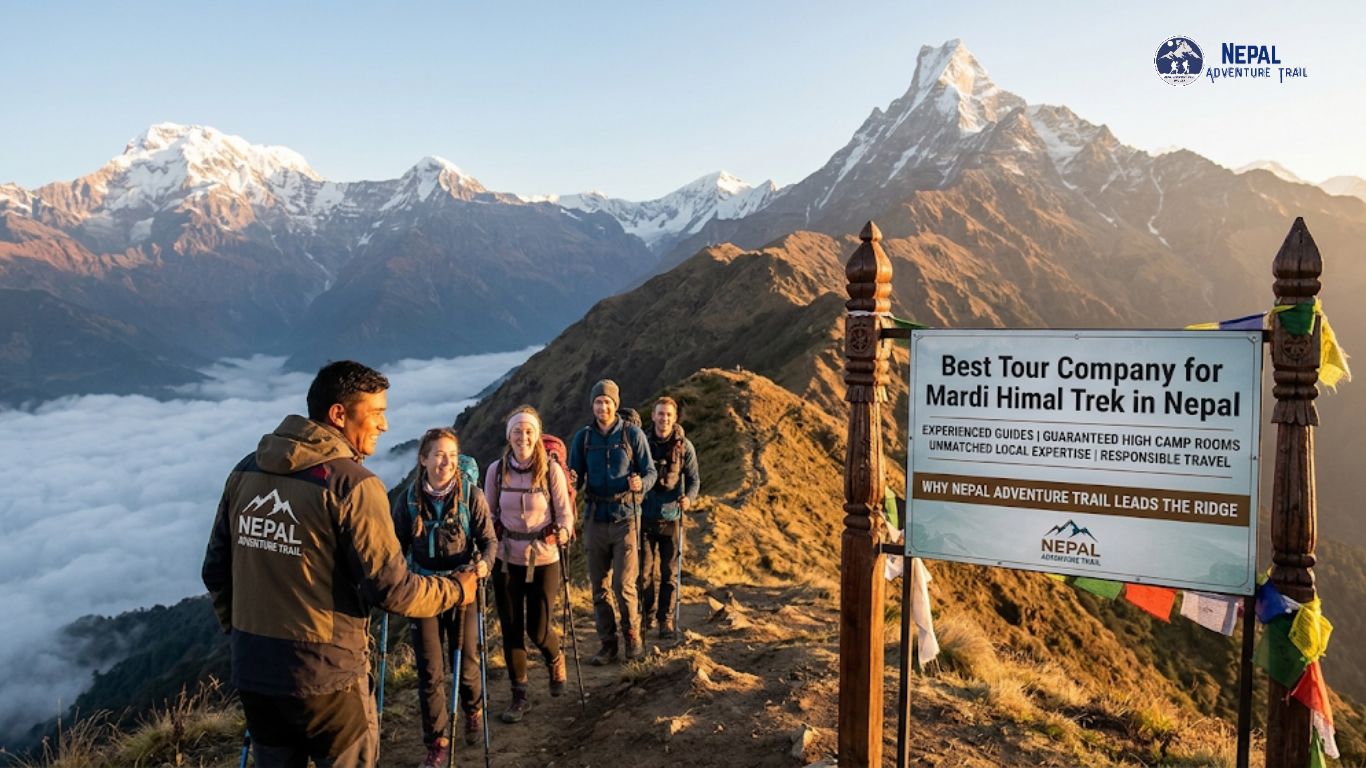
The best tour company for Mardi Himal trek in Nepal is the one that solves the ridge’s logistics before you land in Pokhara, not after you are standing in a crowded dining hall at 3,580 meters. Scenery is not the hard part. Beds, pacing, and permits are.
Dozens of agencies sell this Mardi Himal guided trek from Pokhara and Kathmandu, and most of them walk the same route on the same stone steps. The difference is in the details. This guide names them.
We are the operator, so test every claim here against the checklist near the end. A good agency survives that test. A weak one does not.
The Mardi Himal Reality: Why Your Choice of Operator Matters
Mardi Himal looks gentle on a map and behaves like a staircase in person. The rise from Pokhara (820 meters) to Mardi Himal Base Camp (4,500 meters) is nearly 3,700 meters.
That is a lot. Operators who treat it like a casual weekend walk get people into trouble.
Steep Ascents, Narrow Ridges, and High Camp Bottlenecks
From Kande (1,770 meters), the trail climbs through rhododendron forest to Australian Camp (2,060 meters) and Forest Camp (2,550 meters). Stone staircases start almost at once. Knees notice on day one.
Beyond Low Camp (2,990 meters) the forest thins, and above Badal Danda (3,210 meters) the trail narrows to a grassy ridge with drops on both sides. Passing is awkward. A slow group holds up everyone behind it.
Then comes the bottleneck. High Camp (3,580 meters) is a small cluster of lodges, and rooms fill early in the March to May and October to November seasons.
Late arrivals sleep in dining halls. Mardi Himal High Camp logistics decide the trip.
The pre-dawn headlamp start up the rocky spine toward Mardi Himal Base Camp (4,500 meters) takes roughly three to four hours each way. Cold and thin air do the rest.
Season shapes the risk. March to May brings rhododendron bloom and crowds.
October to November brings the clearest views and the fullest lodges. The monsoon brings cloud, rain, and leeches in the lower forest.
Why Overseas Middlemen Cost More and Deliver Less
Many overseas booking sites do not run treks themselves. They resell a Nepali operator’s itinerary and add a commission on top, so you pay for a layer that never carries a pack. That layer adds cost, not safety.
When a landslide blocks the Kande road or a lodge double-books, the person you paid is sitting in another time zone. Decisions wait for emails. The guide on the trail often cannot change anything alone.
A local Nepal trekking operator removes the relay. The people who plan the trek also staff it. They can reroute a day out of Pokhara with one phone call.
The best tour company for Mardi Himal trek in Nepal answers to the trekker, not to a booking site.
Why Nepal Adventure Trail Is the Best Tour Company for Mardi Himal Trek in Nepal
Claims are cheap on this ridge. Mechanics are not. Here are six that matter, in the order a trekker feels them.
Why do we say Nepal Adventure Trail Mardi Himal departures lead the field? Because every claim below can be checked. Check them.
1. Guaranteed Teahouse Rooms at Badal Danda and High Camp (3,580m)
Nepal Adventure Trail reserves rooms at Badal Danda (3,210 meters) and High Camp (3,580 meters) before your group leaves Pokhara. Your group arrives expecting a bed. Independent hikers arrive hoping for one.
A pre-booked wooden room matters most at High Camp, where a night in a crowded dining hall at 3,580 meters costs you the sleep you need before a 3 a.m. start. Sleep is part of acclimatization.
Rooms at High Camp are basic: timber walls, thin mattresses, shared toilets, and nights well below freezing outside summer. Bring a proper sleeping bag. A room still beats a bench by the stove.
No operator controls weather or landslides, and we say so up front. What we control is the reservation.
2. Government-Licensed Guides with Deep Annapurna Ridge Experience
Every Nepal Adventure Trail group walks with a licensed Nepali guide, not a freelancer hired at the Kande trailhead. Licensing is the baseline. Local knowledge is the edge.
A guide who has walked the Badal Danda ridge in fog knows which stretch holds ice in November, where the path forks after Low Camp (2,990 meters), and which lodge keeps its stove lit. Brochures do not carry that.
Guide rules in the Annapurna region have shifted since 2023, and sources disagree on how strictly they are enforced. A licensed guide ends the debate.
3. Flexible Acclimatization Pacing and Altitude Safety Protocols
Mardi Himal gains height fast. From Kande (1,770 meters) to High Camp (3,580 meters) is about 1,800 meters in a few days, and the push to Mardi Himal Base Camp adds nearly 900 more in a single day. That is the risk.
At Badal Danda (3,210 meters), guides clip a pulse oximeter onto each trekker and ask about headache, appetite, and sleep. Readings start a conversation. Symptoms make the decision.
A trekker with worsening symptoms stays below. The group holds at High Camp or descends toward Low Camp (2,990 meters). Schedules bend around people.
A paced plan sleeps at Forest Camp (2,550 meters), then Low Camp (2,990 meters), then High Camp (3,580 meters). The base camp day follows. The descent runs through Siding (1,885 meters).
We can add a night at Low Camp or High Camp when the body asks. Altitude is not negotiable.
4. Direct Local Pricing with Zero Third-Party Markups
Nepal Adventure Trail sells its treks from a Kathmandu office, so the price you see has no overseas commission folded in. No relay. No markup.
A fair quote lists transport, guide, porter, permits, rooms, and meals line by line. Ask any operator for that breakdown.
A very low price usually cuts one of three things: guide quality, room reservations, or porter pay. The ridge shows which.
5. Door-to-Door Transport (Kathmandu, Pokhara, Kande & Siding)
The two ends of this trek are where plans leak. At the start, a driver collects you from your Pokhara hotel (820 meters) and a private jeep takes you to Kande (1,770 meters), so the first morning is spent walking, not negotiating.
At the finish, the route down through Siding (1,885 meters) meets a pre-arranged jeep. Tired knees skip the dusty road walk. The Kathmandu to Pokhara leg can sit inside the same booking.
6. Fair Porter Welfare and Sustainable Ridge Leave-No-Trace Standards
Porters on our treks carry a capped load, wear proper footwear and warm layers, and sleep indoors. A tired, underpaid porter slows the ridge. Fair treatment is a safety measure.
The ridge has no road above Kande, so everything at High Camp arrives on someone’s back. Plastic bottles pile up fast. Our guides ask groups to carry out wrappers and to purify water instead of buying bottled water.
Side-by-Side Comparison: Nepal Adventure Trail vs. Generic Operators
A table cannot prove a claim. It can show where to push when you compare quotes for the best tour company for Mardi Himal trek in Nepal.
| Factor | Nepal Adventure Trail | Generic Operators |
|---|---|---|
| Booking Model | Direct from our Kathmandu office, no overseas layer | Often resold through overseas sites with a commission |
| High Camp Room Security | Rooms reserved ahead for confirmed groups | Often first come on arrival, or unconfirmed |
| Guide Certification | Licensed Nepali guides | Varies; some hire freelancers at the trailhead |
| Itinerary Flexibility | Extra night at Low Camp (2,990 m) or High Camp (3,580 m) when needed | Fixed packages; changes may need overseas approval |
| Emergency Protocol | Oximeter checks from Badal Danda (3,210 m); guide-led descent decisions; helicopter evacuation coordinated with your insurer | Varies; sometimes a phone number only |
| Pricing Transparency | Itemized quote | Bundled price; extras appear later |
What to Verify Before Booking Any Mardi Himal Trekking Agency
Who is the best operator for Mardi Himal trek? The one whose answers hold up under questioning.
A Mardi Himal trek agency worth hiring welcomes the test. How to choose a Mardi Himal trekking agency in Nepal comes down to documents, quotes, and how clearly the staff speak about risk.
TAAN Registration, NMA Credentials, and ACAP Permit Handling
Ask every operator, including us, for company registration and Trekking Agencies’ Association of Nepal (TAAN) membership details. Verify them independently. Real agencies hand them over in minutes.
Nepal Mountaineering Association (NMA) membership matters more for peak climbing than for Mardi Himal. It still signals mountaineering depth. Ask for the guide’s license number too.
The Annapurna Conservation Area Permit (ACAP) is the core permit for this route, and several 2026 sources put it at about NPR 3,000 for foreign trekkers. Sources disagree on TIMS and local fees. Ask the agency which permits it is buying and what each costs.
Hidden Costs to Watch For (Hot Showers, Wi-Fi, Charging, and Jeep Transfers)
Everything at High Camp (3,580 meters) is carried up or generated by solar panels. Lodges charge for hot showers, Wi-Fi, and device charging. Ask whether your quote covers them.
Check transport too. Some quotes assume a public bus to Kande (1,770 meters) and add a jeep later. Others leave out the return from Siding (1,885 meters).
Tips, extra nights, and weather delays deserve a line in the quote. If a quote hides them, expect to pay later. Compare totals, not headline prices.
Ask how many days a year your guide spends on this ridge, who owns the vehicles, and who answers the phone when the road closes. Specific answers beat polished ones.
Group size matters on a narrow ridge. Ask about the guide-to-trekker ratio and the maximum group size.
Frequently Asked Questions (FAQ)
Which is the best tour company for Mardi Himal trek in Nepal?
The best tour company for Mardi Himal trek in Nepal is one that is locally run, licensed, transparent about permits, and able to secure rooms at Badal Danda and High Camp ahead of time. We believe we meet it. Check us against the list above.
Why should I book Mardi Himal with a local agency like Nepal Adventure Trail instead of an international site?
A local agency runs the trek itself. There is no commission layer, and the planners are in Kathmandu, not another time zone. When a landslide or a full lodge breaks the plan, the people who booked it can fix it.
Does Nepal Adventure Trail guarantee accommodation at Mardi Himal High Camp during peak season?
We reserve rooms at Badal Danda and High Camp ahead of departure for confirmed groups. Book early for March to May and October to November. No operator controls weather or landslides, and if conditions force a change, the same team re-plans the day.
Can Nepal Adventure Trail customize the Mardi Himal itinerary for 4, 5, or 6 days?
Yes. Shorter plans compress the same stages, while longer plans add nights at Low Camp or High Camp for better acclimatization. Tell us your fitness and flights.
What permits are included when trekking Mardi Himal with Nepal Adventure Trail?
We arrange the ACAP permit and TIMS paperwork where it applies. You do not queue in Pokhara. Rules and fees have shifted, so ask for the current permit list and any local municipality fee in your written quote.
How does Nepal Adventure Trail handle altitude sickness on the Mardi Himal ridge?
Guides run oximeter and symptom checks each evening from Badal Danda (3,210 meters). A trekker with worsening symptoms does not climb higher. The group holds or descends, and helicopter evacuation is coordinated with your insurer if needed.
Lock In Your Ridge Dates
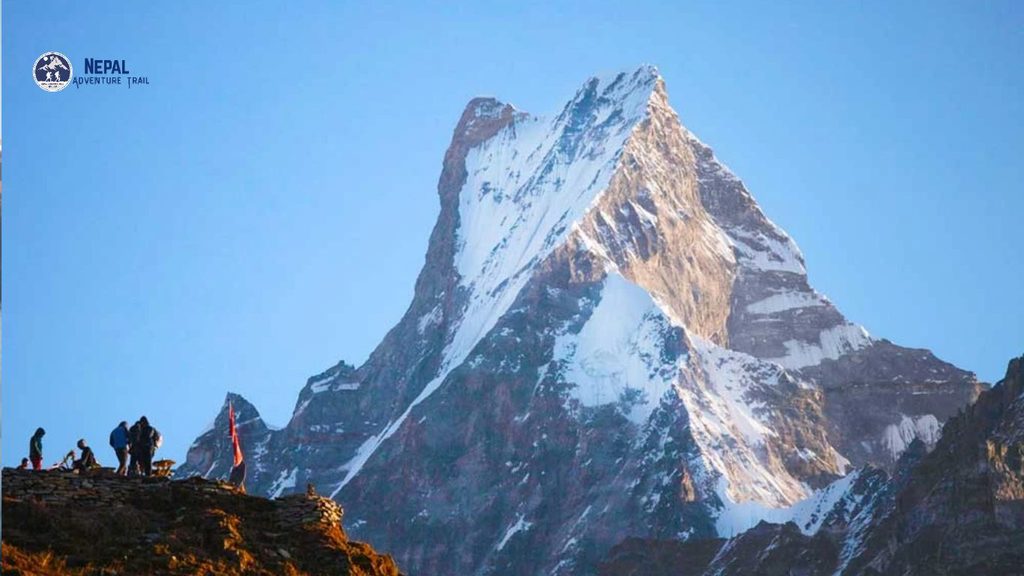
Standing at 4,500 meters on the Mardi Himal viewpoint as dawn hits the vertical wall of Machhapuchhre requires more than luck; it takes an operator that controls every logistical link on the ridge. While many agencies sell generic Annapurna packages, Nepal Adventure Trail delivers the local precision, guaranteed High Camp beds, and safety discipline that make us the best tour company for Mardi Himal trek in Nepal. Reach out to our Kathmandu team today to lock in your dates and customize your route.