
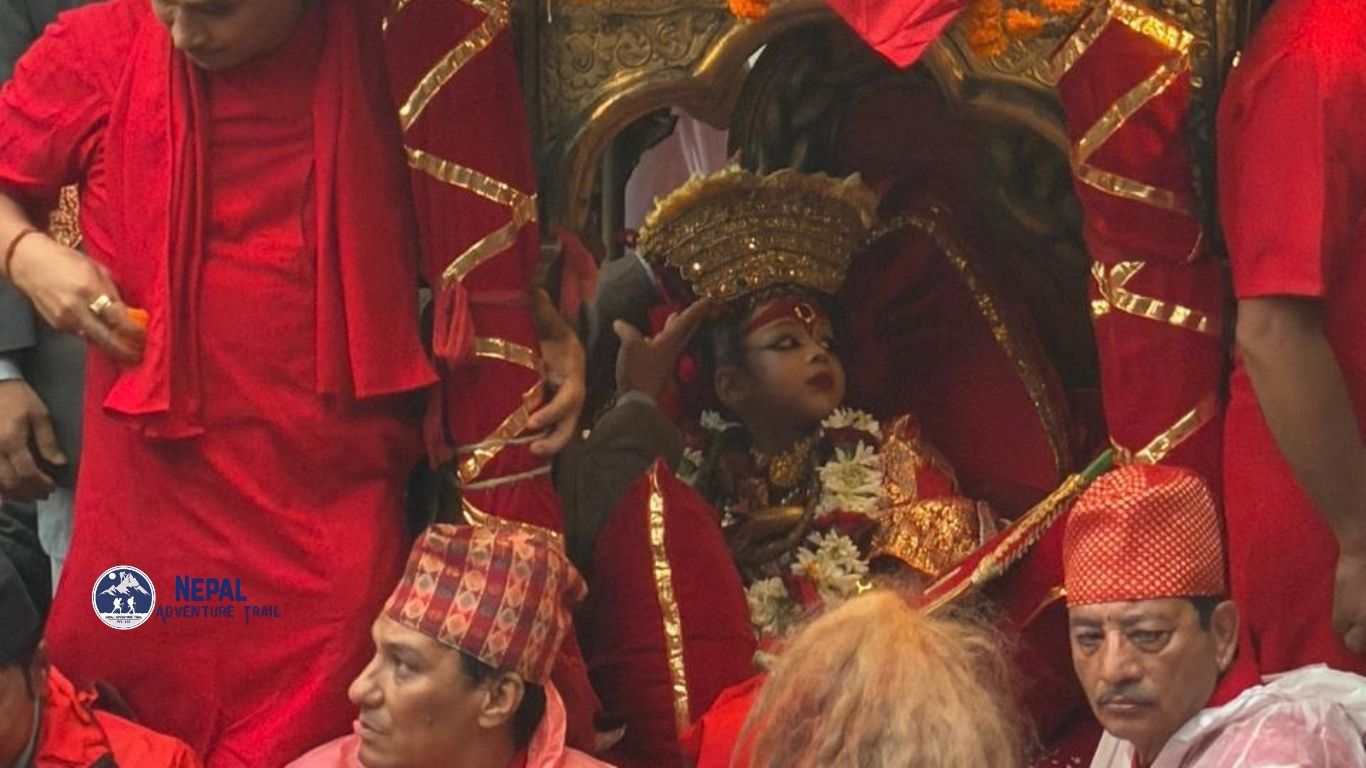
In a carved wooden window above Kathmandu Durbar Square, a small girl in red and gold occasionally looks down at a courtyard full of strangers, and for the length of that glance, the people below believe they are looking at a goddess. Not a statue of one, not a painting, not a symbol. The girl herself. She eats meals prepared for a deity, receives ministers and presidents on their knees, and will step down from the role the moment her body changes in a way that, according to the tradition, means the goddess has left her.
This is the Kumari, the Living Goddess of Nepal, and she is one of the few religious traditions anywhere still practiced in daily life rather than remembered in a museum. Understanding her means understanding a few interlocking things: the Newar culture of the Kathmandu Valley, the Malla kings who formalized her worship, the goddess Taleju Bhawani she is said to embody, the Kumari Ghar where she lives, and Indra Jatra, the festival where thousands of people watch her ride through the old city on a wooden chariot. None of it reduces neatly to a single explanation, and that’s part of what makes it worth understanding properly rather than skimming past.
Who Is the Kumari?
Kumari comes from Sanskrit and simply means “virgin” or “young unmarried girl.” In Kathmandu Valley religious life, it refers to a specific practice: a prepubescent girl from the Newar community, chosen through ritual examination, is worshipped as the living embodiment of Taleju Bhawani, a form of the goddess Durga. She is not seen as a representative of the goddess, or a symbol of her. Within this belief system, Taleju is understood to actually reside in the girl’s body for as long as she holds the role.
Several Kumaris exist across the Kathmandu Valley at any given time, each tied to a different town or neighborhood, but the one people mean when they say “the Kumari” without further specification is the Royal Kumari of Kathmandu, who lives in the Kumari Ghar at Durbar Square. She holds that name because of her former ties to the royal court, not because she outranks other Kumaris in a formal religious sense. Patan, Bhaktapur, and Bungamati maintain their own Kumaris, each with practices that differ in small but real ways from Kathmandu’s.
The girl is chosen from the Shakya or Bajracharya families, both Buddhist clans within the Newar community, yet she is worshipped as an incarnation of a Hindu goddess, and by Hindus and Buddhists alike. That combination confuses visitors expecting the religions to run on separate tracks. In the Kathmandu Valley, they rarely have.
Kumari Mythology
The story most often told about the Kumari’s origin involves King Jaya Prakash Malla, the last independent ruler of Kathmandu before the valley’s unification under the Shah dynasty in the eighteenth century. According to the legend, the goddess Taleju would visit the king’s chambers at night in human form to play a dice game called Tripasa, on the condition that he never tell anyone of her visits. In most versions, the king’s wife or daughter eventually discovers the meetings, Taleju is enraged at the broken promise, and she vanishes. The king, distraught, is told in a dream that the goddess will return, but only by entering the body of a young Shakya girl. The Kumari tradition, the story goes, began from that reconciliation.
It’s worth being honest about what this story is and isn’t. It is a widely repeated legend, central to how the tradition explains itself, and genuinely useful for understanding what the Kumari is believed to represent. It is not a documented historical event. Some chronicles instead credit an earlier king, Trailokya Malla, with formalizing the institution roughly two centuries before Jaya Prakash Malla’s reign, and scholarly research traces the broader practice of worshipping young girls as embodiments of divine feminine energy in the Kathmandu Valley back further still, with an inscription from 1280 CE, during the reign of King Ananta Malla, offering the earliest written record. Oral and ritual tradition suggests roots even earlier, in the Lichhavi period before 750 CE.
So the honest version is layered: the worship of young girls as divine has deep and uncertain roots in the valley; a more formal royal cult developed under later Malla kings; and the popular legend involving Jaya Prakash Malla explains, in story form, why the Kumari is drawn specifically from the Shakya lineage and why the goddess is Taleju. Multiple things can be true here without contradicting each other; myth doesn’t need to be literal history to carry real weight in how a living tradition understands itself.
Kumari Selection Process
When a sitting Kumari’s tenure ends, most commonly through her first menstrual period, though an accidental loss of blood from an injury can also end it, the search for a successor begins. Candidates come from Shakya or Bajracharya families of the Newar community, and for the Royal Kumari, the search traditionally focused on families within Kathmandu itself. She must be in good health, free of scars, birthmarks, or serious illness, and must not yet have shed blood in any form.
The formal examination checks what tradition calls the battis lakshanas, thirty-two physical perfections drawn from Hindu iconography. These are specific and, to modern ears, strange: a neck like a conch shell, thighs like a deer, eyelashes like a cow’s, a voice as soft as a duck’s call. They’re not arbitrary. Each trait ties back to descriptions of divine female beauty in older religious texts, and the examination is meant to identify a body considered a fitting vessel by that inherited standard. A panel that traditionally included senior Vajracharya priests, the state’s chief priest, and the royal astrologer conducts the assessment; today, the process is also communicated to the president’s office and the national government, since the monarchy that once oversaw it no longer exists.
One detail deserves correcting directly, because it circulates constantly online. Popular retellings describe a night-time test in which candidates are shut in a dark room surrounded by the severed heads of sacrificed buffaloes and goats, masked dancers, and men in demon costume, with only the truly fearless girl passing. Rashmila Shakya, who served as the Kumari of Kathmandu from 1984 to 1991 and later wrote a memoir about the experience, has stated plainly that this isn’t how candidates are actually chosen. The ritual involving animal heads is real, but it happens annually, after a girl is already installed as Kumari, not as a test for selecting her in the first place. She has also described the physical examination itself as neither invasive nor frightening. It’s a useful reminder that even well-established traditions accumulate exaggerated internet folklore, and that the people who actually lived the role are the better source.
Life as a Kumari
Once selected, a girl is dressed in red and gold, led across the palace square on a white cloth so her feet never touch bare ground, and brought into the Kumari Ghar, which becomes her home for as long as she holds the role. Her hair is tied into a topknot, and an agni chakshu, a painted third eye, is placed on her forehead, understood as a symbol of the goddess’s all-seeing awareness. When she does need to travel outside the building, for festivals or ceremonies, she’s carried in a palanquin or held by attendants. Her feet are not supposed to touch the ground outside the Kumari Ghar at all.
Public access to her is limited and ritualized. Visitors gather in the courtyard hoping for a glimpse through a latticed window; those granted a closer audience sit on the floor before her, present offerings, and sometimes touch or kiss her feet. Every gesture she makes during these audiences is read as an omen. Crying or loud laughter is traditionally taken as a warning of illness or death; clapping suggests trouble with authorities; picking at food hints at financial loss. If she stays still and silent, whatever the visitor came to ask for is considered granted.
Her family visits, but not constantly, and her regular company is largely limited to the children of her caretakers within the Kumari Ghar. For much of the tradition’s history, she received no formal schooling, since within the belief system she was considered already omniscient as the goddess. That has changed. Modern Kumaris, including the current Kathmandu Kumari, receive daily lessons in Nepali, English, and mathematics, either from tutors inside the palace or, increasingly, through more conventional schooling arrangements. This shift followed real pressure: in 2006, Nepal’s Supreme Court directed the government to examine whether the tradition, as practiced, violated a child’s rights, while explicitly respecting its religious significance. Formal education and a state pension for former Kumaris followed from that ruling.
Kumari Ghar
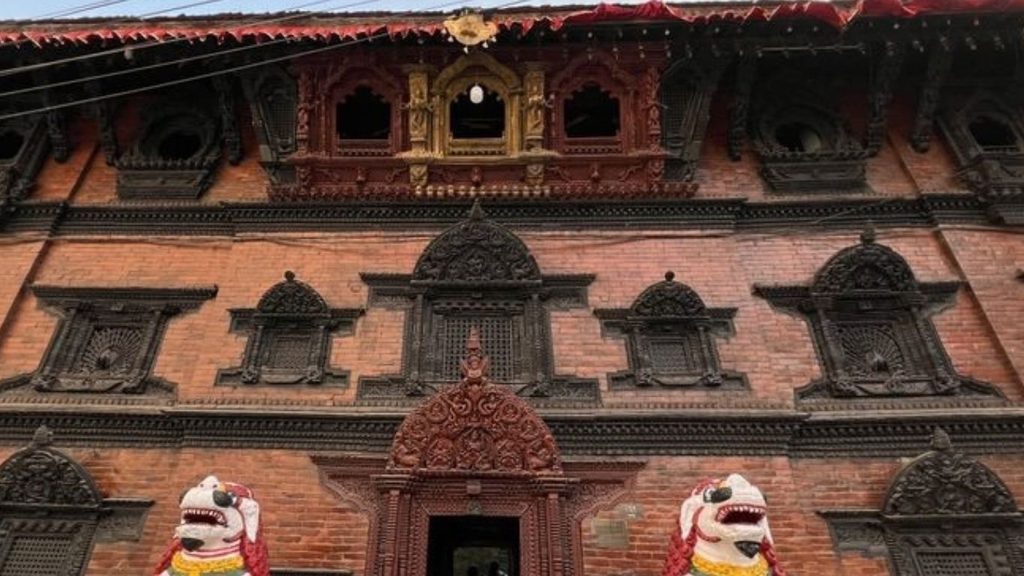
The Kumari Ghar sits in Kathmandu Durbar Square, close to the Gaddi Baithak and within the same UNESCO-listed complex that includes the old royal palace and Taleju’s temple. Jaya Prakash Malla built it in 1757, and its architecture is Newar craftsmanship at its most deliberate: a three-story brick building organized around a central courtyard, with wood carvings running across the windows, doorframes, and struts, many depicting deities and protective symbols rather than pure decoration. The most photographed detail is the elaborately carved wooden window on the upper floor, where the Kumari sometimes appears.
It functions as a residence and a working shrine simultaneously, not a museum exhibit. Visitors can generally enter the courtyard and, if she happens to appear, may catch sight of the Kumari at her window, but the interior living quarters are closed to the public, and photography of the Kumari herself is restricted, particularly once she does appear; policies are enforced on-site and worth confirming with a guide or posted signage rather than assuming. Treat a visit to the courtyard the way you’d treat stepping into any active place of worship: quietly, without expecting a performance, and without treating a devotee’s genuine moment of darshan as a photo opportunity for someone else’s trip.
Indra Jatra and the Kumari
Indra Jatra, known locally as Yenya, is the Kathmandu Valley’s largest street festival, and it existed long before it became closely associated with the Kumari. Tradition credits King Gunakamadeva with starting the festival around the tenth century, to mark the unification and founding of Kathmandu city, centuries before Jaya Prakash Malla or the Kumari tradition as it’s practiced today. The festival honors Indra, the Vedic god of rain and harvest, and unfolds over eight days packed with distinct rituals.
It opens with Yosin Thanegu, the raising of a tall wooden pole, cut from a single pine tree harvested near Nala in Bhaktapur district and hauled into Kathmandu Durbar Square by members of the Manandhar community, where it’s set upright by hand with ropes and sheer effort. From that pole, Indra’s banner is unfurled. Over the following days, masked dancers perform through the old city streets, including the Lakhey, a red-faced demon figure whose dance is one of the festival’s most anticipated performances, and the Pulukisi, a giant fabric elephant representing Indra’s mount, which barrels through the crowds to general delight. A large image of Akash Bhairav, a fierce form of Shiva, is displayed publicly, one of the only times each year this particular deity is shown to the public at all.
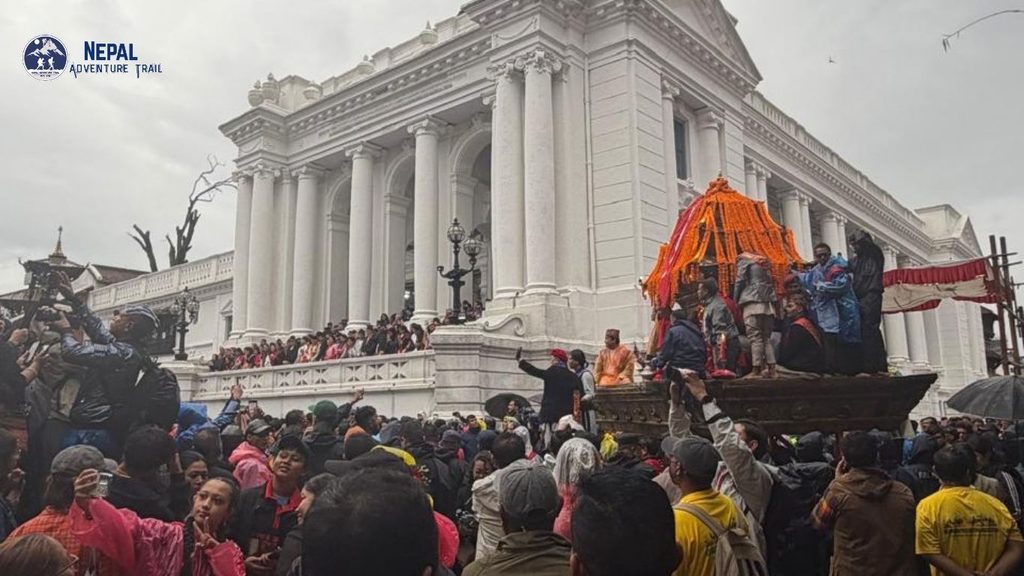
The Kumari’s part in Indra Jatra is the Kumari Jatra, a three-day chariot procession that tradition dates to 1756, under Jaya Prakash Malla, the same king credited with building the Kumari Ghar the following year. On each of the three days, the Kumari’s chariot, along with smaller chariots carrying boy representatives of Ganesh and Bhairav, is pulled by hand through a different quarter of the old city: the southern route on the first day, the northern route on the full moon day itself, and the central route through Kilagal on the third. Historically, the reigning king would stop before the Kumari’s chariot during the procession and receive a tika, a mark of blessing, from her forehead to his, a ritual understood as the goddess conferring legitimacy on the monarch’s rule for the year ahead. Since the monarchy’s abolition in 2008, the President of Nepal has taken on that same ceremonial role, receiving the tika from the Kumari in the king’s place, a detail that says something about how durable the symbolism has proven even after the political structure it originally served disappeared.
Crowds that gather for the chariot procession are dense, and the appeal isn’t limited to devotees. It’s genuinely one of the most striking things to witness in Kathmandu: narrow medieval streets, wooden chariots taller than the doorways around them, masked dancers, and a small child at the center of it all, regarded by thousands of people as something considerably more than a child for as long as the procession lasts.
Other Jatras and the Wider Newar Calendar
Indra Jatra is the festival most tied to the Kumari, but it sits inside a much larger calendar of Newar processions and living-deity traditions across the valley. Dashain, the largest Hindu festival in Nepal, includes its own Kalratri rituals connected historically to Kumari selection in some accounts, though the details vary by source and community. Patan, Bhaktapur, and Bungamati each hold their own Kumari-related observances tied to local calendars rather than Kathmandu’s. None of these are lesser versions of the Kathmandu tradition; they’re parallel practices rooted in their own towns, with their own priesthoods and histories.
The Hindu-Buddhist Connection
It’s tempting to describe the Kumari as “a Hindu goddess worshipped by Buddhists,” and that phrase shows up constantly in casual writing about her, but it flattens something more interesting. The Kathmandu Valley’s religious life, particularly among the Newar community, has never divided neatly along Hindu and Buddhist lines the way those categories often function elsewhere. Newar Buddhism, a Vajrayana tradition with its own priesthood in the Vajracharya caste, developed for centuries alongside Hindu Shaivite and Shakta practice in the same towns, often within the same families and the same temple complexes.
The Kumari sits precisely at that overlap. She is drawn from Buddhist Shakya or Bajracharya lineages, prepared through tantric ritual conducted by Buddhist priests, and yet worshipped as the living form of Taleju, a goddess understood within Hindu tradition as an aspect of Durga. Rather than treating this as a contradiction to be explained away, it makes more sense as evidence of how thoroughly interwoven Kathmandu Valley religion actually is. The Kumari isn’t borrowed from one tradition into another. She’s a product of both, in a place where “both” was never really a strange combination to begin with.
The Kumari and Nepal’s Monarchy
For centuries, the relationship between the Kumari and Nepal’s rulers was direct and structurally important. Malla kings positioned themselves as devotees of Taleju, their family’s protector deity, and the Kumari’s blessing carried real political weight, a sign that the goddess sanctioned the ruler’s authority. That relationship carried forward through the Shah dynasty, which unified Nepal in the late eighteenth century and ruled until 2008. Each year during Indra Jatra, the king would receive a tika from the Kumari, publicly renewing that same claim to divine sanction.
The monarchy’s abolition in 2008, when Nepal became a federal republic, removed the king from that equation but didn’t end the ritual. It shifted. The president now fills the ceremonial role once held by the monarch, receiving the Kumari’s blessing during Indra Jatra much as kings once did. Whether that continuity reflects genuine religious conviction among current officials, political pragmatism, respect for cultural heritage, or some mix of all three likely depends on who you ask. What’s clear is that the tradition itself didn’t require a monarchy to keep functioning.
When a Kumari Stops Being Kumari
Within the belief system, the goddess Taleju is understood to leave the girl’s body the moment she experiences a significant loss of blood, most commonly her first menstrual period, though an accidental injury has occasionally ended a Kumari’s tenure early. At that point, the search for a successor begins, and the outgoing Kumari returns to an ordinary childhood after years of a life built almost entirely around ritual, seclusion, and reverence.
That transition has not always gone smoothly, and it’s worth discussing honestly rather than glossing over. Former Kumaris have spoken publicly about the difficulty of adjusting, learning to walk long distances after years of being carried, catching up academically after limited or late schooling, and navigating an old and largely unfounded superstition that marrying a former Kumari brings bad luck, a belief Rashmila Shakya has directly and publicly rejected through her own life; she is married. Nepal’s government now provides a modest pension to former Kumaris, introduced partly in response to the 2006 Supreme Court ruling and to sustained advocacy from former Kumaris themselves, who have generally described the tradition as culturally meaningful even while pushing for the reforms that eventually followed.
Other Kumaris of Nepal
Kathmandu’s Royal Kumari draws the most attention, but she’s one of several. Patan, just across the Bagmati River, maintains its own Kumari lineage and its own selection customs, drawn from the Bajracharya community there. Bhaktapur, roughly ten kilometers east, does the same. Bungamati, a smaller Newar town, has a distinct practice worth noting specifically: a Bungamati Kumari’s tenure traditionally ends not with menstruation but with the loss of her first milk tooth, a difference that underlines how much local variation exists even within what looks, from outside, like one unified tradition. Smaller and less thoroughly documented Kumari traditions also exist in towns including Nuwakot, Tokha, Sankhu, and Panauti.
None of these local Kumaris report to Kathmandu’s, and none of their practices are simply smaller copies of the capital’s version. They’re independent traditions that happen to share a name, a general theology, and a home region.
Symbolism
The theology behind the Kumari draws on the concept of Shakti, the feminine cosmic energy understood in Shakta traditions as animating the universe. In the Devi Mahatmyam, a foundational Shakta text, the goddess is described as declaring that she resides within all female beings. The Kumari tradition takes that idea and makes it literal and specific rather than abstract: instead of representing the divine feminine through a painted image or carved idol, the belief holds that the goddess genuinely inhabits a living human girl, at least for a defined period of her childhood.
A girl is chosen, within this framework, precisely because childhood is considered a state of purity not yet touched by the bodily changes, particularly menstruation, that tradition treats as incompatible with housing a deity. That’s also why her tenure has a built-in expiration: the goddess’s presence is tied to a specific bodily condition, not to the individual girl permanently, which is part of why a new Kumari is found rather than the same one continuing indefinitely. There’s something worth sitting with in a belief system built around the idea that ultimate divine power chooses, again and again, to inhabit the most powerless and dependent members of society: young girls, not kings or priests. Whether or not you share the theology, it’s not a small thing to notice.
Kumari and Tourism
Travelers researching Kathmandu often want to know whether they’ll get to see the Kumari, and the honest answer is: maybe, and it’s never guaranteed. Kumari Ghar’s courtyard, in Kathmandu Durbar Square, is open to visitors, and she does sometimes appear briefly at her carved window, particularly during the hours when devotees gather, but there’s no scheduled viewing time, and she is a child with a private life, not an attraction on a timetable. Photography of her, when she does appear, is typically restricted, and this is enforced on-site.
Indra Jatra, usually falling in September, is the one occasion where seeing her is close to guaranteed, since the entire point of the Kumari Jatra procession is public visibility, with her chariot moving through crowded streets over three days. If witnessing the Kumari specifically is a priority for a Kathmandu visit, timing a trip around Indra Jatra is the more reliable route than hoping for a courtyard sighting on an ordinary day.
Responsible Cultural Tourism
A few practical habits go a long way here. Dress modestly when visiting Kumari Ghar or Durbar Square generally, since this remains an active religious complex rather than a historical backdrop. Follow whatever photography restrictions are posted or communicated on-site, especially anything involving the Kumari herself, and don’t attempt to photograph her through the window if asked not to. Don’t touch shrines, offerings, or ritual objects. If a ceremony or procession is underway, don’t push into the path of participants or block devotees who are there for religious reasons rather than a photo. And it’s worth remembering, simply, that the Kumari is a child living inside a role most of us would find genuinely difficult, worshipped by people for whom this is not folklore but active, present-tense faith. Curiosity is a reasonable response to encountering the tradition. Treating her as a photo opportunity is not.
Travelers who want to understand the Kumari properly, alongside the temples, courtyards, and Newar architecture that surround her in Durbar Square, tend to get more out of the visit with someone who can explain what’s being seen in real time. Nepal Adventure Trail arranges Kathmandu heritage walks that go beyond the standard sightseeing stops, connecting the Kumari tradition to the wider religious and architectural history of the old city rather than leaving it as an isolated curiosity.
Frequently Asked Questions
Who is the Kumari Living Goddess of Nepal?
The Kumari is a young girl from the Newar Shakya or Bajracharya community who is worshipped as the living embodiment of the goddess Taleju Bhawani, a form of Durga. She holds the role from early childhood until her first menstrual period, or occasionally an earlier accidental loss of blood, at which point a new Kumari is selected.
Why is the Kumari called a Living Goddess?
Unlike deities represented through statues or paintings, the Kumari is believed to actually house the goddess within her body for the duration of her tenure. Within the tradition, worshippers aren’t honoring a symbol of Taleju when they visit the Kumari Ghar; they believe they’re in the physical presence of the goddess herself.
How is a Kumari selected in Nepal?
Candidates from Shakya or Bajracharya families are evaluated against the battis lakshanas, thirty-two traditional physical perfections, alongside health, horoscope compatibility, and freedom from scars or blemishes. A panel historically including senior priests and the royal astrologer conducts the selection, with the president’s office informed today in place of the former monarchy.
Where does the Kumari live in Kathmandu?
She lives in the Kumari Ghar, a three-story Newar building in Kathmandu Durbar Square, built in 1757 by King Jaya Prakash Malla. It remains her residence for the entire length of her tenure as Kumari.
What is Kumari Ghar?
Kumari Ghar is the historic residence of Kathmandu’s Royal Kumari, located within the Durbar Square UNESCO World Heritage complex. It combines living quarters with an active shrine, decorated with traditional Newar wood carving, and includes the carved window where the Kumari occasionally appears to visitors below.
What happens when a Kumari reaches puberty?
Her tenure ends, since tradition holds that Taleju leaves her body once she experiences her first menstrual period. She returns to ordinary life, receives a government pension, and a new Kumari is selected to succeed her.
Is the Kumari Hindu or Buddhist?
Both, in a sense that reflects how intertwined Hindu and Buddhist practice has long been in the Kathmandu Valley. She’s chosen from Buddhist Shakya or Bajracharya families and prepared through Buddhist tantric ritual, yet worshipped as the incarnation of a Hindu goddess, Taleju, by devotees from both traditions.
What is the connection between Kumari and Taleju?
Taleju Bhawani is the goddess the Kumari is believed to embody. Taleju served as the protector deity of the Malla kings, and the belief that she can manifest within a young girl’s body is the theological foundation of the entire Kumari tradition.
What is the connection between Kumari and Indra Jatra?
During Indra Jatra, the valley’s largest annual street festival, the Kumari Jatra takes place: a three-day chariot procession in which the Kumari, along with boy representatives of Ganesh and Bhairav, is pulled through different quarters of old Kathmandu. It’s the most public and visible expression of her role each year, and traditionally the occasion when the king, now the president, received her blessing.
Can tourists see the Living Goddess Kumari?
Sometimes, but it’s never guaranteed on an ordinary visit to Kumari Ghar, since she appears at her window only occasionally and isn’t on a public schedule. Indra Jatra, usually in September, offers the most reliable opportunity, since the Kumari Jatra procession is specifically a public event.
Are there Kumaris outside Kathmandu?
Yes. Patan, Bhaktapur, and Bungamati each maintain their own Kumari traditions with locally specific selection customs, and smaller, less documented Kumari practices exist in towns including Nuwakot, Tokha, Sankhu, and Panauti. Bungamati’s tradition notably ends with the loss of a first milk tooth rather than puberty.
Can visitors enter Kumari Ghar?
The courtyard is generally open to the public, but the Kumari’s private living quarters are not, and photography of the Kumari herself is typically restricted when she does appear. Visitors should follow on-site guidance and treat the space as an active religious site rather than a museum.
Conclusion
The Kumari tradition resists the easy version of itself, the one where a mysterious legend explains everything and a child goddess sits behind a window for tourists to photograph. The reality is layered: centuries of Newar religious practice, a Malla-era legend that may or may not describe an actual event, a genuine 1757 building still standing in Durbar Square, a festival that predates the Kumari tradition by hundreds of years, and a living theology that Hindus and Buddhists in the Kathmandu Valley have shared, without much friction, for a very long time. None of that fits neatly into a single explanation, and it shouldn’t have to.
For travelers who want to see it firsthand, and to understand what they’re actually looking at rather than just what’s in front of them, Indra Jatra remains the clearest window into the tradition, and Kathmandu Durbar Square rewards a slower, guided look far more than a quick photo stop. Nepal Adventure Trail can help build that context into a Kathmandu itinerary, for anyone who’d rather understand the city’s living heritage than just walk past it.